 Add to Chrome
 Add to Firefox
 Add to Edge
Quantifying the Impact of Translation Errors on Multilingual LLM Evaluation
May 24, 2026
Machine-translated benchmarks are widely used to assess the multilingual capabilities of large language models (LLMs), yet translation errors in these benchmarks remain underexplored, raising concerns about the reliability and comparability of multilingual evaluation. We address two practical gaps: (i) how well automatic MQM-style error spans from LLM judges and a span-aware QE baseline (xCOMET-XXL) match expert human span annotations on benchmark translations, and (ii) how strongly translation errors (as opposed to source-side issues in the English original) explain accuracy drops on translated benchmarks. We find that span agreement is non-trivial on naturally occurring benchmark translations, and that target-side translation errors are consistently associated with measurable, percentage-point drops in translated accuracy even after controlling for English correctness and source-side anomalies.

Diagnosing Translated Benchmarks: An Automated Quality Assurance Study of the EU20 Benchmark Suite
Apr 02, 2026Machine-translated benchmark datasets reduce costs and offer scale, but noise, loss of structure, and uneven quality weaken confidence. What matters is not merely whether we can translate, but also whether we can measure and verify translation reliability at scale. We study translation quality in the EU20 benchmark suite, which comprises five established benchmarks translated into 20 languages, via a three-step automated quality assurance approach: (i) a structural corpus audit with targeted fixes; (ii) quality profiling using a neural metric (COMET, reference-free and reference-based) with translation service comparisons (DeepL / ChatGPT / Google); and (iii) an LLM-based span-level translation error landscape. Trends are consistent: datasets with lower COMET scores exhibit a higher share of accuracy/mistranslation errors at span level (notably HellaSwag; ARC is comparatively clean). Reference-based COMET on MMLU against human-edited samples points in the same direction. We release cleaned/corrected versions of the EU20 datasets, and code for reproducibility. In sum, automated quality assurance offers practical, scalable indicators that help prioritize review -- complementing, not replacing, human gold standards.
Towards Multilingual LLM Evaluation for European Languages
Oct 17, 2024


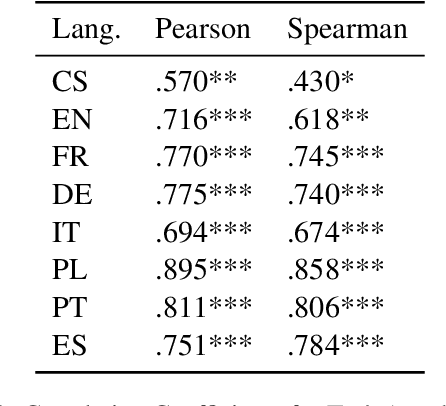
The rise of Large Language Models (LLMs) has revolutionized natural language processing across numerous languages and tasks. However, evaluating LLM performance in a consistent and meaningful way across multiple European languages remains challenging, especially due to the scarcity of language-parallel multilingual benchmarks. We introduce a multilingual evaluation approach tailored for European languages. We employ translated versions of five widely-used benchmarks to assess the capabilities of 40 LLMs across 21 European languages. Our contributions include examining the effectiveness of translated benchmarks, assessing the impact of different translation services, and offering a multilingual evaluation framework for LLMs that includes newly created datasets: EU20-MMLU, EU20-HellaSwag, EU20-ARC, EU20-TruthfulQA, and EU20-GSM8K. The benchmarks and results are made publicly available to encourage further research in multilingual LLM evaluation.
Towards Cross-Lingual LLM Evaluation for European Languages
Oct 11, 2024The rise of Large Language Models (LLMs) has revolutionized natural language processing across numerous languages and tasks. However, evaluating LLM performance in a consistent and meaningful way across multiple European languages remains challenging, especially due to the scarcity of multilingual benchmarks. We introduce a cross-lingual evaluation approach tailored for European languages. We employ translated versions of five widely-used benchmarks to assess the capabilities of 40 LLMs across 21 European languages. Our contributions include examining the effectiveness of translated benchmarks, assessing the impact of different translation services, and offering a multilingual evaluation framework for LLMs that includes newly created datasets: EU20-MMLU, EU20-HellaSwag, EU20-ARC, EU20-TruthfulQA, and EU20-GSM8K. The benchmarks and results are made publicly available to encourage further research in multilingual LLM evaluation.