 Add to Chrome
 Add to Firefox
 Add to Edge
Adaptive Loops and Memory in Transformers: Think Harder or Know More?
Mar 11, 2026
Chain-of-thought (CoT) prompting enables reasoning in language models but requires explicit verbalization of intermediate steps. Looped transformers offer an alternative by iteratively refining representations within hidden states. This parameter efficiency comes at a cost, as looped models lack the storage capacity of deeper models which use unique weights per layer. In this work, we investigate transformer models that feature both adaptive per-layer looping, where each transformer block learns to iterate its hidden state via a learned halting mechanism, and gated memory banks, that provide additional learned storage. We find that looping primarily benefits mathematical reasoning, while memory banks help recover performance on commonsense tasks compared to parameter and FLOP matched models. Combining both mechanisms yields a model that outperforms an iso-FLOP baseline, with three times the number of layers, across math benchmarks. Analysis of model internals reveals layer specialization: early layers learn to loop minimally and access memory sparingly, while later layers do both more heavily.

Automatic Defect Detection in Sewer Network Using Deep Learning Based Object Detector
Apr 09, 2024

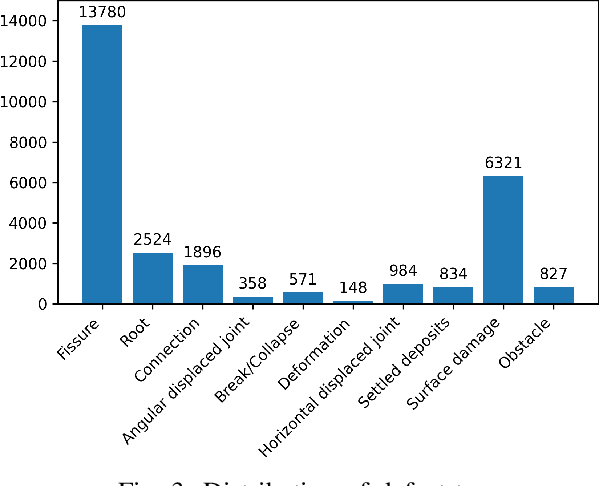
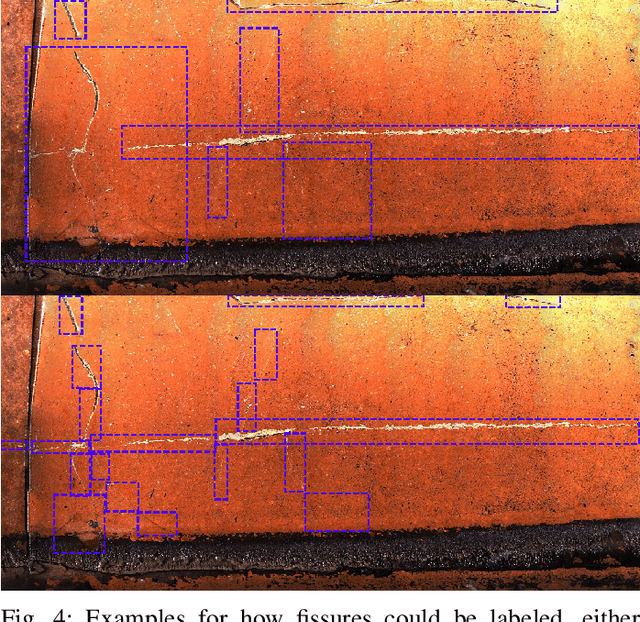
Maintaining sewer systems in large cities is important, but also time and effort consuming, because visual inspections are currently done manually. To reduce the amount of aforementioned manual work, defects within sewer pipes should be located and classified automatically. In the past, multiple works have attempted solving this problem using classical image processing, machine learning, or a combination of those. However, each provided solution only focus on detecting a limited set of defect/structure types, such as fissure, root, and/or connection. Furthermore, due to the use of hand-crafted features and small training datasets, generalization is also problematic. In order to overcome these deficits, a sizable dataset with 14.7 km of various sewer pipes were annotated by sewer maintenance experts in the scope of this work. On top of that, an object detector (EfficientDet-D0) was trained for automatic defect detection. From the result of several expermients, peculiar natures of defects in the context of object detection, which greatly effect annotation and training process, are found and discussed. At the end, the final detector was able to detect 83% of defects in the test set; out of the missing 17%, only 0.77% are very severe defects. This work provides an example of applying deep learning-based object detection into an important but quiet engineering field. It also gives some practical pointers on how to annotate peculiar "object", such as defects.