 Add to Chrome
 Add to Firefox
 Add to Edge
When Future Communications Shift Toward Narrow Beams: A Forward Looking Survey on Pointing Errors and Alignment Limits
Dec 24, 2025
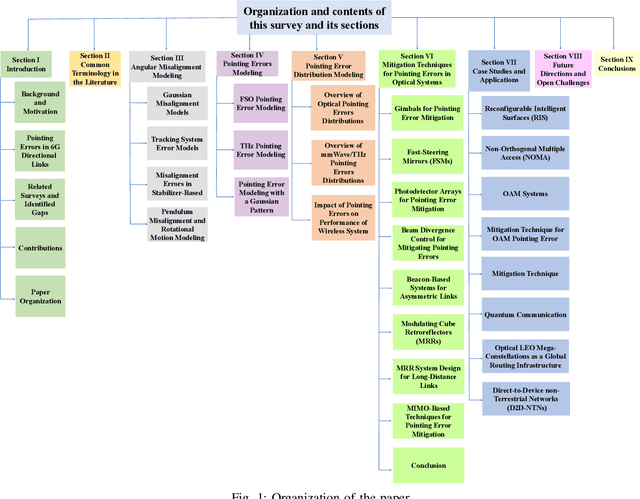
Directional links in free-space optical (FSO), millimeter-wave (mmWave), and terahertz (THz) systems are a cornerstone of emerging 6G networks, yet their reliability is fundamentally limited by pointing errors and misalignment. Existing studies address this impairment using technology-specific definitions, models, and mitigation approaches, which hinders cross-domain comparison and transferable design insight. This survey provides a unified treatment of pointing errors across optical and high frequency wireless communications. We establish consistent terminology and a cross-technology taxonomy of pointing errors, review angular misalignment and statistical distribution models, and analyze their impact on system performance. Mitigation techniques are systematically surveyed with emphasis on optical systems and their connection to underlying pointing error models. The survey further provides a detailed examination of pointing-error effects in orbital angular momentum (OAM) links and quantum optical communications, and surveys the corresponding mitigation approaches tailored to mode-dependent impairments and quantum measurement constraints. The survey also outlines open challenges and future research directions. By consolidating fragmented literature into a coherent framework, this work supports consistent analysis and robust design of next generation directional communication systems.

QoS- and Physics-Aware Routing in Optical LEO Satellite Networks via Deep Reinforcement Learning
Dec 23, 2025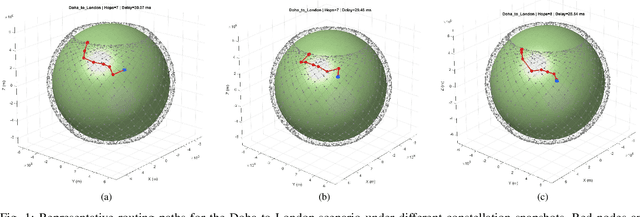
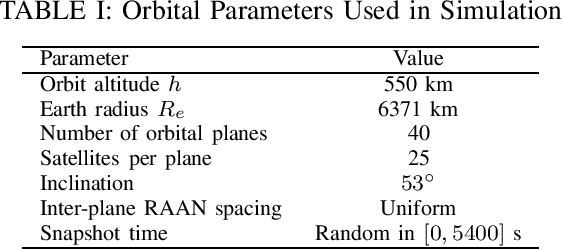
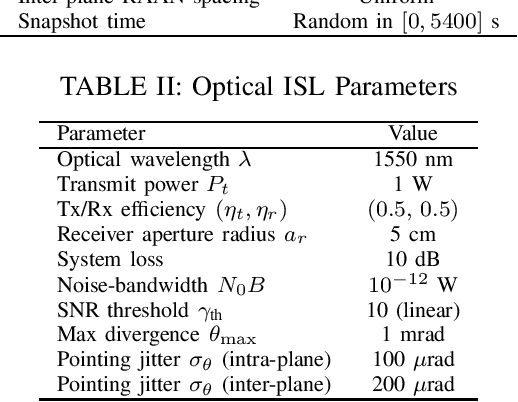
Optical inter-satellite links (ISLs) are becoming the principal communication backbone in modern large-scale LEO constellations, offering multi-Gb/s capacity and near speed-of-light latency. However, the extreme sensitivity of optical beams to relative satellite motion, pointing jitter, and rapidly evolving geometry makes routing fundamentally more challenging than in RF-based systems. In particular, intra-plane and inter-plane ISLs exhibit markedly different stability and feasible range profiles, producing a dynamic, partially constrained connectivity structure that must be respected by any physically consistent routing strategy. This paper presents a lightweight geometry- and QoS-aware routing framework for optical LEO networks that incorporates class-dependent feasibility constraints derived from a jitter-aware Gaussian-beam model. These analytically computed thresholds are embedded directly into the time-varying ISL graph and enforced via feasible-action masking in a deep reinforcement learning (DRL) agent. The proposed method leverages local geometric progress, feasible-neighbor structure, and congestion indicators to select next-hop relays without requiring global recomputation. Simulation results on a Starlink-like constellation show that the learned paths are physically consistent, exploit intra-plane stability, adapt to jitter-limited inter-plane connectivity, and maintain robust end-to-end latency under dynamic topology evolution.
Balancing Decentralized Trust and Physical Evidence: A Blockchain-Physical Layer Co-Design for Real-Time 3D Prioritization in Disaster Zones
Dec 23, 2025During disaster response, making rapid and well-informed decisions about which areas require immediate attention can save lives. However, current coordination models often struggle with unreliable data, intentional misinformation, and the breakdown of critical communication infrastructure. A decentralized, vote-based blockchain model offers a compelling substrate for achieving this real-time, trusted coordination. This article explores a blockchain-driven approach to rapidly update a dynamic 3D crisis map based on inputs from users and local sensors. Each node submits a timestamped and geotagged vote to a public ledger, enabling agencies to visualize needs as they emerge. However, ensuring the physical authenticity of these claims demands more than cryptography alone. We propose a dual-layer architecture where mobile UAV verifiers perform physical-layer attestation and issue independent location flags to the blockchain. This dual-signature mechanism fuses immutable digital records with sensory-grounded trust. We analyze core technical and human centric challenges, ranging from spoofing and vote ambiguity to verifier compromise and connectivity loss, and outline layered mitigation strategies and future research directions. As a concrete instantiation, we present a UAV mapping scheme leveraging modulated retro-reflector (MRR) sensors and 3D-aware LoS placement to maximize verifiability under urban occlusion, offering a path toward resilient, trust-anchored crisis coordination.
Towards City-Scale Quantum Timing: Wireless Synchronization via Quantum Hubs
Dec 23, 2025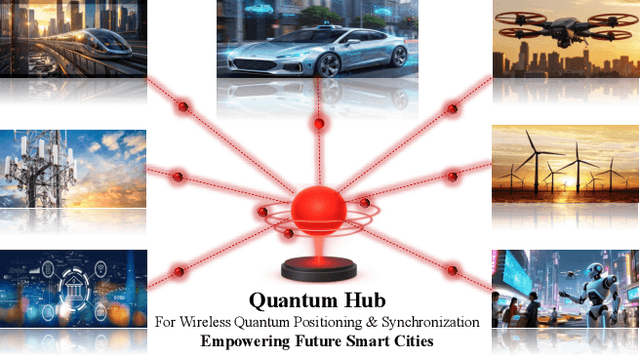
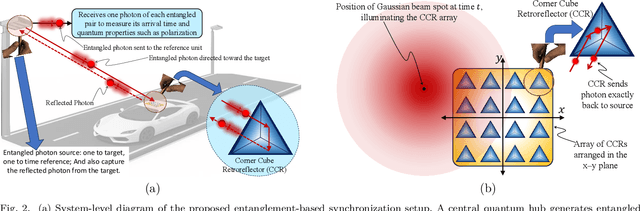
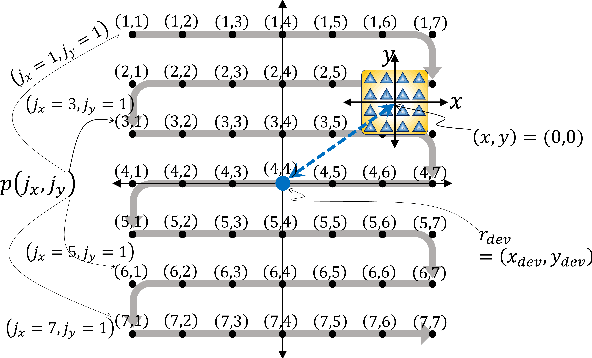
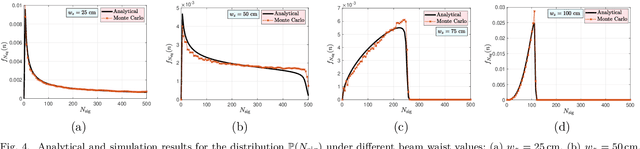
This paper presents a novel wireless quantum synchronization framework tailored for city-scale deployment using entangled photon pairs and passive corner cube retroreflector (CCR) arrays. A centralized quantum hub emits entangled photons, directing one toward a target device and the other toward a local reference unit. The target, equipped with a planar CCR array, reflects the incoming photon without active circuitry, enabling secure round-trip quantum measurements for sub-nanosecond synchronization and localization. We develop a comprehensive analytical model that captures key physical-layer phenomena, including Gaussian beam spread, spatial misalignment, atmospheric turbulence, and probabilistic photon generation. A closed-form expression is derived for the single-photon detection probability under Gamma-Gamma fading, and its distribution is used to model photon arrival events and synchronization error. Moreover, we analyze the impact of background photons, SPAD detector jitter, and quantum generation randomness on synchronization accuracy and outage probability. Simulation results confirm the accuracy of the analytical models and reveal key trade-offs among beam waist, CCR array size, and background light. The proposed architecture offers a low-power, infrastructure-free solution for secure timing in next-generation smart cities.
Deep Learning Surrogate for Fast CIR Prediction in Reactive Molecular Diffusion Advection Channels
Dec 19, 2025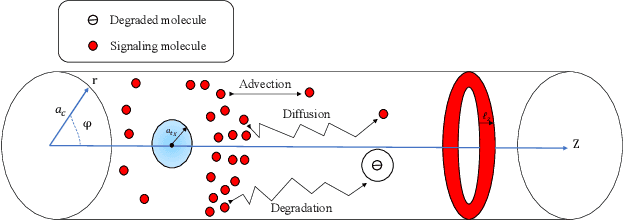
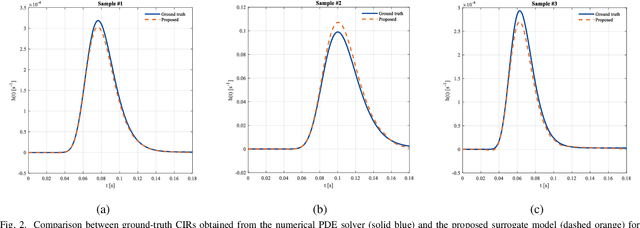
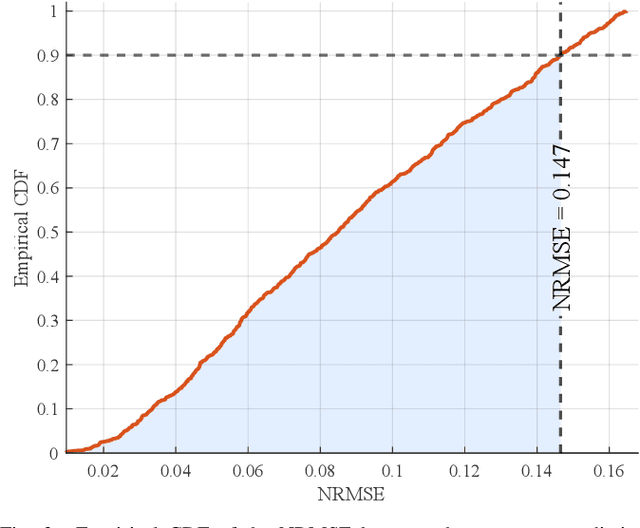
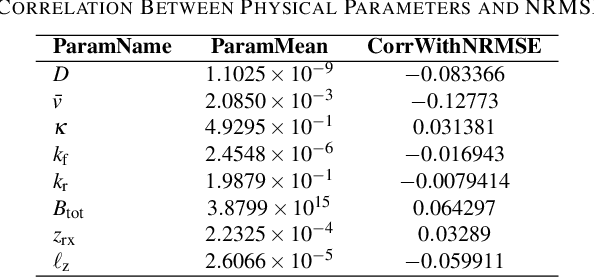
Accurate channel impulse response (CIR) modeling in molecular communication (MC) often requires solving coupled reactive diffusion-advection equations, which is computationally expensive for large parameter sweeps or design loops. We develop a deep-learning surrogate for a three-dimensional duct MC channel with reactive diffusion-advection transport and reversible ligand-receptor binding on a finite ring receiver. Using a physics-based partial differential equation (PDE)-ordinary differential equation (ODE) model, we generate a large CIR dataset across broad transport, reaction, and geometric ranges and train a neural network that maps these parameters directly to the CIR. On an independent test set, the surrogate closely matches reference CIRs both qualitatively and quantitatively: the empirical cumulative distribution function (CDF) of the normalized root mean square error (NRMSE) shows that 90% of test channels are predicted with error below 0.15, with only weak dependence on individual parameters. The surrogate therefore offers an accurate and computationally efficient replacement for repeated PDE-based CIR evaluations in MC system analysis and design.
AI Assisted Next Gen Outdoor Optical Networks: Camera Sensing for Monitoring and User Localization
Dec 19, 2025We consider outdoor optical access points (OAPs), which, enabled by recent advances in metasurface technology, have attracted growing interest. While OAPs promise high data rates and strong physical-layer security, practical deployments still expose vulnerabilities and misuse patterns that necessitate a dedicated monitoring layer - the focus of this work. We therefore propose a user positioning and monitoring system that infers locations from spatial intensity measurements on a photodetector (PD) array. Specifically, our hybrid approach couples an optics-informed forward model and sparse, model-based inversion with a lightweight data-driven calibration stage, yielding high accuracy at low computational cost. This design preserves the interpretability and stability of model-based reconstruction while leveraging learning to absorb residual nonidealities and device-specific distortions. Under identical hardware and training conditions (both with 5 x 10^5 samples), the hybrid method attains consistently lower mean-squared error than a generic deep-learning baseline while using substantially less training time and compute. Accuracy improves with array resolution and saturates around 60 x 60-80 x 80, indicating a favorable accuracy-complexity trade-off for real-time deployment. The resulting position estimates can be cross-checked with real-time network logs to enable continuous monitoring, anomaly detection (e.g., potential eavesdropping), and access control in outdoor optical access networks.
CV Quantum Communications with Angular Rejection Filtering: Modeling and Security Analysis
Dec 19, 2025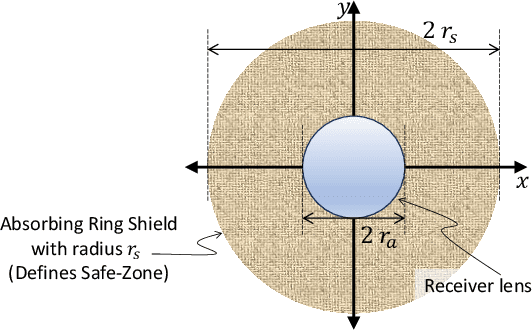
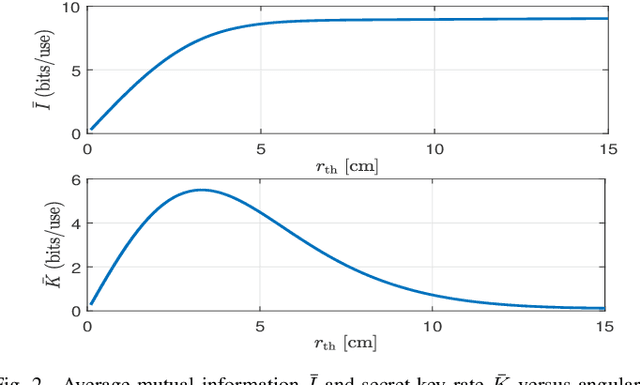
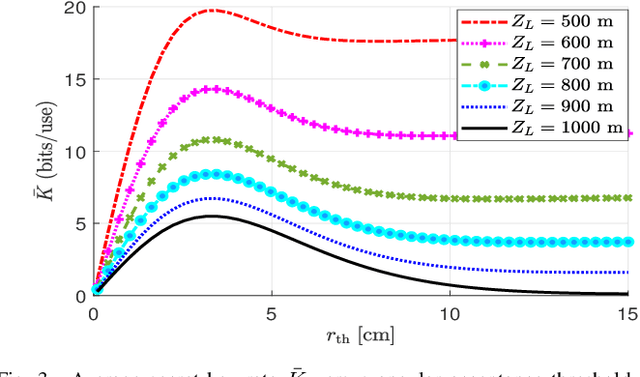
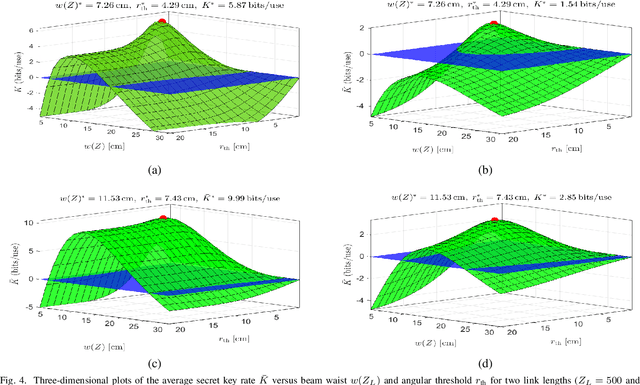
Continuous-variable quantum key distribution (CVQKD) over free-space optical links is a promising approach for secure communication, but its performance is limited by turbulence, pointing errors, and angular leakage that can be exploited by an eavesdropper. To mitigate this, we consider an angular rejection filter that defines a safe-zone at the receiver and blocks signals from outside the desired cone. A system and channel model is developed including turbulence, misalignment, and safe-zone effects, and information theoretic metrics are derived to evaluate security. Simulation results show that the safe zone significantly reduces information leakage and that careful tuning of beam waist, angular threshold, and aperture size is essential for maximizing the secret key rate. Larger apertures improve performance but increase receiver size, while longer links require sub 100 urad alignment accuracy. These results highlight safe-zone enforcement and parameter optimization as effective strategies for practical and secure CV-QKD.
Learning-Driven Dual-Line Laser Scanning for Fast and Accurate LEO Satellite Positioning
Dec 13, 2025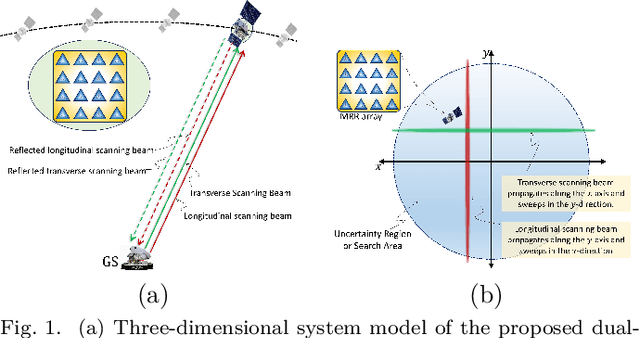
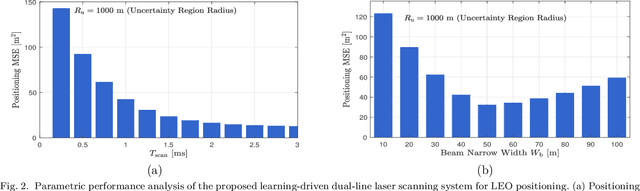

Accurate and low-latency positioning is a key enabler for optical links with Low Earth Orbit (LEO) satellites, where millisecond-level beam alignment is required to maintain reliable high-data-rate communication. This paper presents a learning-driven dual-line laser scanning framework for fast and precise satellite positioning. Unlike conventional Gaussian-beam acquisition systems that rely on multiple sequential beams or mechanical steering, the proposed approach employs two orthogonal line-shaped laser beams to perform structured optical scanning over the ambiguity region without any moving parts. A physics-based model incorporating atmospheric attenuation, turbulence, and MRR-based reflection is developed, and a data-driven neural estimator is trained to map received optical energy patterns to the satellite's two-dimensional position. Simulation results demonstrate that the learning-driven method achieves near-MAP accuracy with typical errors of 7-10 m and deterministic scanning time of 1-2 ms, while conventional two-stage Gaussian-beam schemes exhibit comparable errors but random sensing durations of up to 5 ms. The proposed framework therefore offers a favorable trade-off between positioning accuracy, computational complexity, and sensing latency, making it a practical candidate for next-generation optical LEO tracking systems.
MRR-Based Line-Laser Scanning for Reliable Vehicular Positioning and Optical Communication
Dec 13, 2025High-speed vehicular environments require optical systems capable of joint sensing, positioning, and communication (JSPC) without mechanical tracking. Existing optical and integrated sensing-communication approaches often rely on point-source emitters or camera-based receivers, limiting spatial coverage and update rate under highway dynamics. This work introduces a new class of tracking-free optical JSPC systems that combine structured line-laser illumination with modulating retroreflector (MRR) arrays on vehicles. Two orthogonal line lasers perform synchronized longitudinal and transverse scanning to provide continuous, wide-area coverage across the roadway. A coverage-driven analytical framework models the coupling between beam divergence, scan geometry, and dwell-time allocation, enabling joint evaluation of sensing reliability and communication quality. An optimization scheme is developed to adapt scanning and divergence parameters for uniform coverage and power efficiency. Simulation results demonstrate significant improvements in spatial coverage uniformity, link stability, and reliability within a fixed scan period. These results establish a practical pathway toward scalable, turbulence-resilient optical architectures for next-generation vehicular JSPC networks.
Hierarchical Deep Learning for Joint Turbulence and PE Estimation in Multi-Aperture FSO Systems
Dec 13, 2025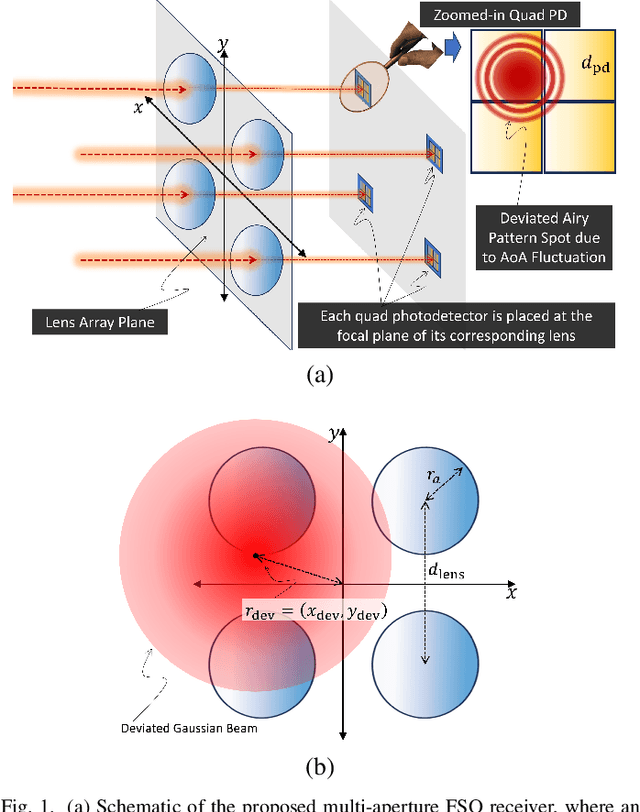
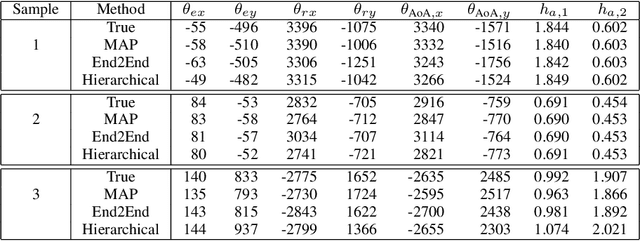

Accurate characterization of free-space optical (FSO) channels requires joint estimation of transmitter pointing errors, receiver angle-of-arrival (AoA) fluctuations, and turbulence-induced fading. However, existing literature addresses these impairments in isolation, since their multiplicative coupling in the received signal severely limits conventional estimators and prevents simultaneous recovery. In this paper, we introduce a novel multi-aperture FSO receiver architecture that leverages spatial diversity across a lens array to decouple these intertwined effects. Building on this hardware design, we propose a hierarchical deep learning framework that sequentially estimates AoA, transmitter pointing error, and turbulence coefficients. This decomposition significantly reduces learning complexity and enables robust inference even under strong atmospheric fading. Simulation results demonstrate that the proposed method achieves near-MAP accuracy with orders-of-magnitude lower computational cost, and substantially outperforms end-to-end learning baselines in terms of estimation accuracy and generalization. To the best of our knowledge, this is the first work to demonstrate practical joint estimation of these three key parameters, paving the way for reliable, turbulence-resilient multi-aperture FSO systems.