 Add to Chrome
 Add to Firefox
 Add to Edge
Hierarchical Deep Learning for Joint Turbulence and PE Estimation in Multi-Aperture FSO Systems
Paper and Code
Dec 13, 2025
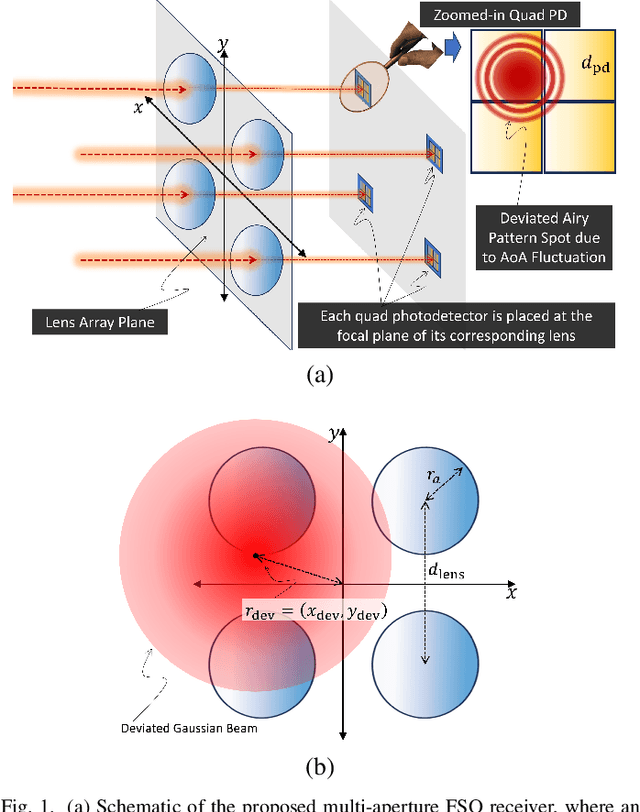
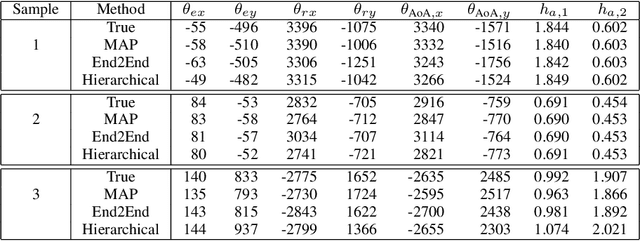

Accurate characterization of free-space optical (FSO) channels requires joint estimation of transmitter pointing errors, receiver angle-of-arrival (AoA) fluctuations, and turbulence-induced fading. However, existing literature addresses these impairments in isolation, since their multiplicative coupling in the received signal severely limits conventional estimators and prevents simultaneous recovery. In this paper, we introduce a novel multi-aperture FSO receiver architecture that leverages spatial diversity across a lens array to decouple these intertwined effects. Building on this hardware design, we propose a hierarchical deep learning framework that sequentially estimates AoA, transmitter pointing error, and turbulence coefficients. This decomposition significantly reduces learning complexity and enables robust inference even under strong atmospheric fading. Simulation results demonstrate that the proposed method achieves near-MAP accuracy with orders-of-magnitude lower computational cost, and substantially outperforms end-to-end learning baselines in terms of estimation accuracy and generalization. To the best of our knowledge, this is the first work to demonstrate practical joint estimation of these three key parameters, paving the way for reliable, turbulence-resilient multi-aperture FSO systems.
