 Add to Chrome
 Add to Firefox
 Add to Edge
Learning-Driven Dual-Line Laser Scanning for Fast and Accurate LEO Satellite Positioning
Paper and Code
Dec 13, 2025
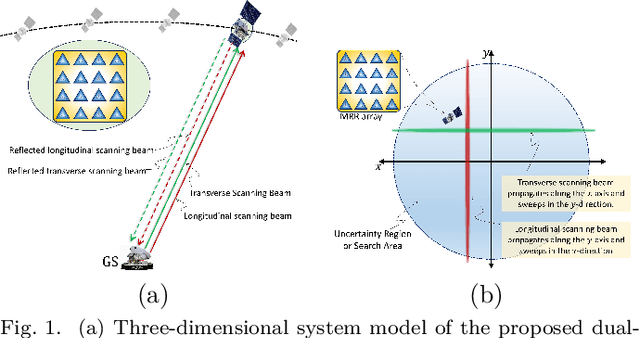
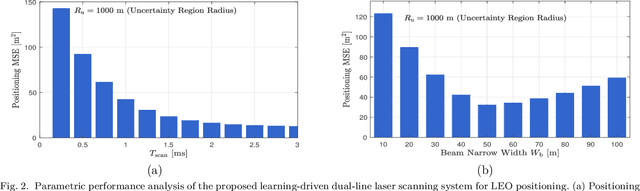

Accurate and low-latency positioning is a key enabler for optical links with Low Earth Orbit (LEO) satellites, where millisecond-level beam alignment is required to maintain reliable high-data-rate communication. This paper presents a learning-driven dual-line laser scanning framework for fast and precise satellite positioning. Unlike conventional Gaussian-beam acquisition systems that rely on multiple sequential beams or mechanical steering, the proposed approach employs two orthogonal line-shaped laser beams to perform structured optical scanning over the ambiguity region without any moving parts. A physics-based model incorporating atmospheric attenuation, turbulence, and MRR-based reflection is developed, and a data-driven neural estimator is trained to map received optical energy patterns to the satellite's two-dimensional position. Simulation results demonstrate that the learning-driven method achieves near-MAP accuracy with typical errors of 7-10 m and deterministic scanning time of 1-2 ms, while conventional two-stage Gaussian-beam schemes exhibit comparable errors but random sensing durations of up to 5 ms. The proposed framework therefore offers a favorable trade-off between positioning accuracy, computational complexity, and sensing latency, making it a practical candidate for next-generation optical LEO tracking systems.
