 Add to Chrome
 Add to Firefox
 Add to Edge
Complementary Matrix-Gated QKAN Fast-Weight Programmers for Quantum Dynamics Forecasting
Jul 30, 2026
Sequence models must decide what to write into memory and what to retain. In quantum and quantum-inspired sequence learning, nonlinear recurrent updates often require repeated circuit evaluations and sequential backpropagation through time, making long contexts costly. Gated fast-weight programmers (FWPs) based on quantum-inspired Kolmogorov-Arnold networks (QKANs) alleviate this bottleneck by storing context in time-varying fast parameters. However, their scalar gate applies one retention-write balance to every fast-state coordinate, forcing all parameters to share a memory timescale. We introduce Self-Modulating QKAN-based FWPs, which replace this broadcast gate with low-rank-generated element-wise modulation of the new-proposal branch, a bounded old-state branch, or both. We further propose Complementary Matrix Gating (CMG), which uses one sigmoid matrix gate to retain the old state and its complement to write the new proposal. CMG provides coordinate-wise memory control while preserving the bounded convex update and affine prefix-scan structure of scalar gating, at the modulation-head cost of a single-branch rule. We compare four self-modulating rules with scalar gating across four FWP architectures combining classical and QKAN-based slow and fast programmers. Across seven single-step forecasting benchmarks and five sequence lengths, CMG gives the most consistent improvements for architectures whose fast programmer incorporates a QKAN-based module. In direct multi-step forecasting of Jaynes-Cummings and transmon-resonator dynamics simulated with CUDA-Q Dynamics, CMG models maintain mean-squared errors on the order of 0.001 or lower across forecasting horizons of 4, 8, and 16 steps, while improving on their scalar-gated counterparts by at least 91.2%. These results establish coordinate-wise complementary modulation as a stable and effective update for QKAN-based FWPs.

Superpixel-Based QUBO for Scalable Quantum-Enhanced Medical Image Segmentation
Jul 27, 2026Quadratic unconstrained binary optimization (QUBO) has emerged as a powerful framework for medical computing problems. Binary decision variables naturally represent clinical choices, making QUBO formulations well-suited for quantum annealing hardware. However, a fundamental scalability challenge limits practical deployment: problem size grows rapidly with input dimensionality, creating computational bottlenecks that restrict applications to simplified scenarios. This paper addresses this challenge through hierarchical problem reduction, as demonstrated in medical image segmentation, where pixel-level QUBO formulations create over 65,000 variables for a 256x256 image, forcing existing approaches to downsample to 42x42 resolution and discard 97% of pixel information. A superpixel-based QUBO framework is proposed using simple linear iterative clustering (SLIC) to group pixels into perceptually meaningful regions, then formulate segmentation as QUBO over a region adjacency graph (RAG) combining min-cut and smoothness objectives. Validation on INbreast mammography breast cancer images demonstrates a 4.2% improvement in segmentation quality (mean IoU 0.76 vs 0.73) with 33 computational speedup (0.67s vs 21.97s) and a 97.3% reduction in problem size (1764 to 48 variables), all achieved while processing full-resolution images rather than downsampled versions. The reduced problem size also fits well within current quantum annealer connectivity limits, removing the embedding overhead that has historically blocked direct deployment of pixel-level QUBO segmentation on quantum hardware.
QDS-SNN: Energy-efficient Quantum Deeply-Supervised Spiking Neural Network Algorithm for Traffic Sign Recognition
Jun 03, 2026Traffic sign recognition is crucial for intelligent transportation and autonomous driving, as it can improve driving efficiency and ensure road safety. However, traditional recognition methods are based on large datasets and intensive computation, which limits their real-time applicability. Spiking Neural Networks (SNNs) offer a biologically inspired, energy-efficient alternative due to their spatiotemporal processing capabilities, but suffer from information loss and vanishing gradients during training. To overcome these limitations, this study proposes a Quantum Deep-supervised Spiking Neural Network (QDS-SNN) that integrates Quantum Neural Networks (QNNs) for efficient, low-power deep supervision. Using quantum superposition and entanglement, QNNs enable expressive representations and parallel computation, thereby enhancing performance without compromising energy efficiency. The proposed QDS-SNN incorporates a temporally and spatially adaptive LIF (TSA-LIF) neuron and a quantum-assisted classifier module (QACM) to mitigate gradient issues and improve training effectiveness. This study conducts experiments on the PennyLane quantum simulation platform, and the results show that QDS-SNN achieves 99.72\% accuracy on the GTSRB dataset in only 6 time steps -- outperforming the MS-ResNet baseline by 1.32\% while reducing energy consumption by 55.77\%. In the TSRD dataset, it achieves 97.90\% accuracy while reducing energy use to 52.68\% of the baseline. These results demonstrate that QDS-SNN offers a high-performance, energy-efficient solution for traffic sign recognition in intelligent transportation systems.
Towards City-Scale Quantum Timing: Wireless Synchronization via Quantum Hubs
Dec 23, 2025
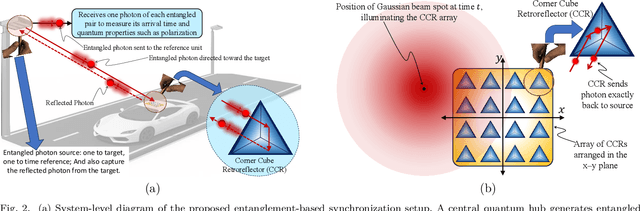
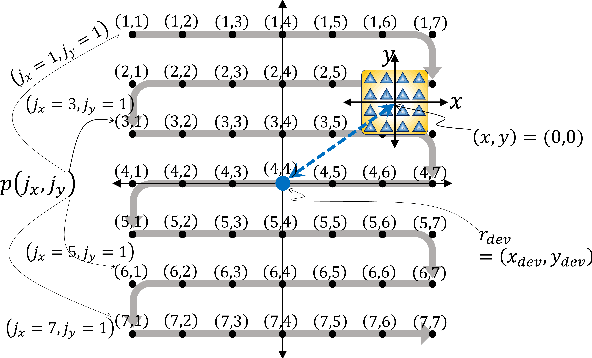
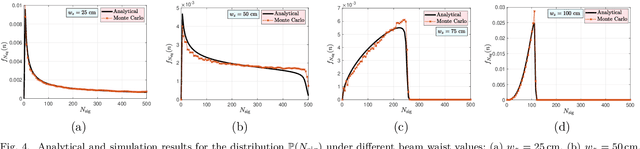
This paper presents a novel wireless quantum synchronization framework tailored for city-scale deployment using entangled photon pairs and passive corner cube retroreflector (CCR) arrays. A centralized quantum hub emits entangled photons, directing one toward a target device and the other toward a local reference unit. The target, equipped with a planar CCR array, reflects the incoming photon without active circuitry, enabling secure round-trip quantum measurements for sub-nanosecond synchronization and localization. We develop a comprehensive analytical model that captures key physical-layer phenomena, including Gaussian beam spread, spatial misalignment, atmospheric turbulence, and probabilistic photon generation. A closed-form expression is derived for the single-photon detection probability under Gamma-Gamma fading, and its distribution is used to model photon arrival events and synchronization error. Moreover, we analyze the impact of background photons, SPAD detector jitter, and quantum generation randomness on synchronization accuracy and outage probability. Simulation results confirm the accuracy of the analytical models and reveal key trade-offs among beam waist, CCR array size, and background light. The proposed architecture offers a low-power, infrastructure-free solution for secure timing in next-generation smart cities.
CV Quantum Communications with Angular Rejection Filtering: Modeling and Security Analysis
Dec 19, 2025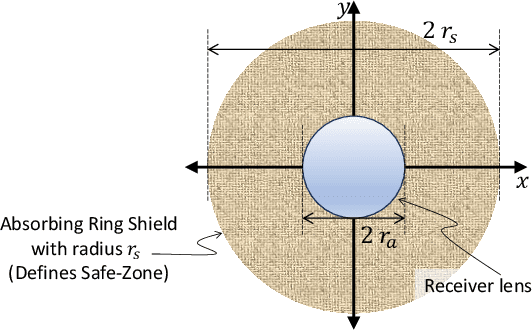
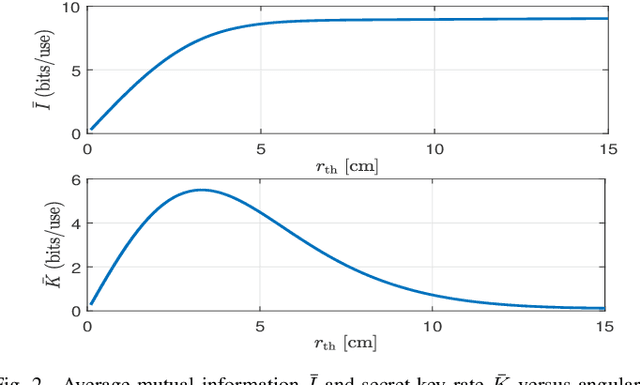
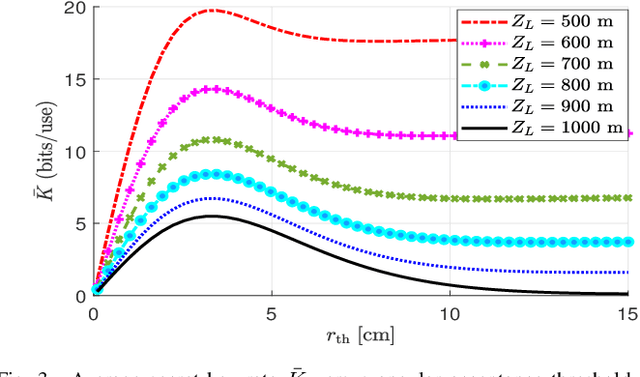
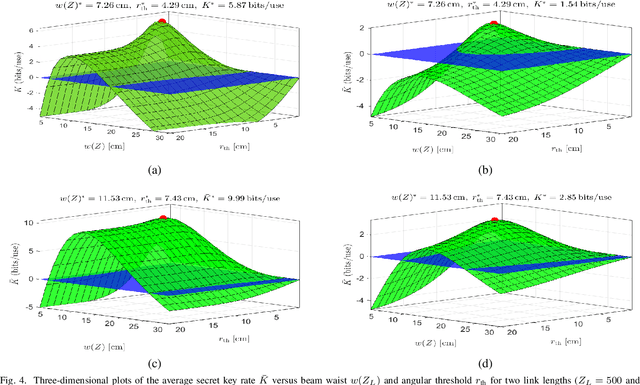
Continuous-variable quantum key distribution (CVQKD) over free-space optical links is a promising approach for secure communication, but its performance is limited by turbulence, pointing errors, and angular leakage that can be exploited by an eavesdropper. To mitigate this, we consider an angular rejection filter that defines a safe-zone at the receiver and blocks signals from outside the desired cone. A system and channel model is developed including turbulence, misalignment, and safe-zone effects, and information theoretic metrics are derived to evaluate security. Simulation results show that the safe zone significantly reduces information leakage and that careful tuning of beam waist, angular threshold, and aperture size is essential for maximizing the secret key rate. Larger apertures improve performance but increase receiver size, while longer links require sub 100 urad alignment accuracy. These results highlight safe-zone enforcement and parameter optimization as effective strategies for practical and secure CV-QKD.
Physical Limits of Entanglement-Based Quantum Key Distribution over Long-Distance Satellite Links
Jun 25, 2025Entanglement-based quantum key distribution (QKD) protocols, such as E91 and BBM92, offer strong information-theoretic security and are naturally suited for satellite-to-satellite QKD (SatQKD) links. However, implementing these protocols over long-distance inter-satellite free-space optical (FSO) channels poses critical physical-layer challenges that are not addressed in the existing literature. In particular, photon losses due to beam divergence, pointing errors, and background noise can severely degrade the key generation rate and quantum bit error rate (QBER), especially under narrow receiver field-of-view (FoV) constraints. This paper presents a comprehensive performance analysis of entanglement-based inter-satellite QKD, focusing on photon-level modeling and the impact of practical impairments. We develop analytical expressions for signal detection probabilities, background photon influence, multi-pair emissions, and QBER, incorporating key parameters such as link distance, transmitter tracking jitter, receiver misalignment, and photon pair generation rate. Simulation results reveal the nonlinear sensitivity of system performance to tracking error and FoV limitations, and highlight optimal parameter regimes that jointly maximize secret key rate while maintaining QBER below acceptable thresholds. The proposed model provides actionable design insights for reliable and efficient deployment of entanglement-based SatQKD systems.
QSVM-QNN: Quantum Support Vector Machine Based Quantum Neural Network Learning Algorithm for Brain-Computer Interfacing Systems
May 20, 2025A brain-computer interface (BCI) system enables direct communication between the brain and external devices, offering significant potential for assistive technologies and advanced human-computer interaction. Despite progress, BCI systems face persistent challenges, including signal variability, classification inefficiency, and difficulty adapting to individual users in real time. In this study, we propose a novel hybrid quantum learning model, termed QSVM-QNN, which integrates a Quantum Support Vector Machine (QSVM) with a Quantum Neural Network (QNN), to improve classification accuracy and robustness in EEG-based BCI tasks. Unlike existing models, QSVM-QNN combines the decision boundary capabilities of QSVM with the expressive learning power of QNN, leading to superior generalization performance. The proposed model is evaluated on two benchmark EEG datasets, achieving high accuracies of 0.990 and 0.950, outperforming both classical and standalone quantum models. To demonstrate real-world viability, we further validated the robustness of QNN, QSVM, and QSVM-QNN against six realistic quantum noise models, including bit flip and phase damping. These experiments reveal that QSVM-QNN maintains stable performance under noisy conditions, establishing its applicability for deployment in practical, noisy quantum environments. Beyond BCI, the proposed hybrid quantum architecture is generalizable to other biomedical and time-series classification tasks, offering a scalable and noise-resilient solution for next-generation neurotechnological systems.
QFDNN: A Resource-Efficient Variational Quantum Feature Deep Neural Networks for Fraud Detection and Loan Prediction
Apr 28, 2025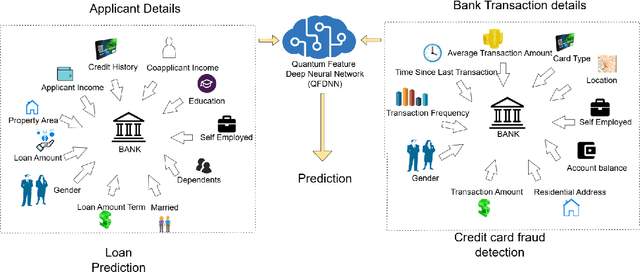
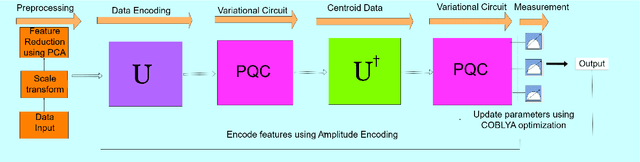
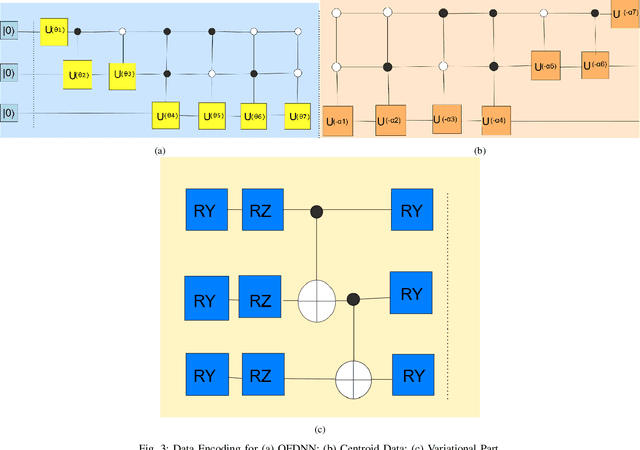
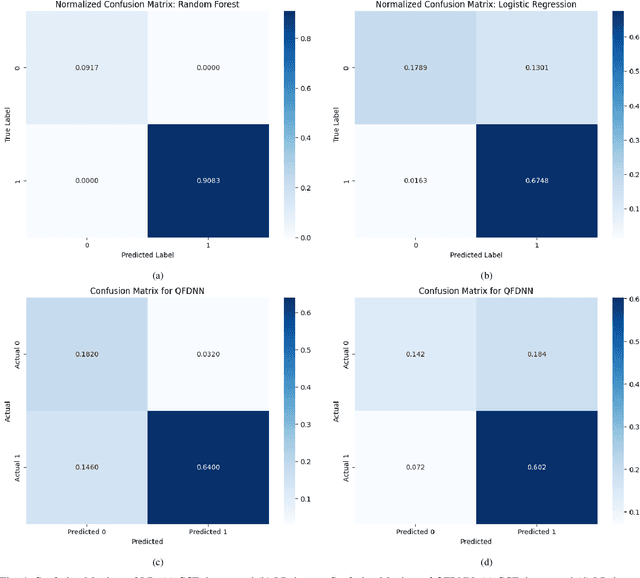
Social financial technology focuses on trust, sustainability, and social responsibility, which require advanced technologies to address complex financial tasks in the digital era. With the rapid growth in online transactions, automating credit card fraud detection and loan eligibility prediction has become increasingly challenging. Classical machine learning (ML) models have been used to solve these challenges; however, these approaches often encounter scalability, overfitting, and high computational costs due to complexity and high-dimensional financial data. Quantum computing (QC) and quantum machine learning (QML) provide a promising solution to efficiently processing high-dimensional datasets and enabling real-time identification of subtle fraud patterns. However, existing quantum algorithms lack robustness in noisy environments and fail to optimize performance with reduced feature sets. To address these limitations, we propose a quantum feature deep neural network (QFDNN), a novel, resource efficient, and noise-resilient quantum model that optimizes feature representation while requiring fewer qubits and simpler variational circuits. The model is evaluated using credit card fraud detection and loan eligibility prediction datasets, achieving competitive accuracies of 82.2% and 74.4%, respectively, with reduced computational overhead. Furthermore, we test QFDNN against six noise models, demonstrating its robustness across various error conditions. Our findings highlight QFDNN potential to enhance trust and security in social financial technology by accurately detecting fraudulent transactions while supporting sustainability through its resource-efficient design and minimal computational overhead.
Benchmarking Online Object Trackers for Underwater Robot Position Locking Applications
Feb 23, 2025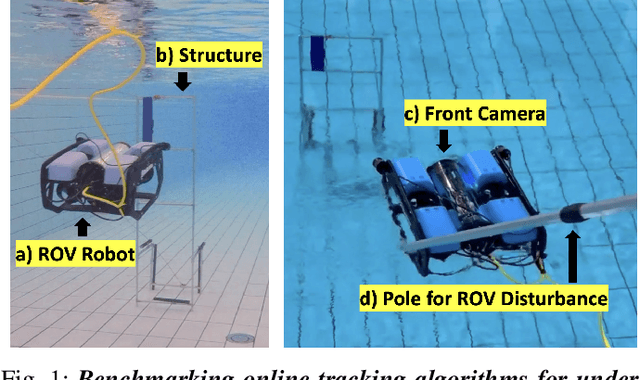
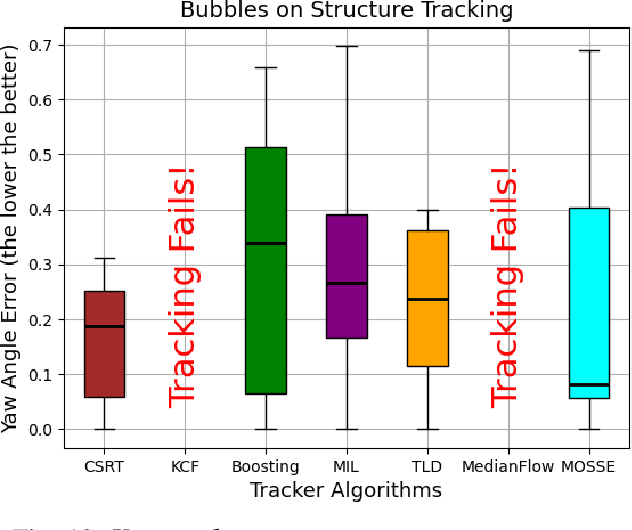
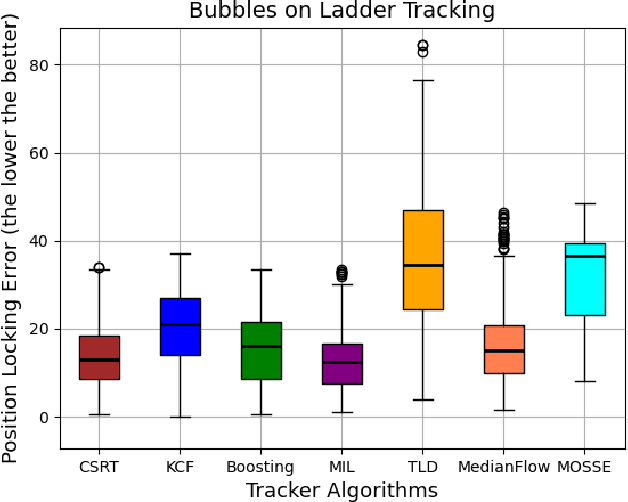
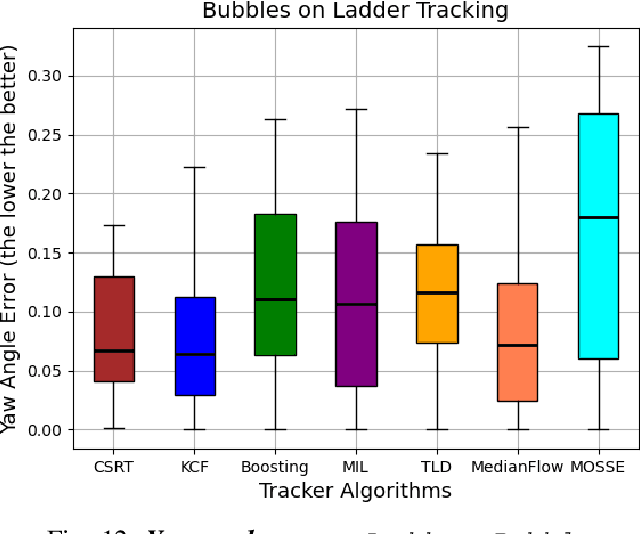
Autonomously controlling the position of Remotely Operated underwater Vehicles (ROVs) is of crucial importance for a wide range of underwater engineering applications, such as in the inspection and maintenance of underwater industrial structures. Consequently, studying vision-based underwater robot navigation and control has recently gained increasing attention to counter the numerous challenges faced in underwater conditions, such as lighting variability, turbidity, camera image distortions (due to bubbles), and ROV positional disturbances (due to underwater currents). In this paper, we propose (to the best of our knowledge) a first rigorous unified benchmarking of more than seven Machine Learning (ML)-based one-shot object tracking algorithms for vision-based position locking of ROV platforms. We propose a position-locking system that processes images of an object of interest in front of which the ROV must be kept stable. Then, our proposed system uses the output result of different object tracking algorithms to automatically correct the position of the ROV against external disturbances. We conducted numerous real-world experiments using a BlueROV2 platform within an indoor pool and provided clear demonstrations of the strengths and weaknesses of each tracking approach. Finally, to help alleviate the scarcity of underwater ROV data, we release our acquired data base as open-source with the hope of benefiting future research.
SentiQNF: A Novel Approach to Sentiment Analysis Using Quantum Algorithms and Neuro-Fuzzy Systems
Dec 17, 2024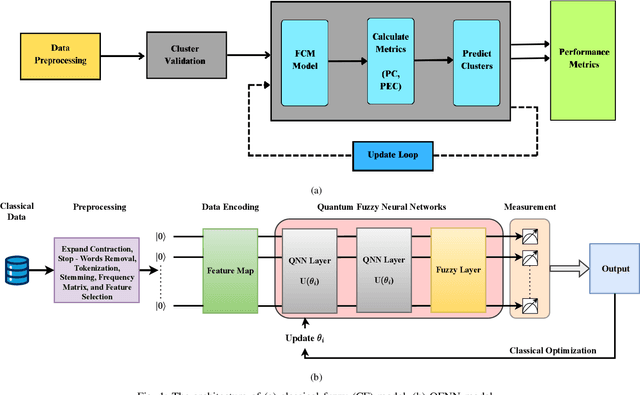

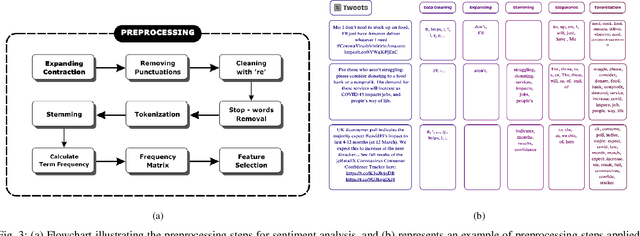
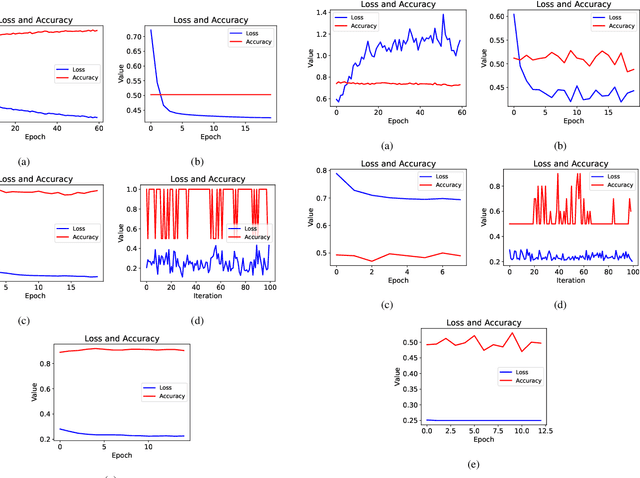
Sentiment analysis is an essential component of natural language processing, used to analyze sentiments, attitudes, and emotional tones in various contexts. It provides valuable insights into public opinion, customer feedback, and user experiences. Researchers have developed various classical machine learning and neuro-fuzzy approaches to address the exponential growth of data and the complexity of language structures in sentiment analysis. However, these approaches often fail to determine the optimal number of clusters, interpret results accurately, handle noise or outliers efficiently, and scale effectively to high-dimensional data. Additionally, they are frequently insensitive to input variations. In this paper, we propose a novel hybrid approach for sentiment analysis called the Quantum Fuzzy Neural Network (QFNN), which leverages quantum properties and incorporates a fuzzy layer to overcome the limitations of classical sentiment analysis algorithms. In this study, we test the proposed approach on two Twitter datasets: the Coronavirus Tweets Dataset (CVTD) and the General Sentimental Tweets Dataset (GSTD), and compare it with classical and hybrid algorithms. The results demonstrate that QFNN outperforms all classical, quantum, and hybrid algorithms, achieving 100% and 90% accuracy in the case of CVTD and GSTD, respectively. Furthermore, QFNN demonstrates its robustness against six different noise models, providing the potential to tackle the computational complexity associated with sentiment analysis on a large scale in a noisy environment. The proposed approach expedites sentiment data processing and precisely analyses different forms of textual data, thereby enhancing sentiment classification and insights associated with sentiment analysis.