 Add to Chrome
 Add to Firefox
 Add to Edge
QoS- and Physics-Aware Routing in Optical LEO Satellite Networks via Deep Reinforcement Learning
Paper and Code
Dec 23, 2025
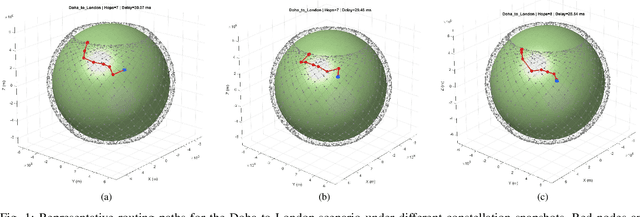
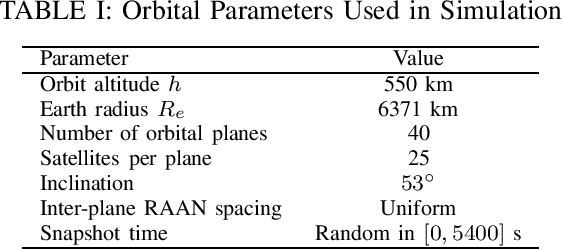
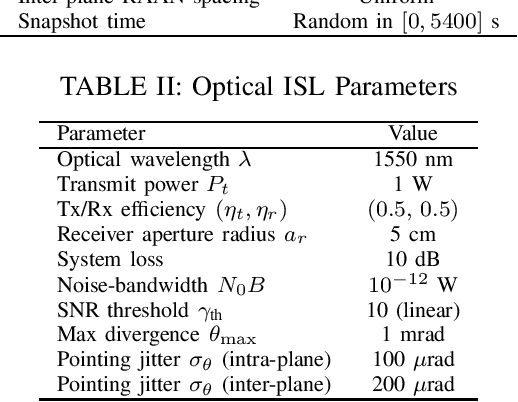
Optical inter-satellite links (ISLs) are becoming the principal communication backbone in modern large-scale LEO constellations, offering multi-Gb/s capacity and near speed-of-light latency. However, the extreme sensitivity of optical beams to relative satellite motion, pointing jitter, and rapidly evolving geometry makes routing fundamentally more challenging than in RF-based systems. In particular, intra-plane and inter-plane ISLs exhibit markedly different stability and feasible range profiles, producing a dynamic, partially constrained connectivity structure that must be respected by any physically consistent routing strategy. This paper presents a lightweight geometry- and QoS-aware routing framework for optical LEO networks that incorporates class-dependent feasibility constraints derived from a jitter-aware Gaussian-beam model. These analytically computed thresholds are embedded directly into the time-varying ISL graph and enforced via feasible-action masking in a deep reinforcement learning (DRL) agent. The proposed method leverages local geometric progress, feasible-neighbor structure, and congestion indicators to select next-hop relays without requiring global recomputation. Simulation results on a Starlink-like constellation show that the learned paths are physically consistent, exploit intra-plane stability, adapt to jitter-limited inter-plane connectivity, and maintain robust end-to-end latency under dynamic topology evolution.
