 Add to Chrome
 Add to Firefox
 Add to Edge
CV Quantum Communications with Angular Rejection Filtering: Modeling and Security Analysis
Paper and Code
Dec 19, 2025
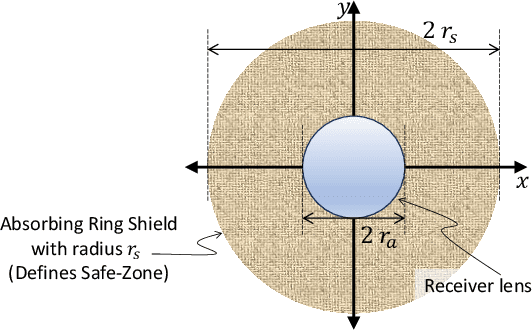
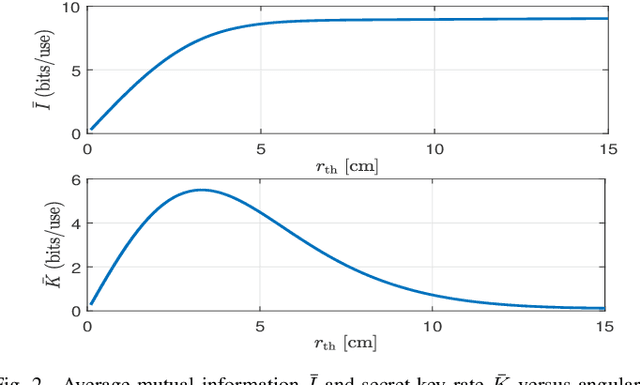
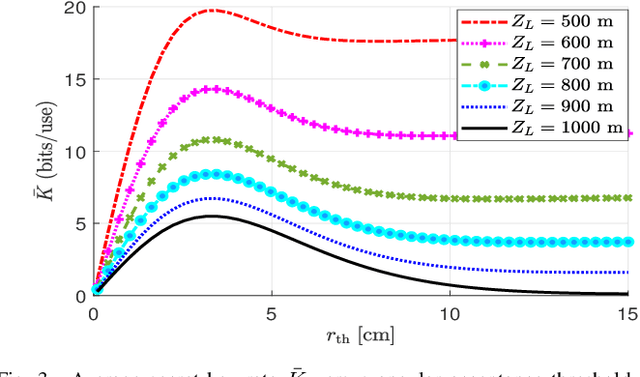
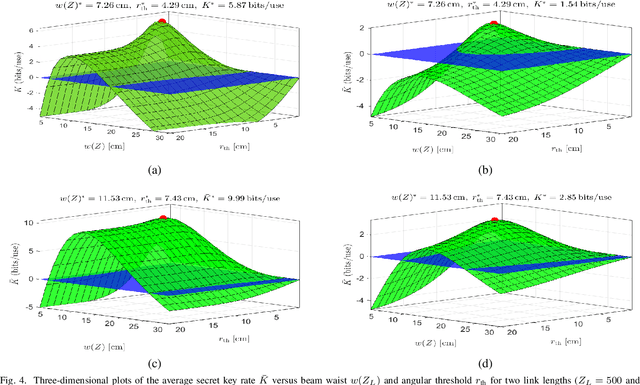
Continuous-variable quantum key distribution (CVQKD) over free-space optical links is a promising approach for secure communication, but its performance is limited by turbulence, pointing errors, and angular leakage that can be exploited by an eavesdropper. To mitigate this, we consider an angular rejection filter that defines a safe-zone at the receiver and blocks signals from outside the desired cone. A system and channel model is developed including turbulence, misalignment, and safe-zone effects, and information theoretic metrics are derived to evaluate security. Simulation results show that the safe zone significantly reduces information leakage and that careful tuning of beam waist, angular threshold, and aperture size is essential for maximizing the secret key rate. Larger apertures improve performance but increase receiver size, while longer links require sub 100 urad alignment accuracy. These results highlight safe-zone enforcement and parameter optimization as effective strategies for practical and secure CV-QKD.
