 Add to Chrome
 Add to Firefox
 Add to Edge
End-to-end multi-particle reconstruction in high occupancy imaging calorimeters with graph neural networks
Apr 14, 2022
We present an end-to-end reconstruction algorithm to build particle candidates from detector hits in next-generation granular calorimeters similar to that foreseen for the high-luminosity upgrade of the CMS detector. The algorithm exploits a distance-weighted graph neural network, trained with object condensation, a graph segmentation technique. Through a single-shot approach, the reconstruction task is paired with energy regression. We describe the reconstruction performance in terms of efficiency as well as in terms of energy resolution. In addition, we show the jet reconstruction performance of our method and discuss its inference computational cost. To our knowledge, this work is the first-ever example of single-shot calorimetric reconstruction of ${\cal O}(1000)$ particles in high-luminosity conditions with 200 pileup.

Learning new physics efficiently with nonparametric methods
Apr 05, 2022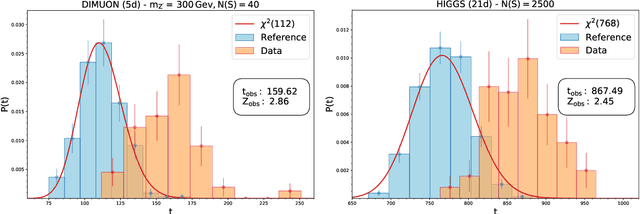

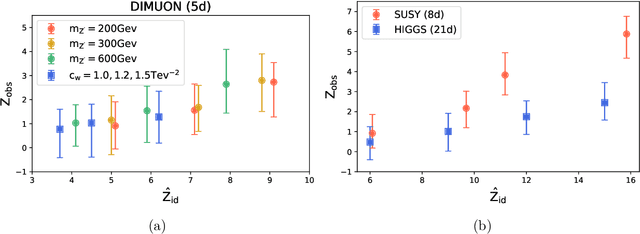
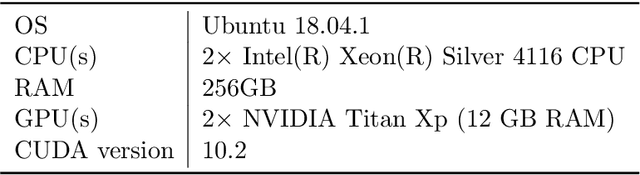
We present a machine learning approach for model-independent new physics searches. The corresponding algorithm is powered by recent large-scale implementations of kernel methods, nonparametric learning algorithms that can approximate any continuous function given enough data. Based on the original proposal by D'Agnolo and Wulzer (arXiv:1806.02350), the model evaluates the compatibility between experimental data and a reference model, by implementing a hypothesis testing procedure based on the likelihood ratio. Model-independence is enforced by avoiding any prior assumption about the presence or shape of new physics components in the measurements. We show that our approach has dramatic advantages compared to neural network implementations in terms of training times and computational resources, while maintaining comparable performances. In particular, we conduct our tests on higher dimensional datasets, a step forward with respect to previous studies.
Particle-based Fast Jet Simulation at the LHC with Variational Autoencoders
Mar 01, 2022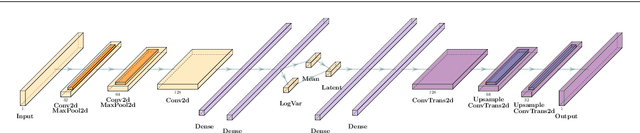
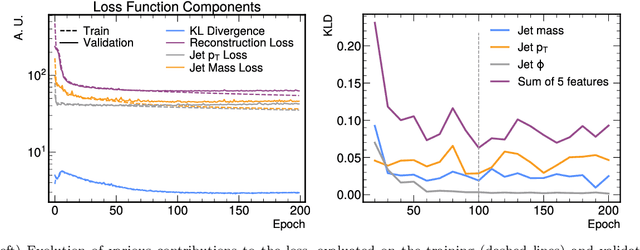
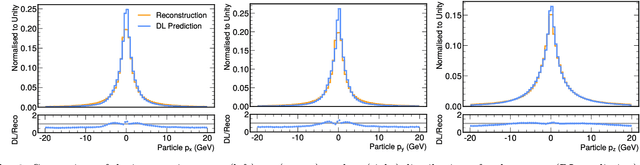
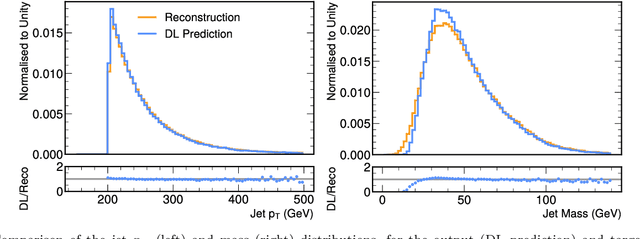
We study how to use Deep Variational Autoencoders for a fast simulation of jets of particles at the LHC. We represent jets as a list of constituents, characterized by their momenta. Starting from a simulation of the jet before detector effects, we train a Deep Variational Autoencoder to return the corresponding list of constituents after detection. Doing so, we bypass both the time-consuming detector simulation and the collision reconstruction steps of a traditional processing chain, speeding up significantly the events generation workflow. Through model optimization and hyperparameter tuning, we achieve state-of-the-art precision on the jet four-momentum, while providing an accurate description of the constituents momenta, and an inference time comparable to that of a rule-based fast simulation.
Machine Learning for Particle Flow Reconstruction at CMS
Mar 01, 2022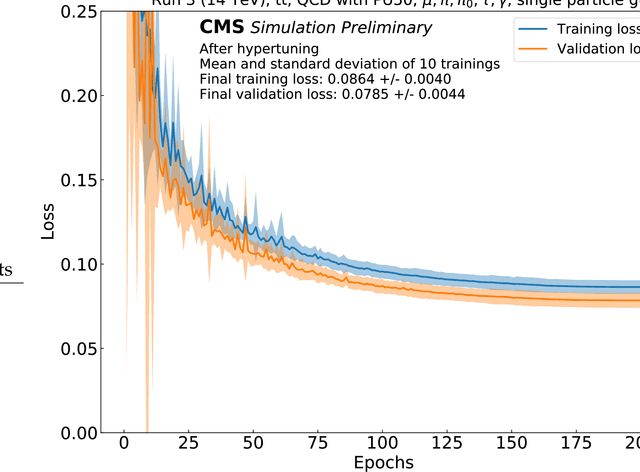
We provide details on the implementation of a machine-learning based particle flow algorithm for CMS. The standard particle flow algorithm reconstructs stable particles based on calorimeter clusters and tracks to provide a global event reconstruction that exploits the combined information of multiple detector subsystems, leading to strong improvements for quantities such as jets and missing transverse energy. We have studied a possible evolution of particle flow towards heterogeneous computing platforms such as GPUs using a graph neural network. The machine-learned PF model reconstructs particle candidates based on the full list of tracks and calorimeter clusters in the event. For validation, we determine the physics performance directly in the CMS software framework when the proposed algorithm is interfaced with the offline reconstruction of jets and missing transverse energy. We also report the computational performance of the algorithm, which scales approximately linearly in runtime and memory usage with the input size.
Lightweight Jet Reconstruction and Identification as an Object Detection Task
Feb 09, 2022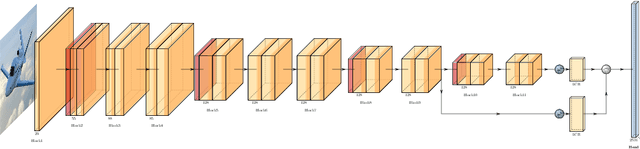
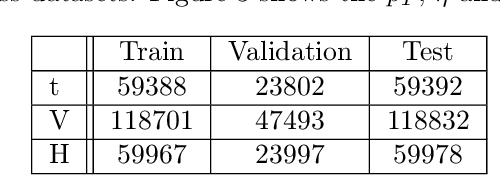
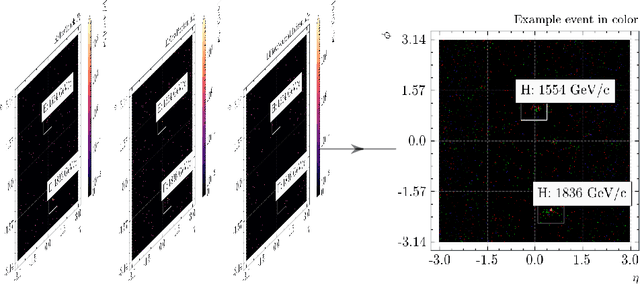
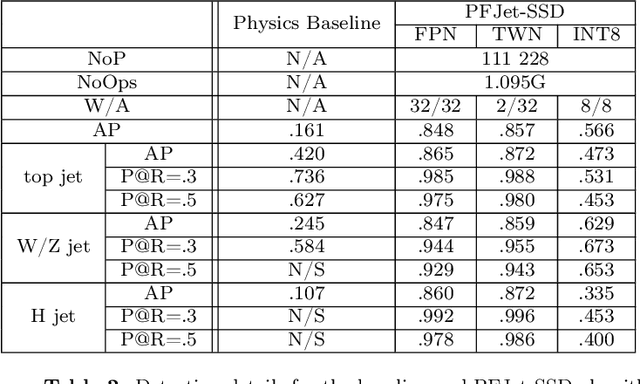
We apply object detection techniques based on deep convolutional blocks to end-to-end jet identification and reconstruction tasks encountered at the CERN Large Hadron Collider (LHC). Collision events produced at the LHC and represented as an image composed of calorimeter and tracker cells are given as an input to a Single Shot Detection network. The algorithm, named PFJet-SSD performs simultaneous localization, classification and regression tasks to cluster jets and reconstruct their features. This all-in-one single feed-forward pass gives advantages in terms of execution time and an improved accuracy w.r.t. traditional rule-based methods. A further gain is obtained from network slimming, homogeneous quantization, and optimized runtime for meeting memory and latency constraints of a typical real-time processing environment. We experiment with 8-bit and ternary quantization, benchmarking their accuracy and inference latency against a single-precision floating-point. We show that the ternary network closely matches the performance of its full-precision equivalent and outperforms the state-of-the-art rule-based algorithm. Finally, we report the inference latency on different hardware platforms and discuss future applications.
Autoencoders for Semivisible Jet Detection
Dec 09, 2021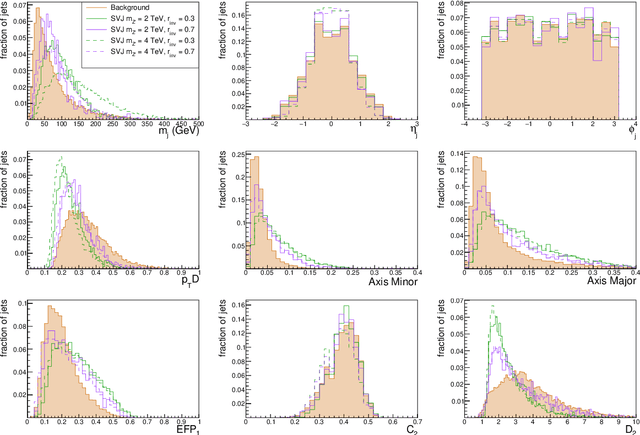
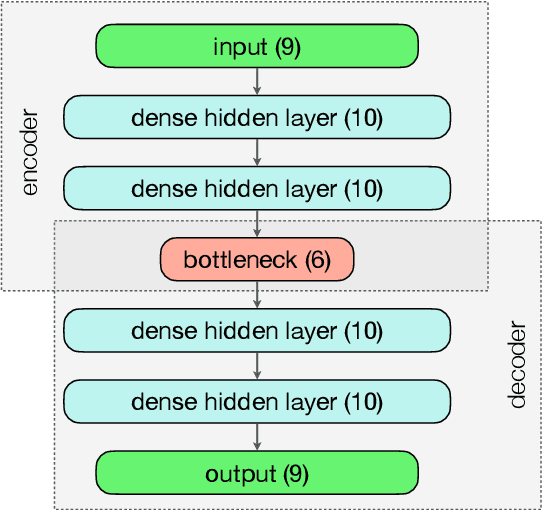
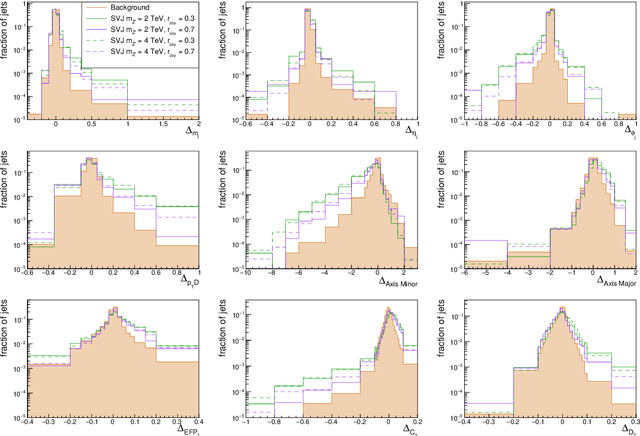
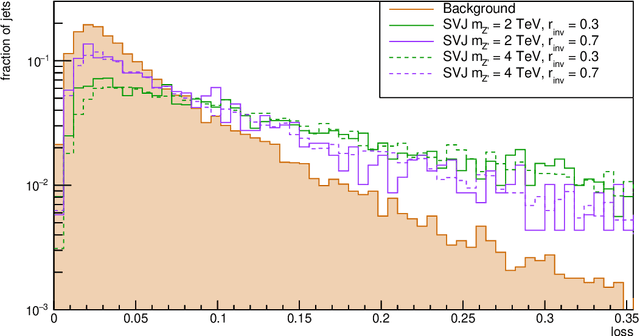
The production of dark matter particles from confining dark sectors may lead to many novel experimental signatures. Depending on the details of the theory, dark quark production in proton-proton collisions could result in semivisible jets of particles: collimated sprays of dark hadrons of which only some are detectable by particle collider experiments. The experimental signature is characterised by the presence of reconstructed missing momentum collinear with the visible components of the jets. This complex topology is sensitive to detector inefficiencies and mis-reconstruction that generate artificial missing momentum. With this work, we propose a signal-agnostic strategy to reject ordinary jets and identify semivisible jets via anomaly detection techniques. A deep neural autoencoder network with jet substructure variables as input proves highly useful for analyzing anomalous jets. The study focuses on the semivisible jet signature; however, the technique can apply to any new physics model that predicts signatures with jets from non-SM particles.
Particle Graph Autoencoders and Differentiable, Learned Energy Mover's Distance
Nov 24, 2021
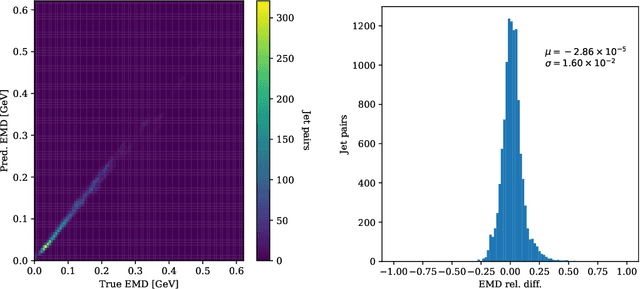
Autoencoders have useful applications in high energy physics in anomaly detection, particularly for jets - collimated showers of particles produced in collisions such as those at the CERN Large Hadron Collider. We explore the use of graph-based autoencoders, which operate on jets in their "particle cloud" representations and can leverage the interdependencies among the particles within a jet, for such tasks. Additionally, we develop a differentiable approximation to the energy mover's distance via a graph neural network, which may subsequently be used as a reconstruction loss function for autoencoders.
Explaining machine-learned particle-flow reconstruction
Nov 24, 2021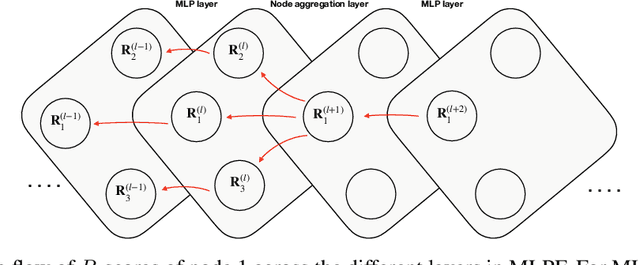

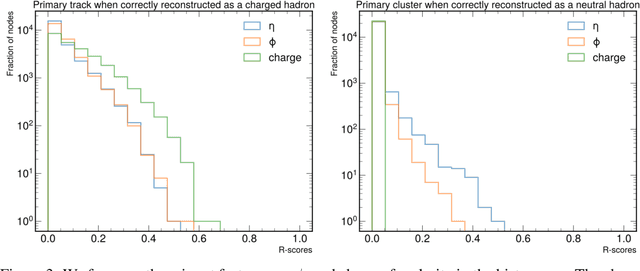
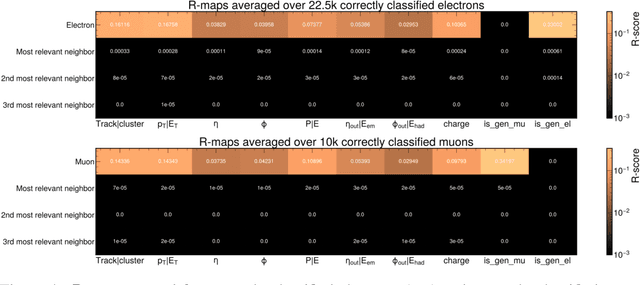
The particle-flow (PF) algorithm is used in general-purpose particle detectors to reconstruct a comprehensive particle-level view of the collision by combining information from different subdetectors. A graph neural network (GNN) model, known as the machine-learned particle-flow (MLPF) algorithm, has been developed to substitute the rule-based PF algorithm. However, understanding the model's decision making is not straightforward, especially given the complexity of the set-to-set prediction task, dynamic graph building, and message-passing steps. In this paper, we adapt the layerwise-relevance propagation technique for GNNs and apply it to the MLPF algorithm to gauge the relevant nodes and features for its predictions. Through this process, we gain insight into the model's decision-making.
Applications and Techniques for Fast Machine Learning in Science
Oct 25, 2021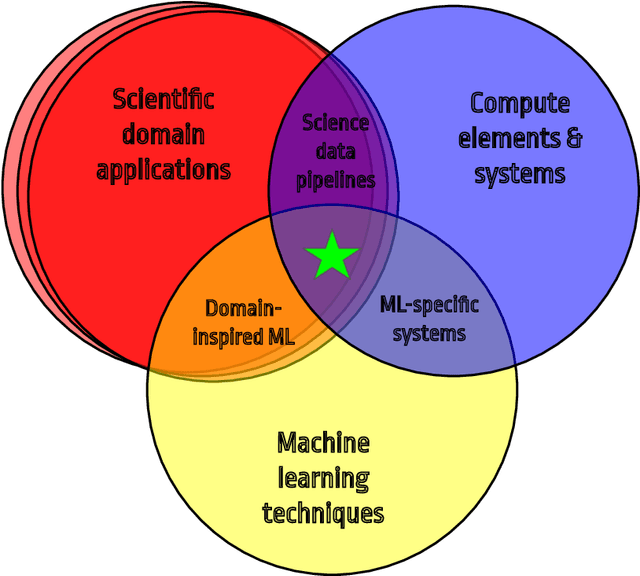
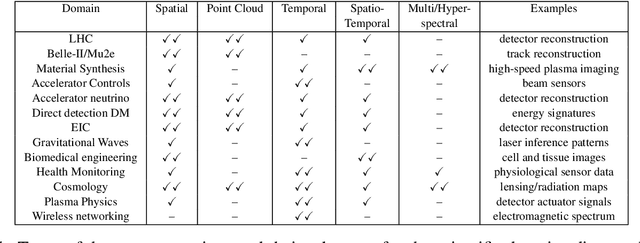
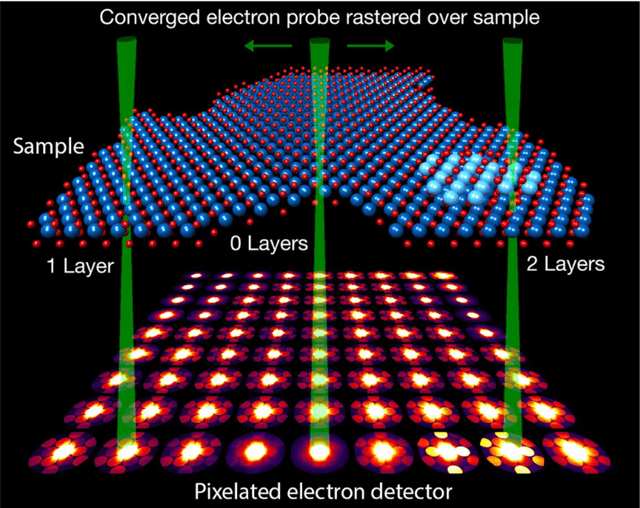
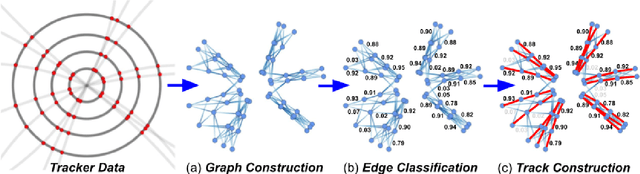
In this community review report, we discuss applications and techniques for fast machine learning (ML) in science -- the concept of integrating power ML methods into the real-time experimental data processing loop to accelerate scientific discovery. The material for the report builds on two workshops held by the Fast ML for Science community and covers three main areas: applications for fast ML across a number of scientific domains; techniques for training and implementing performant and resource-efficient ML algorithms; and computing architectures, platforms, and technologies for deploying these algorithms. We also present overlapping challenges across the multiple scientific domains where common solutions can be found. This community report is intended to give plenty of examples and inspiration for scientific discovery through integrated and accelerated ML solutions. This is followed by a high-level overview and organization of technical advances, including an abundance of pointers to source material, which can enable these breakthroughs.
Source-Agnostic Gravitational-Wave Detection with Recurrent Autoencoders
Aug 13, 2021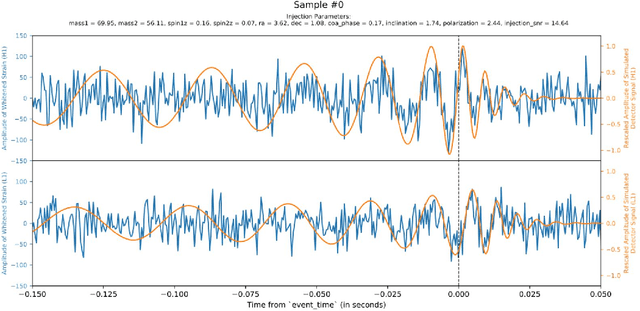
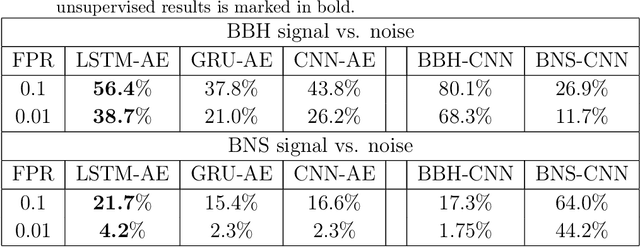
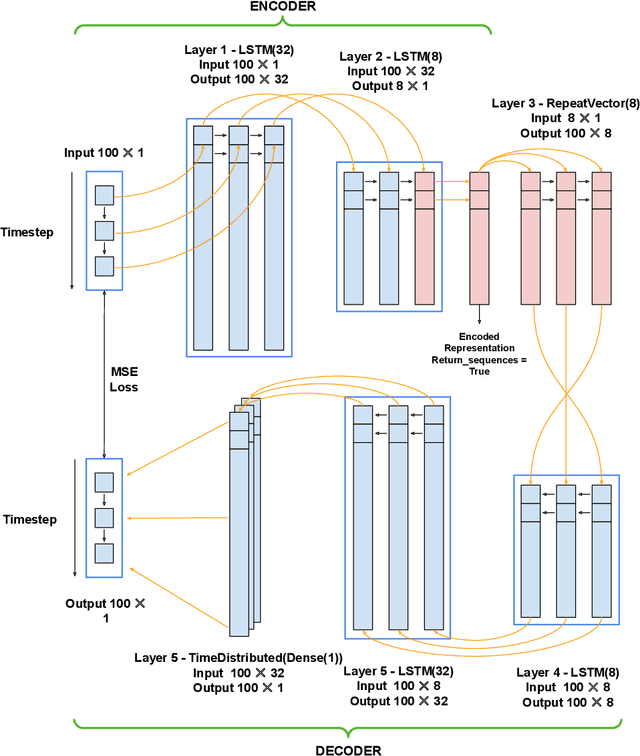
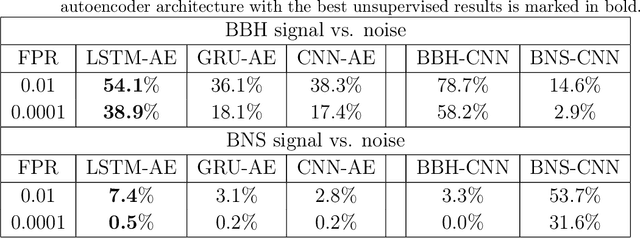
We present an application of anomaly detection techniques based on deep recurrent autoencoders to the problem of detecting gravitational wave signals in laser interferometers. Trained on noise data, this class of algorithms could detect signals using an unsupervised strategy, i.e., without targeting a specific kind of source. We develop a custom architecture to analyze the data from two interferometers. We compare the obtained performance to that obtained with other autoencoder architectures and with a convolutional classifier. The unsupervised nature of the proposed strategy comes with a cost in terms of accuracy, when compared to more traditional supervised techniques. On the other hand, there is a qualitative gain in generalizing the experimental sensitivity beyond the ensemble of pre-computed signal templates. The recurrent autoencoder outperforms other autoencoders based on different architectures. The class of recurrent autoencoders presented in this paper could complement the search strategy employed for gravitational wave detection and extend the reach of the ongoing detection campaigns.