 Add to Chrome
 Add to Firefox
 Add to Edge
DVMNet: Computing Relative Pose for Unseen Objects Beyond Hypotheses
Mar 20, 2024
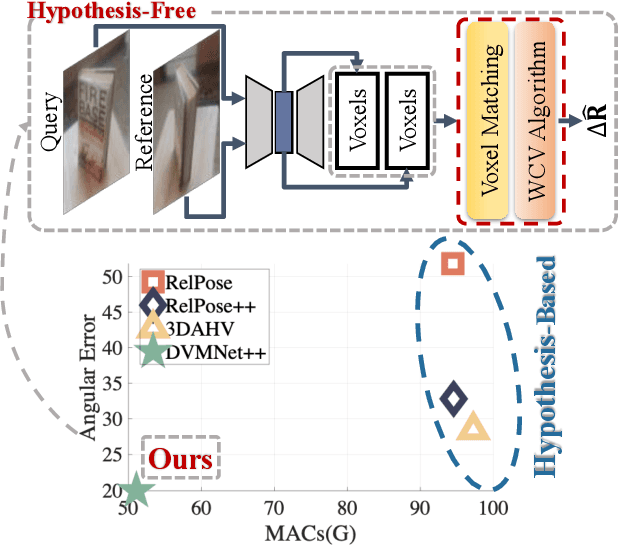
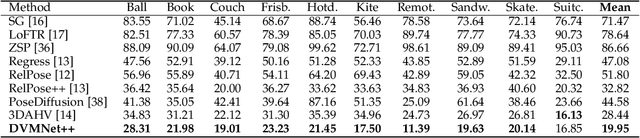
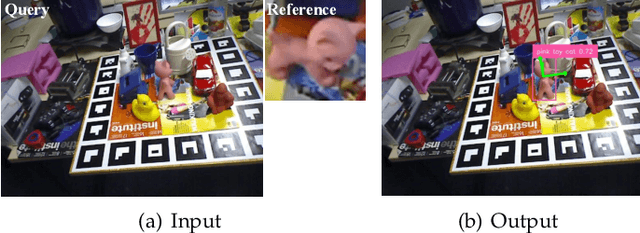

Determining the relative pose of an object between two images is pivotal to the success of generalizable object pose estimation. Existing approaches typically approximate the continuous pose representation with a large number of discrete pose hypotheses, which incurs a computationally expensive process of scoring each hypothesis at test time. By contrast, we present a Deep Voxel Matching Network (DVMNet) that eliminates the need for pose hypotheses and computes the relative object pose in a single pass. To this end, we map the two input RGB images, reference and query, to their respective voxelized 3D representations. We then pass the resulting voxels through a pose estimation module, where the voxels are aligned and the pose is computed in an end-to-end fashion by solving a least-squares problem. To enhance robustness, we introduce a weighted closest voxel algorithm capable of mitigating the impact of noisy voxels. We conduct extensive experiments on the CO3D, LINEMOD, and Objaverse datasets, demonstrating that our method delivers more accurate relative pose estimates for novel objects at a lower computational cost compared to state-of-the-art methods. Our code is released at: https://github.com/sailor-z/DVMNet/.

CLOAF: CoLlisiOn-Aware Human Flow
Mar 14, 2024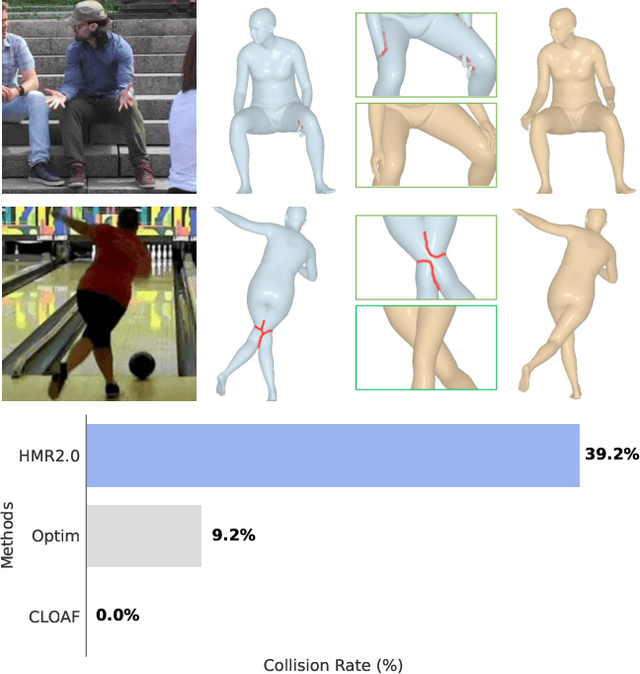
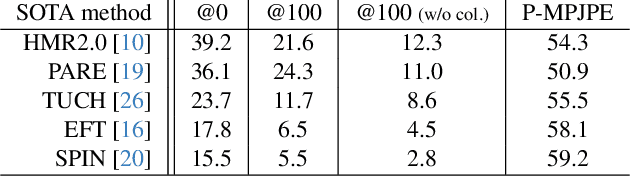
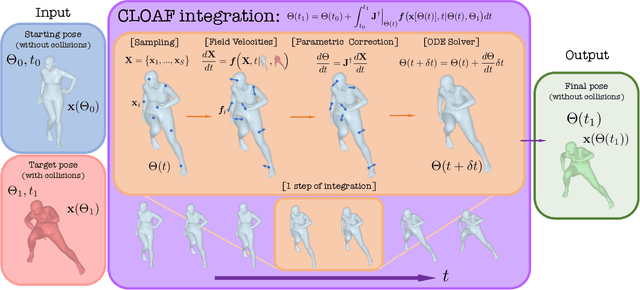
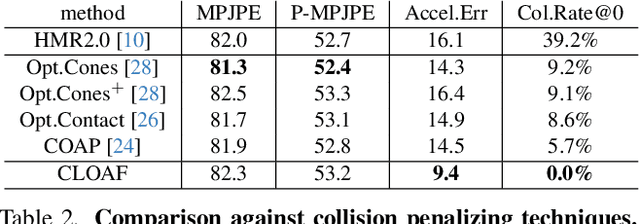
Even the best current algorithms for estimating body 3D shape and pose yield results that include body self-intersections. In this paper, we present CLOAF, which exploits the diffeomorphic nature of Ordinary Differential Equations to eliminate such self-intersections while still imposing body shape constraints. We show that, unlike earlier approaches to addressing this issue, ours completely eliminates the self-intersections without compromising the accuracy of the reconstructions. Being differentiable, CLOAF can be used to fine-tune pose and shape estimation baselines to improve their overall performance and eliminate self-intersections in their predictions. Furthermore, we demonstrate how our CLOAF strategy can be applied to practically any motion field induced by the user. CLOAF also makes it possible to edit motion to interact with the environment without worrying about potential collision or loss of body-shape prior.
OMH: Structured Sparsity via Optimally Matched Hierarchy for Unsupervised Semantic Segmentation
Mar 11, 2024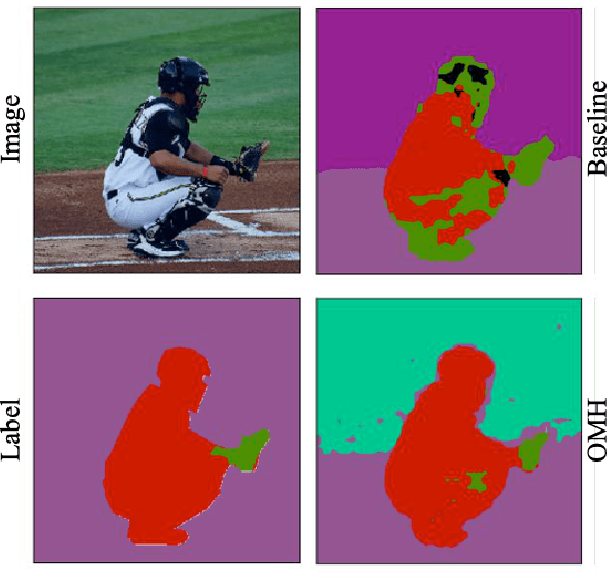
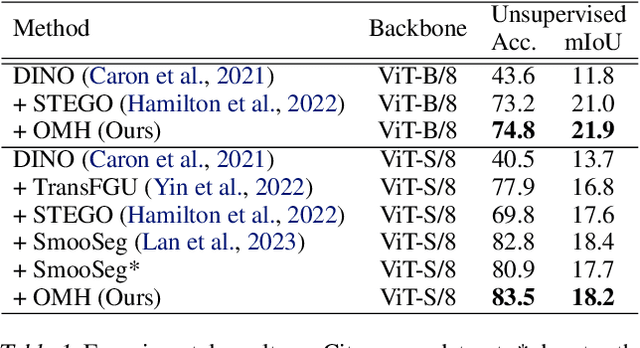
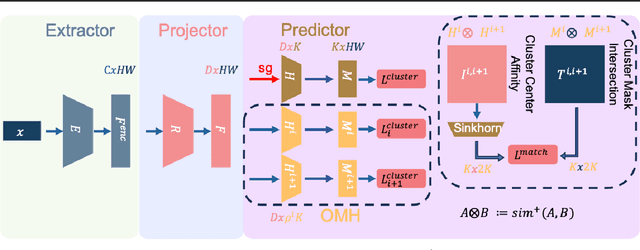
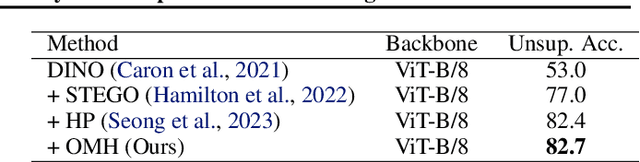
Unsupervised Semantic Segmentation (USS) involves segmenting images without relying on predefined labels, aiming to alleviate the burden of extensive human labeling. Existing methods utilize features generated by self-supervised models and specific priors for clustering. However, their clustering objectives are not involved in the optimization of the features during training. Additionally, due to the lack of clear class definitions in USS, the resulting segments may not align well with the clustering objective. In this paper, we introduce a novel approach called Optimally Matched Hierarchy (OMH) to simultaneously address the above issues. The core of our method lies in imposing structured sparsity on the feature space, which allows the features to encode information with different levels of granularity. The structure of this sparsity stems from our hierarchy (OMH). To achieve this, we learn a soft but sparse hierarchy among parallel clusters through Optimal Transport. Our OMH yields better unsupervised segmentation performance compared to existing USS methods. Our extensive experiments demonstrate the benefits of OMH when utilizing our differentiable paradigm. We will make our code publicly available.
HOISDF: Constraining 3D Hand-Object Pose Estimation with Global Signed Distance Fields
Feb 26, 2024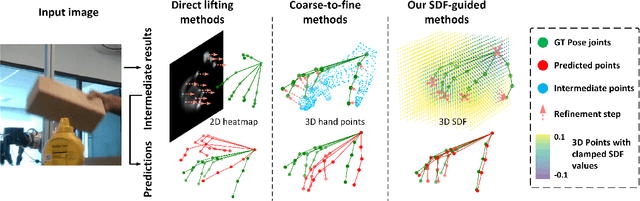
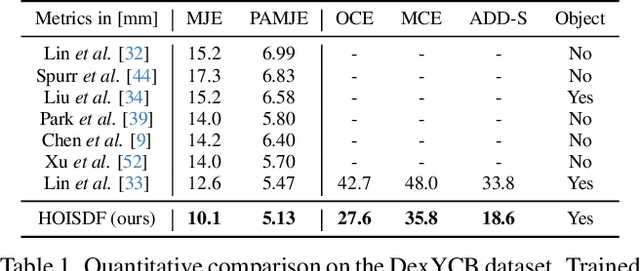
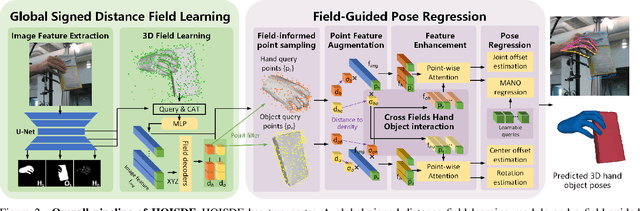
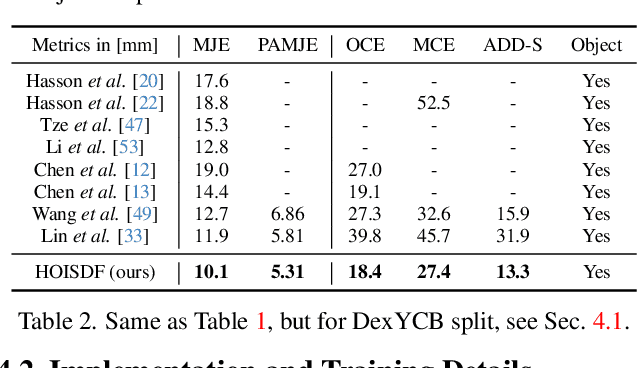
Human hands are highly articulated and versatile at handling objects. Jointly estimating the 3D poses of a hand and the object it manipulates from a monocular camera is challenging due to frequent occlusions. Thus, existing methods often rely on intermediate 3D shape representations to increase performance. These representations are typically explicit, such as 3D point clouds or meshes, and thus provide information in the direct surroundings of the intermediate hand pose estimate. To address this, we introduce HOISDF, a Signed Distance Field (SDF) guided hand-object pose estimation network, which jointly exploits hand and object SDFs to provide a global, implicit representation over the complete reconstruction volume. Specifically, the role of the SDFs is threefold: equip the visual encoder with implicit shape information, help to encode hand-object interactions, and guide the hand and object pose regression via SDF-based sampling and by augmenting the feature representations. We show that HOISDF achieves state-of-the-art results on hand-object pose estimation benchmarks (DexYCB and HO3Dv2). Code is available at https://github.com/amathislab/HOISDF
Using Motion Cues to Supervise Single-Frame Body Pose and Shape Estimation in Low Data Regimes
Feb 05, 2024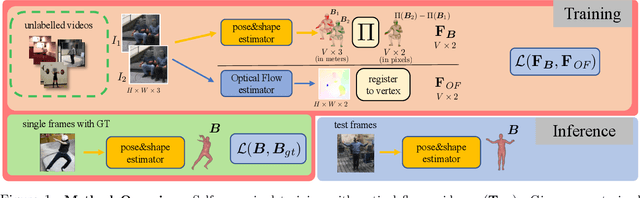
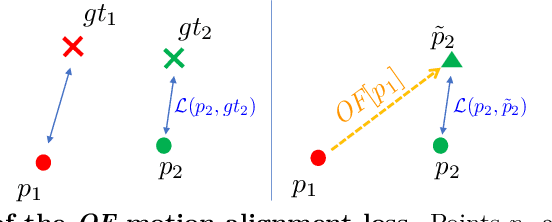
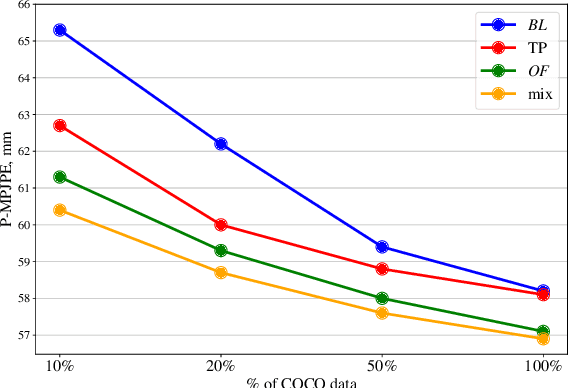
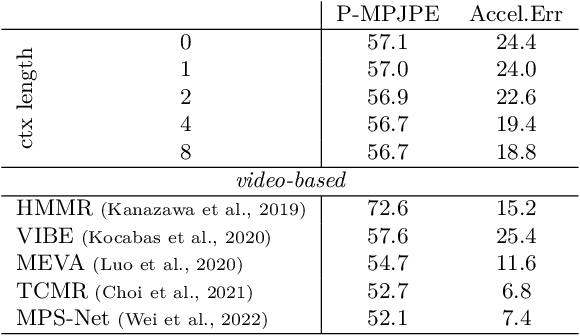
When enough annotated training data is available, supervised deep-learning algorithms excel at estimating human body pose and shape using a single camera. The effects of too little such data being available can be mitigated by using other information sources, such as databases of body shapes, to learn priors. Unfortunately, such sources are not always available either. We show that, in such cases, easy-to-obtain unannotated videos can be used instead to provide the required supervisory signals. Given a trained model using too little annotated data, we compute poses in consecutive frames along with the optical flow between them. We then enforce consistency between the image optical flow and the one that can be inferred from the change in pose from one frame to the next. This provides enough additional supervision to effectively refine the network weights and to perform on par with methods trained using far more annotated data.
DiffusionPCR: Diffusion Models for Robust Multi-Step Point Cloud Registration
Dec 05, 2023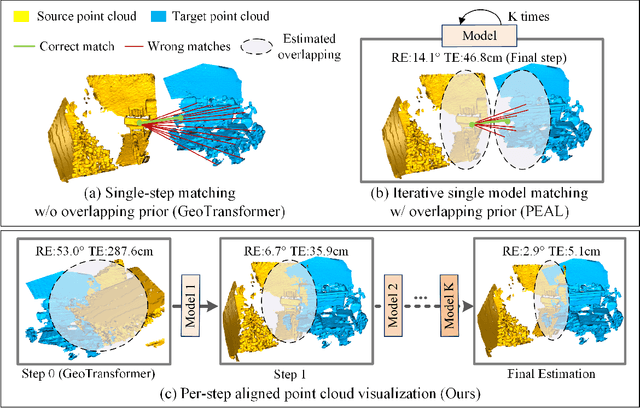
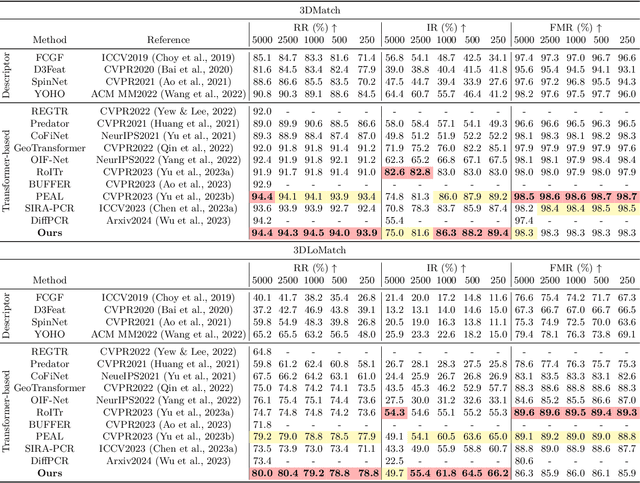
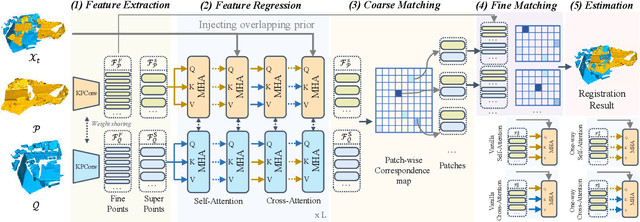
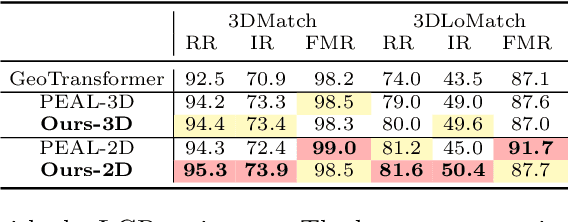
Point Cloud Registration (PCR) estimates the relative rigid transformation between two point clouds. We propose formulating PCR as a denoising diffusion probabilistic process, mapping noisy transformations to the ground truth. However, using diffusion models for PCR has nontrivial challenges, such as adapting a generative model to a discriminative task and leveraging the estimated nonlinear transformation from the previous step. Instead of training a diffusion model to directly map pure noise to ground truth, we map the predictions of an off-the-shelf PCR model to ground truth. The predictions of off-the-shelf models are often imperfect, especially in challenging cases where the two points clouds have low overlap, and thus could be seen as noisy versions of the real rigid transformation. In addition, we transform the rotation matrix into a spherical linear space for interpolation between samples in the forward process, and convert rigid transformations into auxiliary information to implicitly exploit last-step estimations in the reverse process. As a result, conditioned on time step, the denoising model adapts to the increasing accuracy across steps and refines registrations. Our extensive experiments showcase the effectiveness of our DiffusionPCR, yielding state-of-the-art registration recall rates (95.3%/81.6%) on 3DMatch and 3DLoMatch. The code will be made public upon publication.
GigaPose: Fast and Robust Novel Object Pose Estimation via One Correspondence
Nov 23, 2023We present GigaPose, a fast, robust, and accurate method for CAD-based novel object pose estimation in RGB images. GigaPose first leverages discriminative templates, rendered images of the CAD models, to recover the out-of-plane rotation and then uses patch correspondences to estimate the four remaining parameters. Our approach samples templates in only a two-degrees-of-freedom space instead of the usual three and matches the input image to the templates using fast nearest neighbor search in feature space, results in a speedup factor of 38x compared to the state of the art. Moreover, GigaPose is significantly more robust to segmentation errors. Our extensive evaluation on the seven core datasets of the BOP challenge demonstrates that it achieves state-of-the-art accuracy and can be seamlessly integrated with a refinement method. Additionally, we show the potential of GigaPose with 3D models predicted by recent work on 3D reconstruction from a single image, relaxing the need for CAD models and making 6D pose object estimation much more convenient. Our source code and trained models are publicly available at https://github.com/nv-nguyen/gigaPose
TIC-TAC: A Framework To Learn And Evaluate Your Covariance
Oct 29, 2023
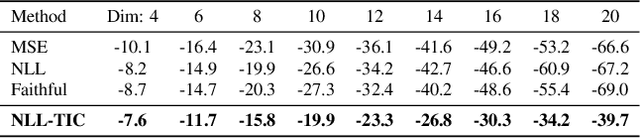
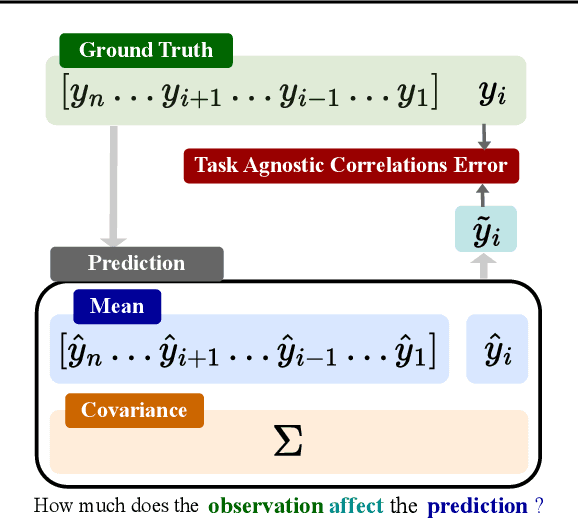

We study the problem of unsupervised heteroscedastic covariance estimation, where the goal is to learn the multivariate target distribution $\mathcal{N}(y, \Sigma_y | x )$ given an observation $x$. This problem is particularly challenging as $\Sigma_{y}$ varies for different samples (heteroscedastic) and no annotation for the covariance is available (unsupervised). Typically, state-of-the-art methods predict the mean $f_{\theta}(x)$ and covariance $\textrm{Cov}(f_{\theta}(x))$ of the target distribution through two neural networks trained using the negative log-likelihood. This raises two questions: (1) Does the predicted covariance truly capture the randomness of the predicted mean? (2) In the absence of ground-truth annotation, how can we quantify the performance of covariance estimation? We address (1) by deriving TIC: Taylor Induced Covariance, which captures the randomness of the multivariate $f_{\theta}(x)$ by incorporating its gradient and curvature around $x$ through the second order Taylor polynomial. Furthermore, we tackle (2) by introducing TAC: Task Agnostic Correlations, a metric which leverages conditioning of the normal distribution to evaluate the covariance. We verify the effectiveness of TIC through multiple experiments spanning synthetic (univariate, multivariate) and real-world datasets (UCI Regression, LSP, and MPII Human Pose Estimation). Our experiments show that TIC outperforms state-of-the-art in accurately learning the covariance, as quantified through TAC.
SE(3) Diffusion Model-based Point Cloud Registration for Robust 6D Object Pose Estimation
Oct 26, 2023In this paper, we introduce an SE(3) diffusion model-based point cloud registration framework for 6D object pose estimation in real-world scenarios. Our approach formulates the 3D registration task as a denoising diffusion process, which progressively refines the pose of the source point cloud to obtain a precise alignment with the model point cloud. Training our framework involves two operations: An SE(3) diffusion process and an SE(3) reverse process. The SE(3) diffusion process gradually perturbs the optimal rigid transformation of a pair of point clouds by continuously injecting noise (perturbation transformation). By contrast, the SE(3) reverse process focuses on learning a denoising network that refines the noisy transformation step-by-step, bringing it closer to the optimal transformation for accurate pose estimation. Unlike standard diffusion models used in linear Euclidean spaces, our diffusion model operates on the SE(3) manifold. This requires exploiting the linear Lie algebra $\mathfrak{se}(3)$ associated with SE(3) to constrain the transformation transitions during the diffusion and reverse processes. Additionally, to effectively train our denoising network, we derive a registration-specific variational lower bound as the optimization objective for model learning. Furthermore, we show that our denoising network can be constructed with a surrogate registration model, making our approach applicable to different deep registration networks. Extensive experiments demonstrate that our diffusion registration framework presents outstanding pose estimation performance on the real-world TUD-L, LINEMOD, and Occluded-LINEMOD datasets.
3D-Aware Hypothesis & Verification for Generalizable Relative Object Pose Estimation
Oct 05, 2023Prior methods that tackle the problem of generalizable object pose estimation highly rely on having dense views of the unseen object. By contrast, we address the scenario where only a single reference view of the object is available. Our goal then is to estimate the relative object pose between this reference view and a query image that depicts the object in a different pose. In this scenario, robust generalization is imperative due to the presence of unseen objects during testing and the large-scale object pose variation between the reference and the query. To this end, we present a new hypothesis-and-verification framework, in which we generate and evaluate multiple pose hypotheses, ultimately selecting the most reliable one as the relative object pose. To measure reliability, we introduce a 3D-aware verification that explicitly applies 3D transformations to the 3D object representations learned from the two input images. Our comprehensive experiments on the Objaverse, LINEMOD, and CO3D datasets evidence the superior accuracy of our approach in relative pose estimation and its robustness in large-scale pose variations, when dealing with unseen objects.