 Add to Chrome
 Add to Firefox
 Add to Edge
Do Egocentric Video-Language Models Capture Both Hand- and Object-Centric Cues?
Jul 09, 2026
Hand-object interaction (HOI) recognition requires capturing both hand manipulations and object transformations. However, existing video-language models often fall into shortcuts by relying on spurious correlations among hands, objects, or environmental context, rather than reasoning from the appearance and dynamics of hands and objects themselves. To address this limitation, we propose a new learning paradigm that combines (i) hand-object masked training, which enables robust reasoning from partial hand or object observations, and (ii) an HOI-dynamics-aware decoder that explicitly learns hand- and object-centric embeddings through auxiliary predictions of their locations and semantics, enhancing sensitivity to both cues. To systematically evaluate such cue-specific reasoning, we introduce Cue-Isolated HOI (CI-HOI), a new evaluation that assesses models' ability to predict actions from hand- and object-related cues independently. To enable CI-HOI, we curate the DEHOI testbed, which separates hand- and object-related observations for disentangled HOI evaluation through inpainting. Using DEHOI, we demonstrate both quantitatively and qualitatively that our training strategy exploits hand- and object-centric information more effectively than existing models. Our approach improves over existing models on DEHOI, standard action recognition, object state recognition, and even robot manipulation action recognition, leading to more robust HOI understanding.

YUBI: Yielding Universal Bidigital Interface for Bimanual Dexterous Manipulation at Scale
Jun 08, 2026We introduce Yielding Universal Bidigital Interface (YUBI), a finger-aligned gripper designed to enable intuitive, ergonomic, and scalable data collection for bimanual dexterous manipulation. While handheld data collection systems such as Universal Manipulation Interface (UMI) enable affordable data collection, their bulky pistol-grip designs can pose ergonomic and usability challenges for fine-grained, dexterous manipulation tasks. To address this, YUBI presents a distinct design principle: yielding, finger-driven actuation that directly maps human finger movements to gripper jaw motion. Using the YUBI devices, we set up a data collection system with integrated VR-based 6 DoF tracking of the gripper, ensuring high-fidelity trajectory data acquisition. We curate a UMI-based dataset of unprecedented scale: 8,434 hours across 1.20M episodes and 119 tasks. Experiments show that YUBI offers advantages over the UMI gripper in versatility for complex bimanual tasks, dexterity, and operational efficiency. A single policy trained on the YUBI dataset transfers across multiple bimanual robots (UR, Franka, and ELEY) simply by mounting the gripper on each platform, confirming that the collected data are directly executable as policy supervision. We release the gripper hardware, data-collection software, and dataset as one integrated stack, offering the open community a reproducible path to large-scale data acquisition for advancing robotic foundation models.
Learning Object States from Actions via Large Language Models
May 02, 2024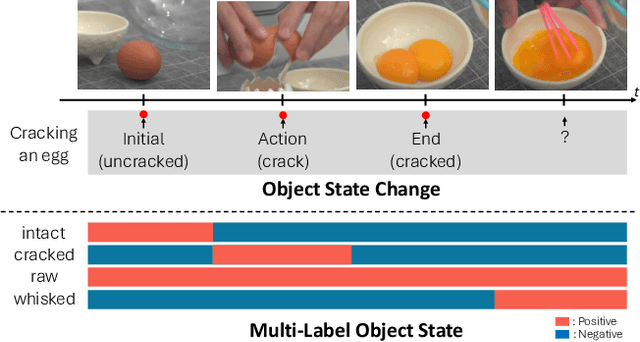

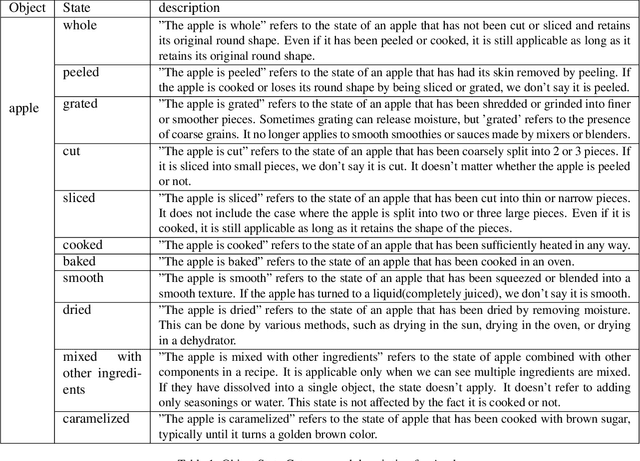
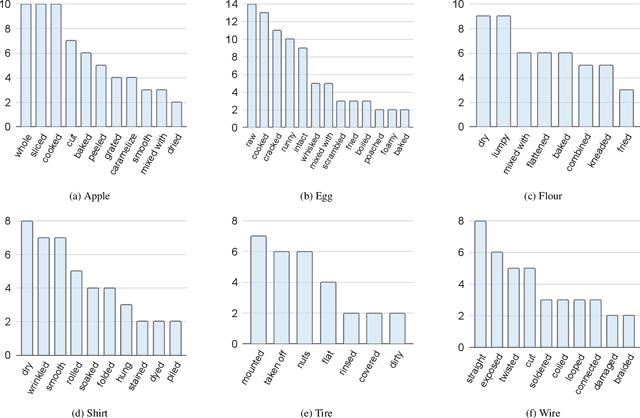
Temporally localizing the presence of object states in videos is crucial in understanding human activities beyond actions and objects. This task has suffered from a lack of training data due to object states' inherent ambiguity and variety. To avoid exhaustive annotation, learning from transcribed narrations in instructional videos would be intriguing. However, object states are less described in narrations compared to actions, making them less effective. In this work, we propose to extract the object state information from action information included in narrations, using large language models (LLMs). Our observation is that LLMs include world knowledge on the relationship between actions and their resulting object states, and can infer the presence of object states from past action sequences. The proposed LLM-based framework offers flexibility to generate plausible pseudo-object state labels against arbitrary categories. We evaluate our method with our newly collected Multiple Object States Transition (MOST) dataset including dense temporal annotation of 60 object state categories. Our model trained by the generated pseudo-labels demonstrates significant improvement of over 29% in mAP against strong zero-shot vision-language models, showing the effectiveness of explicitly extracting object state information from actions through LLMs.
Ego-Exo4D: Understanding Skilled Human Activity from First- and Third-Person Perspectives
Nov 30, 2023
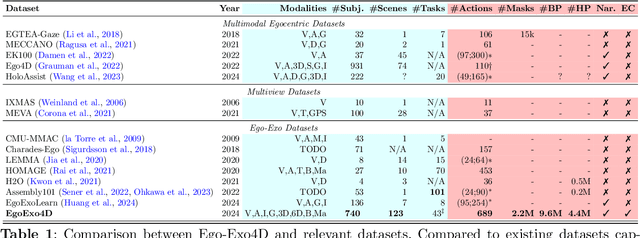

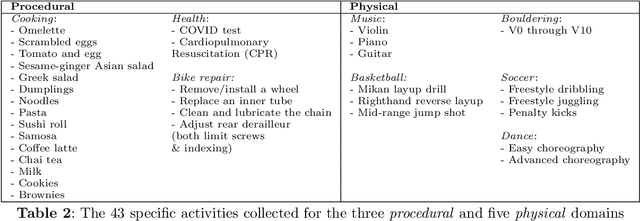
We present Ego-Exo4D, a diverse, large-scale multimodal multiview video dataset and benchmark challenge. Ego-Exo4D centers around simultaneously-captured egocentric and exocentric video of skilled human activities (e.g., sports, music, dance, bike repair). More than 800 participants from 13 cities worldwide performed these activities in 131 different natural scene contexts, yielding long-form captures from 1 to 42 minutes each and 1,422 hours of video combined. The multimodal nature of the dataset is unprecedented: the video is accompanied by multichannel audio, eye gaze, 3D point clouds, camera poses, IMU, and multiple paired language descriptions -- including a novel "expert commentary" done by coaches and teachers and tailored to the skilled-activity domain. To push the frontier of first-person video understanding of skilled human activity, we also present a suite of benchmark tasks and their annotations, including fine-grained activity understanding, proficiency estimation, cross-view translation, and 3D hand/body pose. All resources will be open sourced to fuel new research in the community.