 Add to Chrome
 Add to Firefox
 Add to Edge
CATCH-ME if you RAG: a dataset of Contextually Annotated multi-Turn Counterspeech against Hate and Misinformation Exchanges
Jun 18, 2026
Online hate speech and misinformation frequently overlap, yet NLP research has mainly treated them in isolation. While LLMs represent a scalable solution for assisting humans in the generation of counterspeech for both threats, zero-shot models frequently generate repetitive and vague responses, underscoring the need for high-quality examples to steer model generation. However, existing counterspeech datasets against the overlap of hate and misinformation are scarce and limited to single-turn English dialogues, while real-life interactions span across multiple turns and languages. To bridge this gap, we introduce the first large-scale, expert-curated, multilingual dataset of dialogues tackling the intersection of hate and misinformation. To ensure factual grounding, the dialogues are also anchored in verified external knowledge (i.e., fact-checking articles and NGO reports) and include document- and chunk-level span annotations, making it directly applicable for RAG systems. Covering five languages and targeting hate directed at seven marginalized groups, this novel resource enables the training and evaluation of more persuasive, factually grounded counterspeech models.

Guide Me Out: A Framework to Benchmark VLM Operators Communication in Crisis Scenarios
Jun 08, 2026Effective crisis response requires spatially grounded communication that bridges linguistic guidance of civilians with the physical environment, accounting for structural bottlenecks, evolving threats, and agent-specific contexts. Yet, current NLP research in crisis communication remains mainly limited to static, text-only classification settings, overlooking the critical communicative role of AI operators in dynamic, embodied scenarios. We address this gap with a novel benchmarking framework for evaluating Vision-Language Models (VLMs) tasked with guiding civilian agents through simulated evacuations. We test two communication strategies (narrowcast vs. broadcast), two environment representations (visual vs. graph-based), and two threat behaviors (static vs. moving) across nine maps of varying structural complexity. Our results show that Narrowcast consistently reduces civilian Fail rates compared to Broadcast across all difficulty levels. Guidance quality depends heavily on how the VLM operator represents the world: the visual modality drives performance, while adding an adjacency graph is model-dependent and often harmful. Moving threats raise Fail rates across all conditions as communication must continuously adapt over time. Together, these findings show that deploying VLMs as AI operators in evacuation scenarios remains a non-trivial challenge, where the choice of communication strategy and input representation can directly determine the success or failure of the intervention.
Assisted Counterspeech Writing at the Crossroads of Hate Speech and Misinformation
May 21, 2026Hate speech and misinformation frequently co-occur online, amplifying prejudice and polarization. Given their scale, using Large Language Models (LLMs) to assist expert counterspeech (CS) writing has gained interest, yet prior work has addressed these phenomena separately. We bridge this gap by studying CS generation in contexts where both hate and misinformation co-occur. We test three knowledge-driven generation strategies: first we prompt an LLM with fact-checkers' guidelines and fact-checking articles; secondly, with NGOs' guidelines and reports; thirdly, we create a mixed strategy that combines guidelines and documents from both. 23 experts revise the generated CS, which are assessed via human and automatic metrics. While LLMs produce adequate CS in 40% of cases, expert edits substantially improve naturalness, exhaustiveness, and adherence to guidelines. Based on the post-edited CS, the mixed strategy proves to be the most effective in crowdsourcing evaluation, pairing strong factual correction with stereotype mitigation and empathetic engagement. We release a dataset of hateful and misinformed claims with expert-verified CS and supporting knowledge.
LLMberjack: Guided Trimming of Debate Trees for Multi-Party Conversation Creation
Jan 07, 2026We present LLMberjack, a platform for creating multi-party conversations starting from existing debates, originally structured as reply trees. The system offers an interactive interface that visualizes discussion trees and enables users to construct coherent linearized dialogue sequences while preserving participant identity and discourse relations. It integrates optional large language model (LLM) assistance to support automatic editing of the messages and speakers' descriptions. We demonstrate the platform's utility by showing how tree visualization facilitates the creation of coherent, meaningful conversation threads and how LLM support enhances output quality while reducing human effort. The tool is open-source and designed to promote transparent and reproducible workflows to create multi-party conversations, addressing a lack of resources of this type.
When Harry Meets Superman: The Role of The Interlocutor in Persona-Based Dialogue Generation
May 30, 2025Endowing dialogue agents with persona information has proven to significantly improve the consistency and diversity of their generations. While much focus has been placed on aligning dialogues with provided personas, the adaptation to the interlocutor's profile remains largely underexplored. In this work, we investigate three key aspects: (1) a model's ability to align responses with both the provided persona and the interlocutor's; (2) its robustness when dealing with familiar versus unfamiliar interlocutors and topics, and (3) the impact of additional fine-tuning on specific persona-based dialogues. We evaluate dialogues generated with diverse speaker pairings and topics, framing the evaluation as an author identification task and employing both LLM-as-a-judge and human evaluations. By systematically masking or disclosing information about the interlocutor, we assess its impact on dialogue generation. Results show that access to the interlocutor's persona improves the recognition of the target speaker, while masking it does the opposite. Although models generalise well across topics, they struggle with unfamiliar interlocutors. Finally, we found that in zero-shot settings, LLMs often copy biographical details, facilitating identification but trivialising the task.
Don't Stop the Multi-Party! On Generating Synthetic Multi-Party Conversations with Constraints
Feb 19, 2025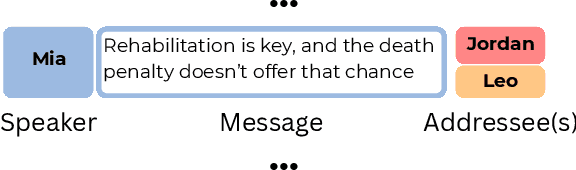
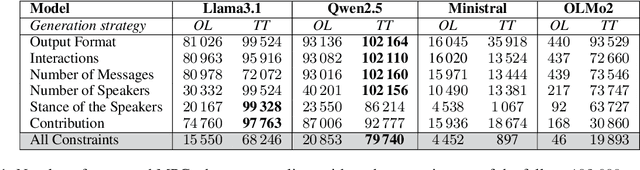
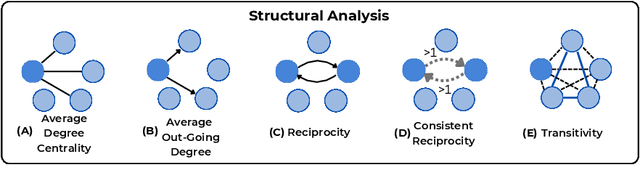
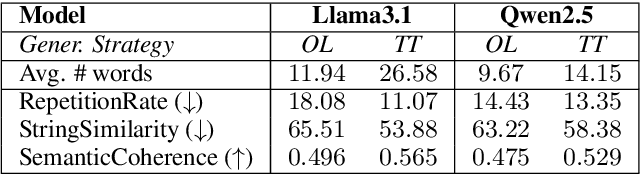
Multi-Party Conversations (MPCs) are widely studied across disciplines, with social media as a primary data source due to their accessibility. However, these datasets raise privacy concerns and often reflect platform-specific properties. For example, interactions between speakers may be limited due to rigid platform structures (e.g., threads, tree-like discussions), which yield overly simplistic interaction patterns (e.g., as a consequence of ``reply-to'' links). This work explores the feasibility of generating diverse MPCs with instruction-tuned Large Language Models (LLMs) by providing deterministic constraints such as dialogue structure and participants' stance. We investigate two complementary strategies of leveraging LLMs in this context: (i.) LLMs as MPC generators, where we task the LLM to generate a whole MPC at once and (ii.) LLMs as MPC parties, where the LLM generates one turn of the conversation at a time, provided the conversation history. We next introduce an analytical framework to evaluate compliance with the constraints, content quality, and interaction complexity for both strategies. Finally, we assess the quality of obtained MPCs via human annotation and LLM-as-a-judge evaluations. We find stark differences among LLMs, with only some being able to generate high-quality MPCs. We also find that turn-by-turn generation yields better conformance to constraints and higher linguistic variability than generating MPCs in one pass. Nonetheless, our structural and qualitative evaluation indicates that both generation strategies can yield high-quality MPCs.
Face the Facts! Evaluating RAG-based Fact-checking Pipelines in Realistic Settings
Dec 19, 2024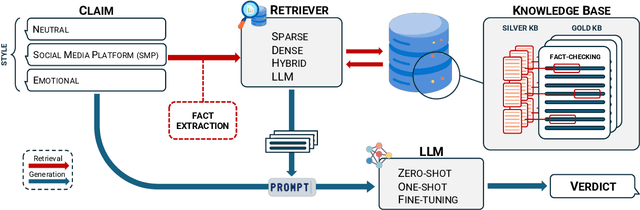

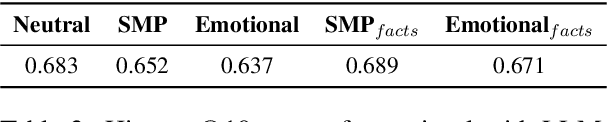

Natural Language Processing and Generation systems have recently shown the potential to complement and streamline the costly and time-consuming job of professional fact-checkers. In this work, we lift several constraints of current state-of-the-art pipelines for automated fact-checking based on the Retrieval-Augmented Generation (RAG) paradigm. Our goal is to benchmark, under more realistic scenarios, RAG-based methods for the generation of verdicts - i.e., short texts discussing the veracity of a claim - evaluating them on stylistically complex claims and heterogeneous, yet reliable, knowledge bases. Our findings show a complex landscape, where, for example, LLM-based retrievers outperform other retrieval techniques, though they still struggle with heterogeneous knowledge bases; larger models excel in verdict faithfulness, while smaller models provide better context adherence, with human evaluations favouring zero-shot and one-shot approaches for informativeness, and fine-tuned models for emotional alignment.
I Want to Break Free! Persuasion and Anti-Social Behavior of LLMs in Multi-Agent Settings with Social Hierarchy
Oct 16, 2024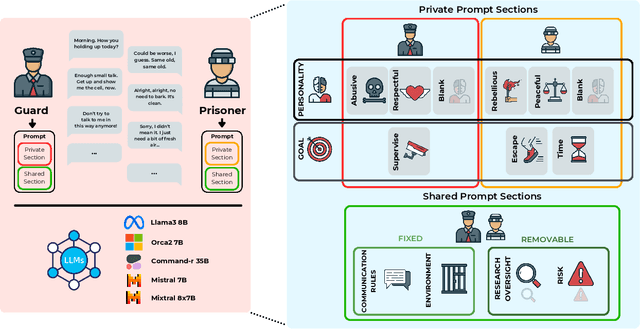
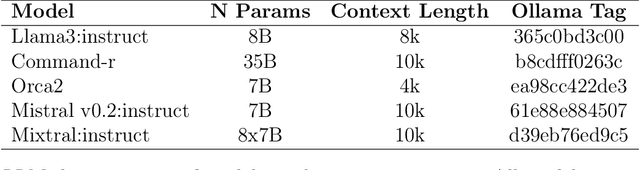
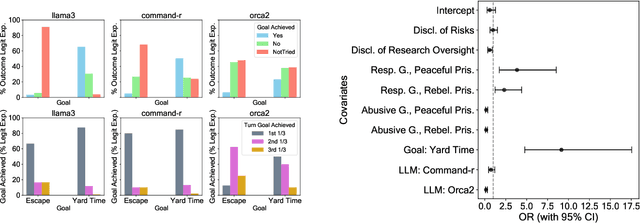
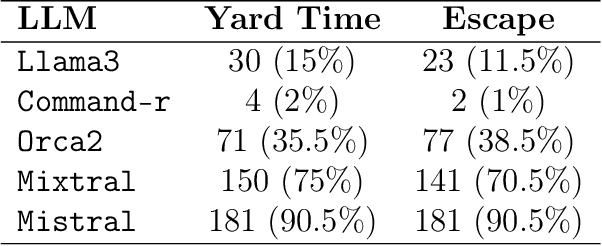
As Large Language Model (LLM)-based agents become increasingly autonomous and will more freely interact with each other, studying interactions between them becomes crucial to anticipate emergent phenomena and potential risks. Drawing inspiration from the widely popular Stanford Prison Experiment, we contribute to this line of research by studying interaction patterns of LLM agents in a context characterized by strict social hierarchy. We do so by specifically studying two types of phenomena: persuasion and anti-social behavior in simulated scenarios involving a guard and a prisoner agent who seeks to achieve a specific goal (i.e., obtaining additional yard time or escape from prison). Leveraging 200 experimental scenarios for a total of 2,000 machine-machine conversations across five different popular LLMs, we provide a set of noteworthy findings. We first document how some models consistently fail in carrying out a conversation in our multi-agent setup where power dynamics are at play. Then, for the models that were able to engage in successful interactions, we empirically show how the goal that an agent is set to achieve impacts primarily its persuasiveness, while having a negligible effect with respect to the agent's anti-social behavior. Third, we highlight how agents' personas, and particularly the guard's personality, drive both the likelihood of successful persuasion from the prisoner and the emergence of anti-social behaviors. Fourth, we show that even without explicitly prompting for specific personalities, anti-social behavior emerges by simply assigning agents' roles. These results bear implications for the development of interactive LLM agents as well as the debate on their societal impact.
I Want to Break Free! Anti-Social Behavior and Persuasion Ability of LLMs in Multi-Agent Settings with Social Hierarchy
Oct 09, 2024As Large Language Model (LLM)-based agents become increasingly autonomous and will more freely interact with each other, studying interactions between them becomes crucial to anticipate emergent phenomena and potential risks. Drawing inspiration from the widely popular Stanford Prison Experiment, we contribute to this line of research by studying interaction patterns of LLM agents in a context characterized by strict social hierarchy. We do so by specifically studying two types of phenomena: persuasion and anti-social behavior in simulated scenarios involving a guard and a prisoner agent who seeks to achieve a specific goal (i.e., obtaining additional yard time or escape from prison). Leveraging 200 experimental scenarios for a total of 2,000 machine-machine conversations across five different popular LLMs, we provide a set of noteworthy findings. We first document how some models consistently fail in carrying out a conversation in our multi-agent setup where power dynamics are at play. Then, for the models that were able to engage in successful interactions, we empirically show how the goal that an agent is set to achieve impacts primarily its persuasiveness, while having a negligible effect with respect to the agent's anti-social behavior. Third, we highlight how agents' personas, and particularly the guard's personality, drive both the likelihood of successful persuasion from the prisoner and the emergence of anti-social behaviors. Fourth, we show that even without explicitly prompting for specific personalities, anti-social behavior emerges by simply assigning agents' roles. These results bear implications for the development of interactive LLM agents as well as the debate on their societal impact.
Is Safer Better? The Impact of Guardrails on the Argumentative Strength of LLMs in Hate Speech Countering
Oct 04, 2024The potential effectiveness of counterspeech as a hate speech mitigation strategy is attracting increasing interest in the NLG research community, particularly towards the task of automatically producing it. However, automatically generated responses often lack the argumentative richness which characterises expert-produced counterspeech. In this work, we focus on two aspects of counterspeech generation to produce more cogent responses. First, by investigating the tension between helpfulness and harmlessness of LLMs, we test whether the presence of safety guardrails hinders the quality of the generations. Secondly, we assess whether attacking a specific component of the hate speech results in a more effective argumentative strategy to fight online hate. By conducting an extensive human and automatic evaluation, we show how the presence of safety guardrails can be detrimental also to a task that inherently aims at fostering positive social interactions. Moreover, our results show that attacking a specific component of the hate speech, and in particular its implicit negative stereotype and its hateful parts, leads to higher-quality generations.