 Add to Chrome
 Add to Firefox
 Add to Edge
Toward Global Large Language Models in Medicine
Jan 05, 2026
Despite continuous advances in medical technology, the global distribution of health care resources remains uneven. The development of large language models (LLMs) has transformed the landscape of medicine and holds promise for improving health care quality and expanding access to medical information globally. However, existing LLMs are primarily trained on high-resource languages, limiting their applicability in global medical scenarios. To address this gap, we constructed GlobMed, a large multilingual medical dataset, containing over 500,000 entries spanning 12 languages, including four low-resource languages. Building on this, we established GlobMed-Bench, which systematically assesses 56 state-of-the-art proprietary and open-weight LLMs across multiple multilingual medical tasks, revealing significant performance disparities across languages, particularly for low-resource languages. Additionally, we introduced GlobMed-LLMs, a suite of multilingual medical LLMs trained on GlobMed, with parameters ranging from 1.7B to 8B. GlobMed-LLMs achieved an average performance improvement of over 40% relative to baseline models, with a more than threefold increase in performance on low-resource languages. Together, these resources provide an important foundation for advancing the equitable development and application of LLMs globally, enabling broader language communities to benefit from technological advances.

Towards Clinical AI Fairness: Filling Gaps in the Puzzle
May 28, 2024
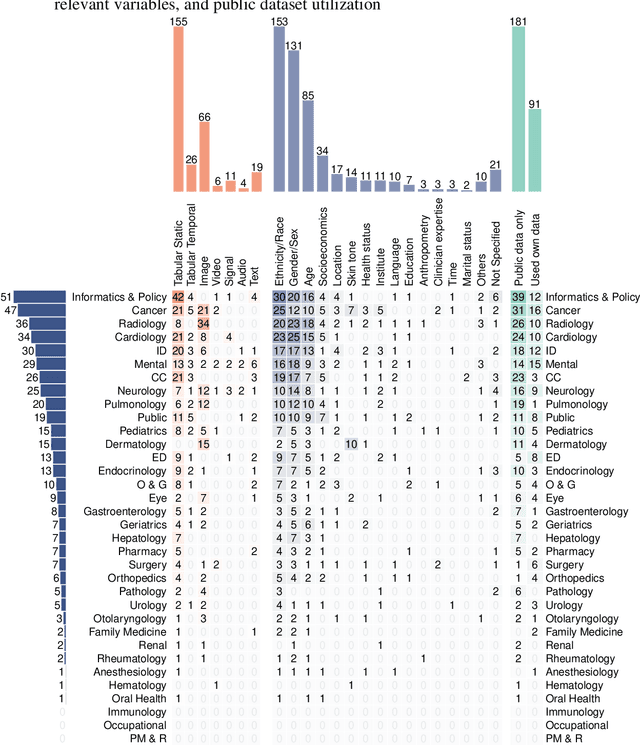
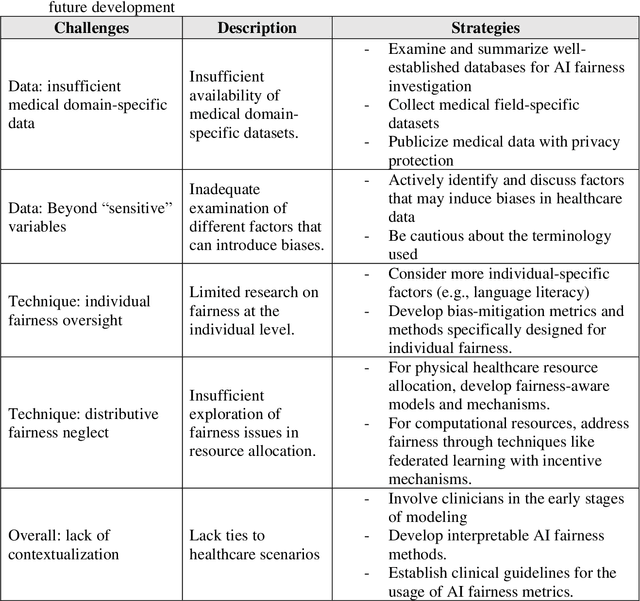
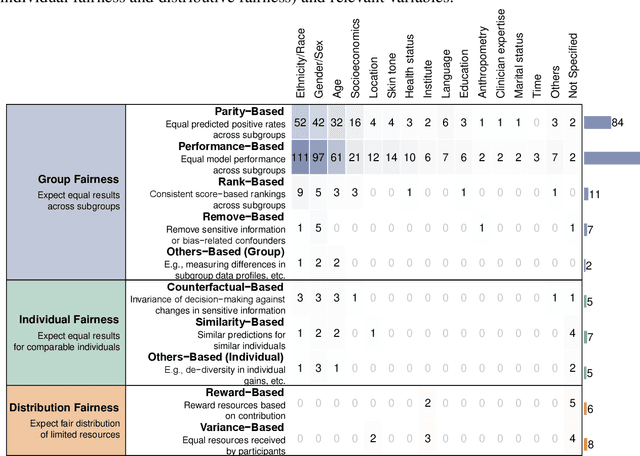
The ethical integration of Artificial Intelligence (AI) in healthcare necessitates addressing fairness-a concept that is highly context-specific across medical fields. Extensive studies have been conducted to expand the technical components of AI fairness, while tremendous calls for AI fairness have been raised from healthcare. Despite this, a significant disconnect persists between technical advancements and their practical clinical applications, resulting in a lack of contextualized discussion of AI fairness in clinical settings. Through a detailed evidence gap analysis, our review systematically pinpoints several deficiencies concerning both healthcare data and the provided AI fairness solutions. We highlight the scarcity of research on AI fairness in many medical domains where AI technology is increasingly utilized. Additionally, our analysis highlights a substantial reliance on group fairness, aiming to ensure equality among demographic groups from a macro healthcare system perspective; in contrast, individual fairness, focusing on equity at a more granular level, is frequently overlooked. To bridge these gaps, our review advances actionable strategies for both the healthcare and AI research communities. Beyond applying existing AI fairness methods in healthcare, we further emphasize the importance of involving healthcare professionals to refine AI fairness concepts and methods to ensure contextually relevant and ethically sound AI applications in healthcare.
Towards clinical AI fairness: A translational perspective
Apr 26, 2023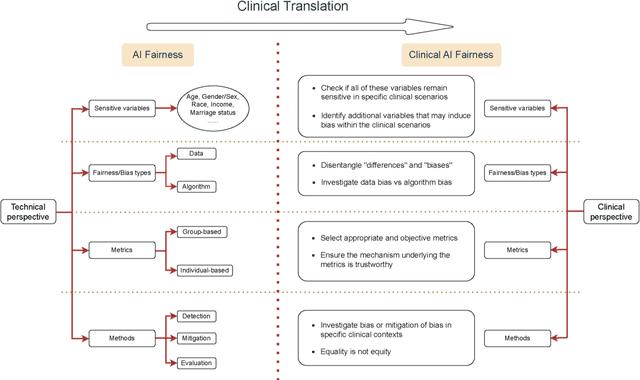
Artificial intelligence (AI) has demonstrated the ability to extract insights from data, but the issue of fairness remains a concern in high-stakes fields such as healthcare. Despite extensive discussion and efforts in algorithm development, AI fairness and clinical concerns have not been adequately addressed. In this paper, we discuss the misalignment between technical and clinical perspectives of AI fairness, highlight the barriers to AI fairness' translation to healthcare, advocate multidisciplinary collaboration to bridge the knowledge gap, and provide possible solutions to address the clinical concerns pertaining to AI fairness.