 Add to Chrome
 Add to Firefox
 Add to Edge
Libra-VLA: Achieving Learning Equilibrium via Asynchronous Coarse-to-Fine Dual-System
Apr 27, 2026
Vision-Language-Action (VLA) models are a promising paradigm for generalist robotic manipulation by grounding high-level semantic instructions into executable physical actions. However, prevailing approaches typically adopt a monolithic generation paradigm, directly mapping visual-linguistic features to high-frequency motor commands in a flat, non-hierarchical fashion. This strategy overlooks the inherent hierarchy of robotic manipulation, where complex actions can be naturally modeled in a Hybrid Action Space, decomposing into discrete macro-directional reaching and continuous micro-pose alignment, severely widening the semantic-actuation gap and imposing a heavy representational burden on grounding high-level semantics to continuous actions. To address this, we introduce Libra-VLA, a novel Coarse-to-Fine Dual-System VLA architecture. We explicitly decouple the learning complexity into a coarse-to-fine hierarchy to strike a training equilibrium, while simultaneously leveraging this structural modularity to implement an asynchronous execution strategy. The Semantic Planner predicts discrete action tokens capturing macro-directional intent, while the Action Refiner conditions on coarse intent to generate high-frequency continuous actions for precise alignment. Crucially, our empirical analysis reveals that performance follows an inverted-U curve relative to action decomposition granularity, peaking exactly when the learning difficulty is balanced between the two sub-systems. With the asynchronous design, our approach offers a scalable, robust, and responsive solution for open-world manipulation.

ACoT-VLA: Action Chain-of-Thought for Vision-Language-Action Models
Jan 16, 2026Vision-Language-Action (VLA) models have emerged as essential generalist robot policies for diverse manipulation tasks, conventionally relying on directly translating multimodal inputs into actions via Vision-Language Model (VLM) embeddings. Recent advancements have introduced explicit intermediary reasoning, such as sub-task prediction (language) or goal image synthesis (vision), to guide action generation. However, these intermediate reasoning are often indirect and inherently limited in their capacity to convey the full, granular information required for precise action execution. Instead, we posit that the most effective form of reasoning is one that deliberates directly in the action space. We introduce Action Chain-of-Thought (ACoT), a paradigm where the reasoning process itself is formulated as a structured sequence of coarse action intents that guide the final policy. In this paper, we propose ACoT-VLA, a novel architecture that materializes the ACoT paradigm. Specifically, we introduce two complementary components: an Explicit Action Reasoner (EAR) and Implicit Action Reasoner (IAR). The former proposes coarse reference trajectories as explicit action-level reasoning steps, while the latter extracts latent action priors from internal representations of multimodal input, co-forming an ACoT that conditions the downstream action head to enable grounded policy learning. Extensive experiments in real-world and simulation environments demonstrate the superiority of our proposed method, which achieves 98.5%, 84.1%, and 47.4% on LIBERO, LIBERO-Plus and VLABench, respectively.
Unified Embodied VLM Reasoning with Robotic Action via Autoregressive Discretized Pre-training
Dec 30, 2025General-purpose robotic systems operating in open-world environments must achieve both broad generalization and high-precision action execution, a combination that remains challenging for existing Vision-Language-Action (VLA) models. While large Vision-Language Models (VLMs) improve semantic generalization, insufficient embodied reasoning leads to brittle behavior, and conversely, strong reasoning alone is inadequate without precise control. To provide a decoupled and quantitative assessment of this bottleneck, we introduce Embodied Reasoning Intelligence Quotient (ERIQ), a large-scale embodied reasoning benchmark in robotic manipulation, comprising 6K+ question-answer pairs across four reasoning dimensions. By decoupling reasoning from execution, ERIQ enables systematic evaluation and reveals a strong positive correlation between embodied reasoning capability and end-to-end VLA generalization. To bridge the gap from reasoning to precise execution, we propose FACT, a flow-matching-based action tokenizer that converts continuous control into discrete sequences while preserving high-fidelity trajectory reconstruction. The resulting GenieReasoner jointly optimizes reasoning and action in a unified space, outperforming both continuous-action and prior discrete-action baselines in real-world tasks. Together, ERIQ and FACT provide a principled framework for diagnosing and overcoming the reasoning-precision trade-off, advancing robust, general-purpose robotic manipulation.
TopV-Nav: Unlocking the Top-View Spatial Reasoning Potential of MLLM for Zero-shot Object Navigation
Nov 25, 2024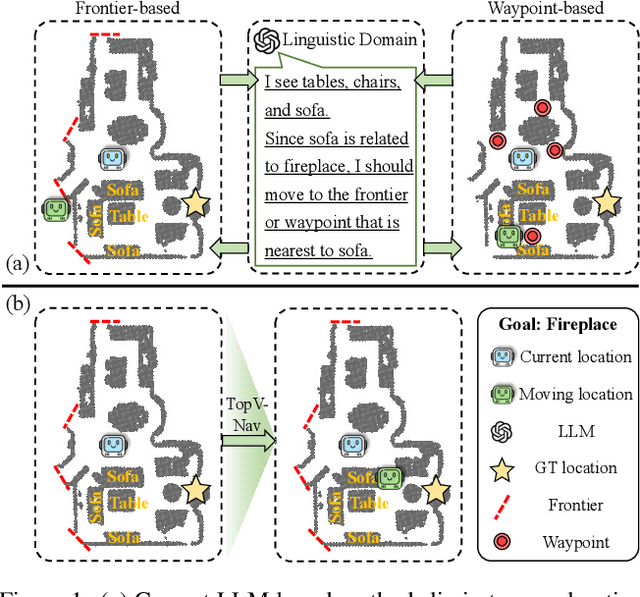
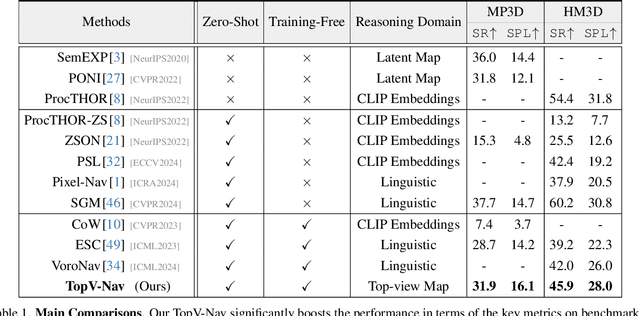
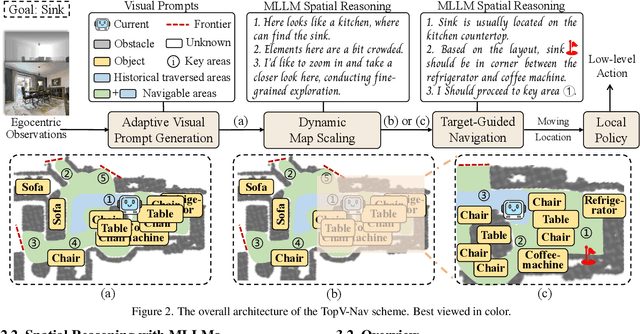
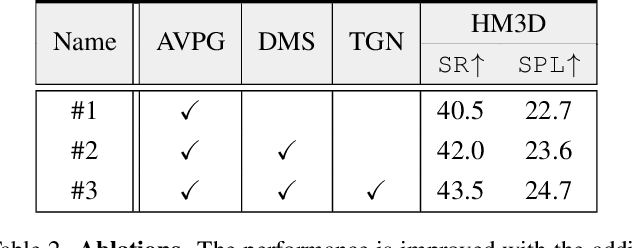
The Zero-Shot Object Navigation (ZSON) task requires embodied agents to find a previously unseen object by navigating in unfamiliar environments. Such a goal-oriented exploration heavily relies on the ability to perceive, understand, and reason based on the spatial information of the environment. However, current LLM-based approaches convert visual observations to language descriptions and reason in the linguistic space, leading to the loss of spatial information. In this paper, we introduce TopV-Nav, a MLLM-based method that directly reasons on the top-view map with complete spatial information. To fully unlock the MLLM's spatial reasoning potential in top-view perspective, we propose the Adaptive Visual Prompt Generation (AVPG) method to adaptively construct semantically-rich top-view map. It enables the agent to directly utilize spatial information contained in the top-view map to conduct thorough reasoning. Besides, we design a Dynamic Map Scaling (DMS) mechanism to dynamically zoom top-view map at preferred scales, enhancing local fine-grained reasoning. Additionally, we devise a Target-Guided Navigation (TGN) mechanism to predict and to utilize target locations, facilitating global and human-like exploration. Experiments on MP3D and HM3D benchmarks demonstrate the superiority of our TopV-Nav, e.g., $+3.9\%$ SR and $+2.0\%$ SPL absolute improvements on HM3D.
SyntheT2C: Generating Synthetic Data for Fine-Tuning Large Language Models on the Text2Cypher Task
Jun 15, 2024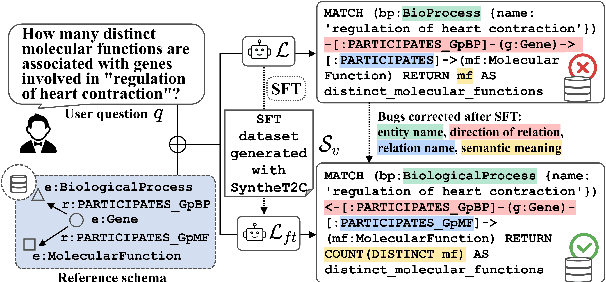
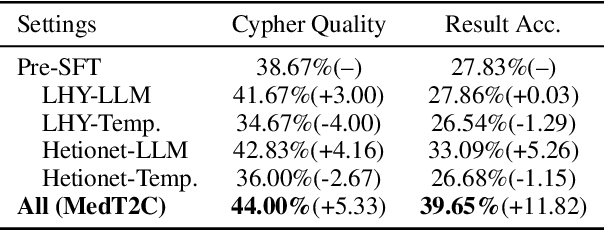
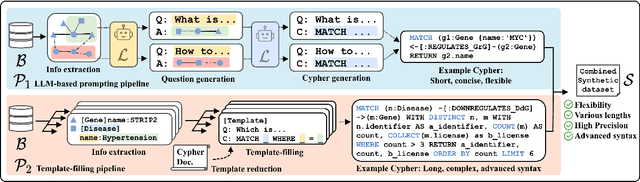
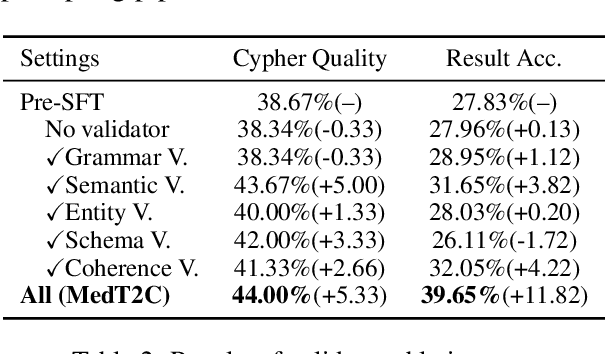
Integrating Large Language Models (LLMs) with existing Knowledge Graph (KG) databases presents a promising avenue for enhancing LLMs' efficacy and mitigating their "hallucinations". Given that most KGs reside in graph databases accessible solely through specialized query languages (e.g., Cypher), there exists a critical need to bridge the divide between LLMs and KG databases by automating the translation of natural language into Cypher queries (commonly termed the "Text2Cypher" task). Prior efforts tried to bolster LLMs' proficiency in Cypher generation through Supervised Fine-Tuning. However, these explorations are hindered by the lack of annotated datasets of Query-Cypher pairs, resulting from the labor-intensive and domain-specific nature of annotating such datasets. In this study, we propose SyntheT2C, a methodology for constructing a synthetic Query-Cypher pair dataset, comprising two distinct pipelines: (1) LLM-based prompting and (2) template-filling. SyntheT2C facilitates the generation of extensive Query-Cypher pairs with values sampled from an underlying Neo4j graph database. Subsequently, SyntheT2C is applied to two medical databases, culminating in the creation of a synthetic dataset, MedT2C. Comprehensive experiments demonstrate that the MedT2C dataset effectively enhances the performance of backbone LLMs on the Text2Cypher task. Both the SyntheT2C codebase and the MedT2C dataset will be released soon.