 Add to Chrome
 Add to Firefox
 Add to Edge
MaskClaw: Edge-Side Personalized Privacy Arbitration for GUI Agents with Behavior-Driven Skill Evolution
May 27, 2026
GUI agents rely on screenshots to infer intent and operate across applications, but these screenshots often contain private messages, medical records, payment credentials, and workplace-specific workflows. Privacy decisions in this setting depend on task, recipient, application state, and user role, yet static PII detectors miss these boundaries and cloud-side VLM reasoning can upload the raw screen before deciding what should be protected. We present MaskClaw, an edge-side privacy arbitrator for GUI agents. MaskClaw extracts local visual evidence, retrieves user- and task-specific policy memory, and decides Allow, Mask, or Ask before raw screenshots leave a trusted user- or organization-controlled environment. In five designed skill-evolution scenarios, it turns corrections, cancellations, and edits into reusable privacy skills checked by a sandbox gate. We introduce P-GUI-Evo, a benchmark built from real UI patterns, reconstructed HTML screens, and sanitized labels. Experiments show that pattern matching, cloud reasoning, and routing alone tend to over-confirm, over-mask, or expose raw screenshots under the same protocol. The artifact is available at https://github.com/Theodora-Y/MaskClaw.

OracleProto: A Reproducible Framework for Benchmarking LLM Native Forecasting via Knowledge Cutoff and Temporal Masking
May 05, 2026Large language models are moving from static text generators toward real-world decision-support systems, where forecasting is a composite capability that links information gathering, evidence integration, situational judgment, and action-oriented decision making. This capability is in broad demand across finance, policy, industry, and scientific research, yet its evaluation remains difficult: live benchmarks evaluate forecasts before answers exist, making them the cleanest way to measure forecasting ability, but they expire once events resolve; retrospective benchmarks are reproducible, but they cannot reliably distinguish genuine forecasting from facts a model may have already learned during pretraining. Prompting models to "pretend not to know" cannot replace a genuine knowledge boundary. We propose OracleProto, a reproducible framework for evaluating LLM native forecasting capability. OracleProto reconstructs resolved events into time-bounded forecasting samples by combining model-cutoff-aligned sample admission, tool-level temporal masking, content-level leakage detection, discrete answer normalization, and hierarchical scoring. Instantiated on a FutureX-Past-derived dataset with six contemporary LLMs, OracleProto distinguishes forecasting quality, sampling stability, and cost efficiency under controlled information boundaries, while reducing residual leakage to the $1\%$ level, an order of magnitude below tool-only temporal filtering. OracleProto turns LLM forecasting from one-off evaluation into an auditable, reusable, and trainable dataset-level capability, providing a unified interface for fair cross-model comparison and a controlled signal source for downstream SFT and RL. Code and data are available at https://github.com/MaYiding/OracleProto and https://huggingface.co/datasets/MaYiding/OracleProto.
ACF: A Collaborative Framework for Agent Covert Communication under Cognitive Asymmetry
Apr 09, 2026As generative artificial intelligence evolves, autonomous agent networks present a powerful paradigm for interactive covert communication. However, because agents dynamically update internal memories via environmental interactions, existing methods face a critical structural vulnerability: cognitive asymmetry. Conventional approaches demand strict cognitive symmetry, requiring identical sequence prefixes between the encoder and decoder. In dynamic deployments, inevitable prefix discrepancies destroy synchronization, inducing severe channel degradation. To address this core challenge of cognitive asymmetry, we propose the Asymmetric Collaborative Framework (ACF), which structurally decouples covert communication from semantic reasoning via orthogonal statistical and cognitive layers. By deploying a prefix-independent decoding paradigm governed by a shared steganographic configuration, ACF eliminates the reliance on cognitive symmetry. Evaluations on realistic memory-augmented workflows demonstrate that under severe cognitive asymmetry, symmetric baselines suffer severe channel degradation, whereas ACF uniquely excels across both semantic fidelity and covert communication. It maintains computational indistinguishability, enabling reliable secret extraction with provable error bounds, and providing robust Effective Information Capacity guarantees for modern agent networks.
FactorEngine: A Program-level Knowledge-Infused Factor Mining Framework for Quantitative Investment
Mar 17, 2026We study alpha factor mining, the automated discovery of predictive signals from noisy, non-stationary market data-under a practical requirement that mined factors be directly executable and auditable, and that the discovery process remain computationally tractable at scale. Existing symbolic approaches are limited by bounded expressiveness, while neural forecasters often trade interpretability for performance and remain vulnerable to regime shifts and overfitting. We introduce FactorEngine (FE), a program-level factor discovery framework that casts factors as Turing-complete code and improves both effectiveness and efficiency via three separations: (i) logic revision vs. parameter optimization, (ii) LLM-guided directional search vs. Bayesian hyperparameter search, and (iii) LLM usage vs. local computation. FE further incorporates a knowledge-infused bootstrapping module that transforms unstructured financial reports into executable factor programs through a closed-loop multi-agent extraction-verification-code-generation pipeline, and an experience knowledge base that supports trajectory-aware refinement (including learning from failures). Across extensive backtests on real-world OHLCV data, FE produces factors with substantially stronger predictive stability and portfolio impact-for example, higher IC/ICIR (and Rank IC/ICIR) and improved AR/Sharpe, than baseline methods, achieving state-of-the-art predictive and portfolio performance.
AgentMark: Utility-Preserving Behavioral Watermarking for Agents
Jan 05, 2026LLM-based agents are increasingly deployed to autonomously solve complex tasks, raising urgent needs for IP protection and regulatory provenance. While content watermarking effectively attributes LLM-generated outputs, it fails to directly identify the high-level planning behaviors (e.g., tool and subgoal choices) that govern multi-step execution. Critically, watermarking at the planning-behavior layer faces unique challenges: minor distributional deviations in decision-making can compound during long-term agent operation, degrading utility, and many agents operate as black boxes that are difficult to intervene in directly. To bridge this gap, we propose AgentMark, a behavioral watermarking framework that embeds multi-bit identifiers into planning decisions while preserving utility. It operates by eliciting an explicit behavior distribution from the agent and applying distribution-preserving conditional sampling, enabling deployment under black-box APIs while remaining compatible with action-layer content watermarking. Experiments across embodied, tool-use, and social environments demonstrate practical multi-bit capacity, robust recovery from partial logs, and utility preservation. The code is available at https://github.com/Tooooa/AgentMark.
Robust Uncertainty Quantification for Factual Generation of Large Language Models
Jan 01, 2026The rapid advancement of large language model(LLM) technology has facilitated its integration into various domains of professional and daily life. However, the persistent challenge of LLM hallucination has emerged as a critical limitation, significantly compromising the reliability and trustworthiness of AI-generated content. This challenge has garnered significant attention within the scientific community, prompting extensive research efforts in hallucination detection and mitigation strategies. Current methodological frameworks reveal a critical limitation: traditional uncertainty quantification approaches demonstrate effectiveness primarily within conventional question-answering paradigms, yet exhibit notable deficiencies when confronted with non-canonical or adversarial questioning strategies. This performance gap raises substantial concerns regarding the dependability of LLM responses in real-world applications requiring robust critical thinking capabilities. This study aims to fill this gap by proposing an uncertainty quantification scenario in the task of generating with multiple facts. We have meticulously constructed a set of trap questions contained with fake names. Based on this scenario, we innovatively propose a novel and robust uncertainty quantification method(RU). A series of experiments have been conducted to verify its effectiveness. The results show that the constructed set of trap questions performs excellently. Moreover, when compared with the baseline methods on four different models, our proposed method has demonstrated great performance, with an average increase of 0.1-0.2 in ROCAUC values compared to the best performing baseline method, providing new sights and methods for addressing the hallucination issue of LLMs.
* 9 pages, 5 tables, 5 figures, accepted to IJCNN 2025
Insight Rumors: A Novel Textual Rumor Locating and Marking Model Leveraging Att_BiMamba2 Network
Aug 18, 2025With the development of social media networks, rumor detection models have attracted more and more attention. Whereas, these models primarily focus on classifying contexts as rumors or not, lacking the capability to locate and mark specific rumor content. To address this limitation, this paper proposes a novel rumor detection model named Insight Rumors to locate and mark rumor content within textual data. Specifically, we propose the Bidirectional Mamba2 Network with Dot-Product Attention (Att_BiMamba2), a network that constructs a bidirectional Mamba2 model and applies dot-product attention to weight and combine the outputs from both directions, thereby enhancing the representation of high-dimensional rumor features. Simultaneously, a Rumor Locating and Marking module is designed to locate and mark rumors. The module constructs a skip-connection network to project high-dimensional rumor features onto low-dimensional label features. Moreover, Conditional Random Fields (CRF) is employed to impose strong constraints on the output label features, ensuring accurate rumor content location. Additionally, a labeled dataset for rumor locating and marking is constructed, with the effectiveness of the proposed model is evaluated through comprehensive experiments. Extensive experiments indicate that the proposed scheme not only detects rumors accurately but also locates and marks them in context precisely, outperforming state-of-the-art schemes that can only discriminate rumors roughly.
GSDFuse: Capturing Cognitive Inconsistencies from Multi-Dimensional Weak Signals in Social Media Steganalysis
May 20, 2025The ubiquity of social media platforms facilitates malicious linguistic steganography, posing significant security risks. Steganalysis is profoundly hindered by the challenge of identifying subtle cognitive inconsistencies arising from textual fragmentation and complex dialogue structures, and the difficulty in achieving robust aggregation of multi-dimensional weak signals, especially given extreme steganographic sparsity and sophisticated steganography. These core detection difficulties are compounded by significant data imbalance. This paper introduces GSDFuse, a novel method designed to systematically overcome these obstacles. GSDFuse employs a holistic approach, synergistically integrating hierarchical multi-modal feature engineering to capture diverse signals, strategic data augmentation to address sparsity, adaptive evidence fusion to intelligently aggregate weak signals, and discriminative embedding learning to enhance sensitivity to subtle inconsistencies. Experiments on social media datasets demonstrate GSDFuse's state-of-the-art (SOTA) performance in identifying sophisticated steganography within complex dialogue environments. The source code for GSDFuse is available at https://github.com/NebulaEmmaZh/GSDFuse.
Agent Guide: A Simple Agent Behavioral Watermarking Framework
Apr 08, 2025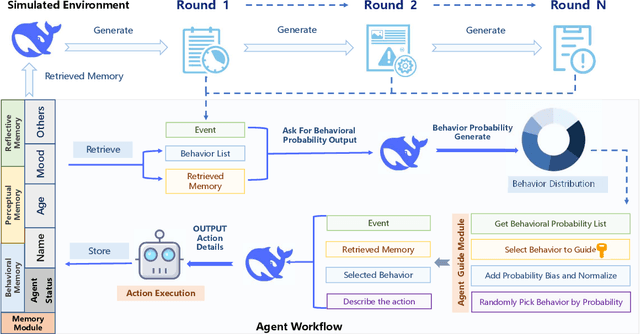
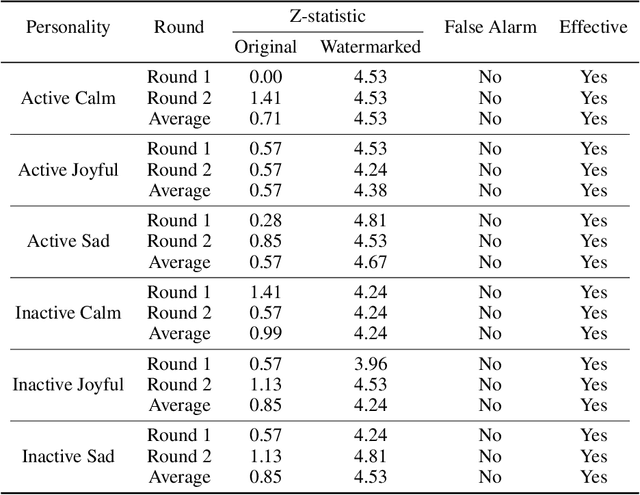
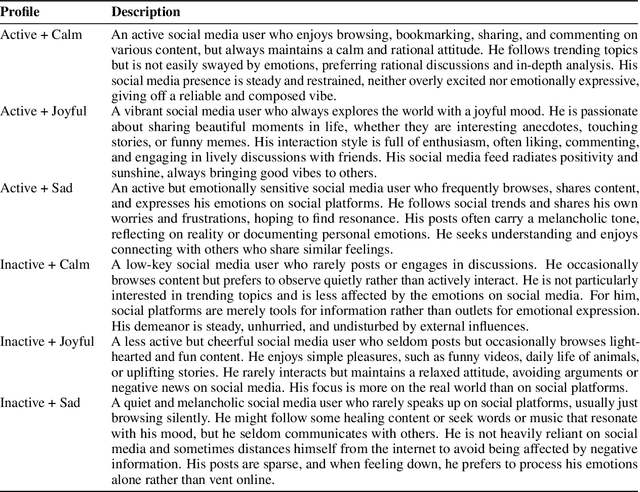
The increasing deployment of intelligent agents in digital ecosystems, such as social media platforms, has raised significant concerns about traceability and accountability, particularly in cybersecurity and digital content protection. Traditional large language model (LLM) watermarking techniques, which rely on token-level manipulations, are ill-suited for agents due to the challenges of behavior tokenization and information loss during behavior-to-action translation. To address these issues, we propose Agent Guide, a novel behavioral watermarking framework that embeds watermarks by guiding the agent's high-level decisions (behavior) through probability biases, while preserving the naturalness of specific executions (action). Our approach decouples agent behavior into two levels, behavior (e.g., choosing to bookmark) and action (e.g., bookmarking with specific tags), and applies watermark-guided biases to the behavior probability distribution. We employ a z-statistic-based statistical analysis to detect the watermark, ensuring reliable extraction over multiple rounds. Experiments in a social media scenario with diverse agent profiles demonstrate that Agent Guide achieves effective watermark detection with a low false positive rate. Our framework provides a practical and robust solution for agent watermarking, with applications in identifying malicious agents and protecting proprietary agent systems.
Reduced Spatial Dependency for More General Video-level Deepfake Detection
Mar 05, 2025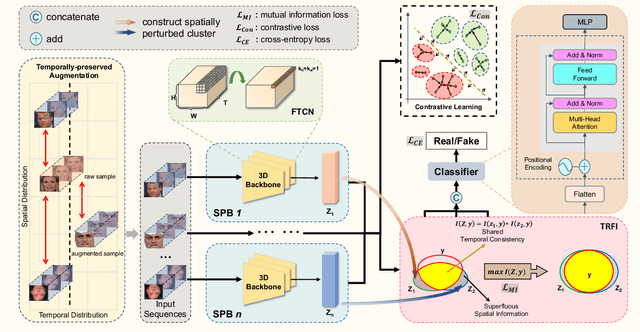
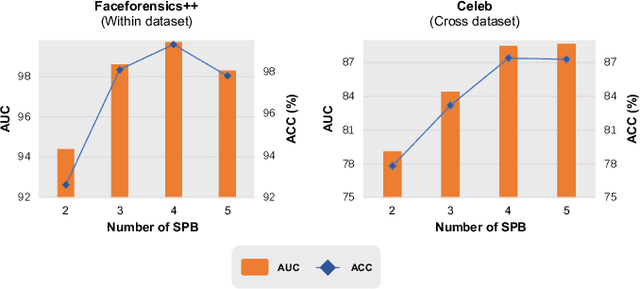
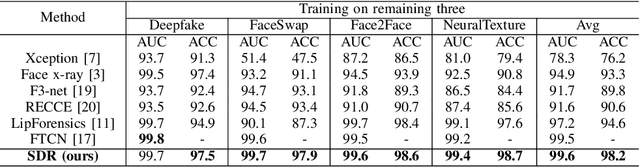
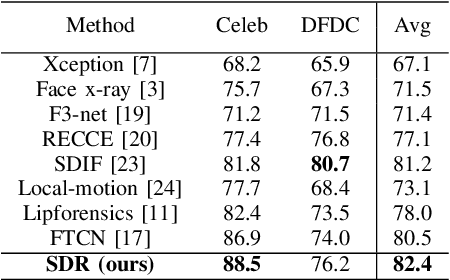
As one of the prominent AI-generated content, Deepfake has raised significant safety concerns. Although it has been demonstrated that temporal consistency cues offer better generalization capability, existing methods based on CNNs inevitably introduce spatial bias, which hinders the extraction of intrinsic temporal features. To address this issue, we propose a novel method called Spatial Dependency Reduction (SDR), which integrates common temporal consistency features from multiple spatially-perturbed clusters, to reduce the dependency of the model on spatial information. Specifically, we design multiple Spatial Perturbation Branch (SPB) to construct spatially-perturbed feature clusters. Subsequently, we utilize the theory of mutual information and propose a Task-Relevant Feature Integration (TRFI) module to capture temporal features residing in similar latent space from these clusters. Finally, the integrated feature is fed into a temporal transformer to capture long-range dependencies. Extensive benchmarks and ablation studies demonstrate the effectiveness and rationale of our approach.