 Add to Chrome
 Add to Firefox
 Add to Edge
ArborKV: Structure-Aware KV Cache Management for Scaling Tree-based LLM Reasoning
May 21, 2026
Recent progress in LLM reasoning has increasingly shifted from single-pass generation to explicit search over intermediate reasoning states. Tree-of-Thoughts (ToT) organizes inference to tree-structured search with branching and backtracking, but it substantially amplifies the Key--Value (KV) cache: retaining KV states for a frontier of partial trajectories quickly becomes a memory bottleneck that limits throughput and constrains search depth and width under fixed hardware budgets. We address this challenge by observing that KV reuse in ToT-style inference is governed by search dynamics: near-term decoding depends primarily on the active branch and its ancestors, whereas inactive subtrees have low short-term reuse probability yet must remain recoverable for backtracking. Motivated by this, we propose ArborKV, a structure-aware eviction framework that couples a lightweight value estimator with a tree-aware allocation policy, and performs purely token-extractive eviction with lazy rehydration to support revisits. Experiments on ToT-style reasoning benchmarks show that ArborKV achieves up to ~4x peak KV-memory reduction while preserving near-full-retention accuracy, enabling larger search configurations under fixed device budgets that would otherwise run out of memory.

FactorEngine: A Program-level Knowledge-Infused Factor Mining Framework for Quantitative Investment
Mar 17, 2026We study alpha factor mining, the automated discovery of predictive signals from noisy, non-stationary market data-under a practical requirement that mined factors be directly executable and auditable, and that the discovery process remain computationally tractable at scale. Existing symbolic approaches are limited by bounded expressiveness, while neural forecasters often trade interpretability for performance and remain vulnerable to regime shifts and overfitting. We introduce FactorEngine (FE), a program-level factor discovery framework that casts factors as Turing-complete code and improves both effectiveness and efficiency via three separations: (i) logic revision vs. parameter optimization, (ii) LLM-guided directional search vs. Bayesian hyperparameter search, and (iii) LLM usage vs. local computation. FE further incorporates a knowledge-infused bootstrapping module that transforms unstructured financial reports into executable factor programs through a closed-loop multi-agent extraction-verification-code-generation pipeline, and an experience knowledge base that supports trajectory-aware refinement (including learning from failures). Across extensive backtests on real-world OHLCV data, FE produces factors with substantially stronger predictive stability and portfolio impact-for example, higher IC/ICIR (and Rank IC/ICIR) and improved AR/Sharpe, than baseline methods, achieving state-of-the-art predictive and portfolio performance.
Accelerating Data Generation for Nonlinear temporal PDEs via homologous perturbation in solution space
Oct 24, 2025
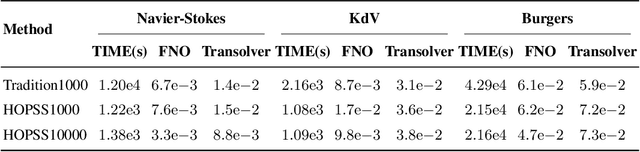
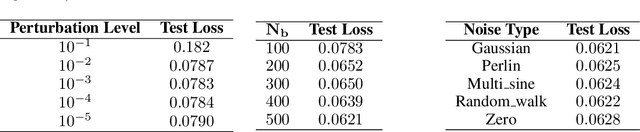
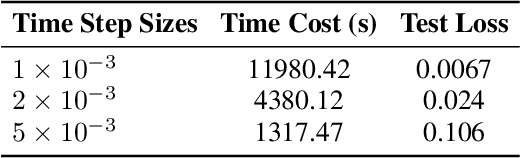
Data-driven deep learning methods like neural operators have advanced in solving nonlinear temporal partial differential equations (PDEs). However, these methods require large quantities of solution pairs\u2014the solution functions and right-hand sides (RHS) of the equations. These pairs are typically generated via traditional numerical methods, which need thousands of time steps iterations far more than the dozens required for training, creating heavy computational and temporal overheads. To address these challenges, we propose a novel data generation algorithm, called HOmologous Perturbation in Solution Space (HOPSS), which directly generates training datasets with fewer time steps rather than following the traditional approach of generating large time steps datasets. This algorithm simultaneously accelerates dataset generation and preserves the approximate precision required for model training. Specifically, we first obtain a set of base solution functions from a reliable solver, usually with thousands of time steps, and then align them in time steps with training datasets by downsampling. Subsequently, we propose a "homologous perturbation" approach: by combining two solution functions (one as the primary function, the other as a homologous perturbation term scaled by a small scalar) with random noise, we efficiently generate comparable-precision PDE data points. Finally, using these data points, we compute the variation in the original equation's RHS to form new solution pairs. Theoretical and experimental results show HOPSS lowers time complexity. For example, on the Navier-Stokes equation, it generates 10,000 samples in approximately 10% of traditional methods' time, with comparable model training performance.