 Add to Chrome
 Add to Firefox
 Add to Edge
Diagnostic Performance of Universal-Learning Ultrasound AI Across Multiple Organs and Tasks: the UUSIC25 Challenge
Dec 19, 2025
IMPORTANCE: Current ultrasound AI remains fragmented into single-task tools, limiting clinical utility compared to versatile modern ultrasound systems. OBJECTIVE: To evaluate the diagnostic accuracy and efficiency of single general-purpose deep learning models for multi-organ classification and segmentation. DESIGN: The Universal UltraSound Image Challenge 2025 (UUSIC25) involved developing algorithms on 11,644 images (public/private). Evaluation used an independent, multi-center test set of 2,479 images, including data from a center completely unseen during training to assess generalization. OUTCOMES: Diagnostic performance (Dice Similarity Coefficient [DSC]; Area Under the Receiver Operating Characteristic Curve [AUC]) and computational efficiency (inference time, GPU memory). RESULTS: Of 15 valid algorithms, the top model (SMART) achieved a macro-averaged DSC of 0.854 across 5 segmentation tasks and AUC of 0.766 for binary classification. Models showed high capability in segmentation (e.g., fetal head DSC: 0.942) but variability in complex tasks subject to domain shift. Notably, in breast cancer molecular subtyping, the top model's performance dropped from AUC 0.571 (internal) to 0.508 (unseen external center), highlighting generalization challenges. CONCLUSIONS: General-purpose AI models achieve high accuracy and efficiency across multiple tasks using a single architecture. However, performance degradation on unseen data suggests domain generalization is critical for future clinical deployment.

Flip Learning: Weakly Supervised Erase to Segment Nodules in Breast Ultrasound
Mar 27, 2025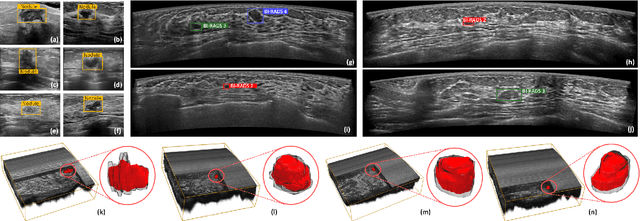
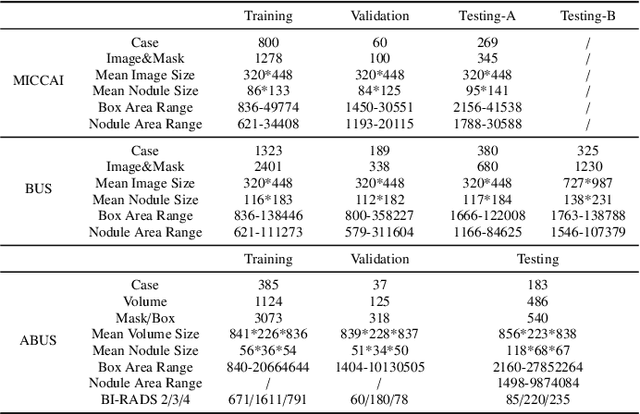
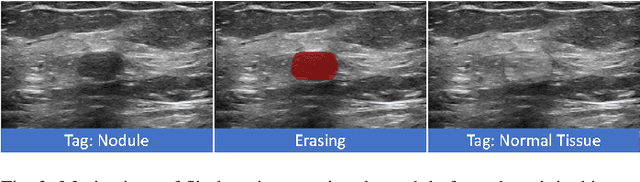
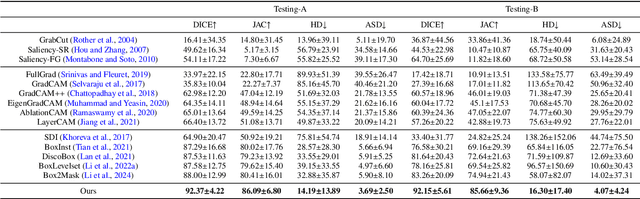
Accurate segmentation of nodules in both 2D breast ultrasound (BUS) and 3D automated breast ultrasound (ABUS) is crucial for clinical diagnosis and treatment planning. Therefore, developing an automated system for nodule segmentation can enhance user independence and expedite clinical analysis. Unlike fully-supervised learning, weakly-supervised segmentation (WSS) can streamline the laborious and intricate annotation process. However, current WSS methods face challenges in achieving precise nodule segmentation, as many of them depend on inaccurate activation maps or inefficient pseudo-mask generation algorithms. In this study, we introduce a novel multi-agent reinforcement learning-based WSS framework called Flip Learning, which relies solely on 2D/3D boxes for accurate segmentation. Specifically, multiple agents are employed to erase the target from the box to facilitate classification tag flipping, with the erased region serving as the predicted segmentation mask. The key contributions of this research are as follows: (1) Adoption of a superpixel/supervoxel-based approach to encode the standardized environment, capturing boundary priors and expediting the learning process. (2) Introduction of three meticulously designed rewards, comprising a classification score reward and two intensity distribution rewards, to steer the agents' erasing process precisely, thereby avoiding both under- and over-segmentation. (3) Implementation of a progressive curriculum learning strategy to enable agents to interact with the environment in a progressively challenging manner, thereby enhancing learning efficiency. Extensively validated on the large in-house BUS and ABUS datasets, our Flip Learning method outperforms state-of-the-art WSS methods and foundation models, and achieves comparable performance as fully-supervised learning algorithms.