 Add to Chrome
 Add to Firefox
 Add to Edge
Optimal Anchor Placement for Wireless Localization in Mixed LOS and NLOS Scenarios
Apr 01, 2026
We develop a unified Fisher-information framework for localization in environments with both Line-of-Sight (LOS) and Non-Line-of-Sight (NLOS) paths, focusing on diffraction-dominated NLOS propagation characteristic of Outdoor-to-Indoor (O2I) signal propagation. The model couples anchor geometry with a physically grounded path-loss law that is continuous across the LOS/NLOS boundary and serves as an optimization objective for our optimal anchor placement problem. As the first step, we analyze single-target anchor placement and derive the classical A-, D-, and E-optimality criteria. Under a specific path-loss assumption, these criteria collapse to a polygon-closure condition in the complex plane: A-, D-, and E-optimal designs coincide, yielding necessary and sufficient conditions for optimal placement. Next, we extend the notion of optimal anchor placement with respect to a single target to optimality over a feasible region (multi-target setting) using a general formulation that explicitly includes a realistic path loss model. This is achieved by recasting the anchor placement as a combinatorial anchor-selection problem with provable guarantees. Next, we specify E- and D-optimal objectives over multiple targets in a predefined feasible target region and show that E-optimality straddles A-optimality (within a constant factor), while D-optimality provides looser bounds. These insights yield two practical algorithms, both mixed-integer second-order cone programs (MISOCP) with exact E-optimal and exact D-optimal objectives that produce robust, region-wide designs under mixed LOS/NLOS conditions.

Full Motion State Localization with Extra Large Aperture Arrays
Mar 26, 2026Conventional localization techniques typically assume far-field (FF) propagation characterized by planar wavefronts and simplified spatial relationships. The use of higher carrier frequencies has given rise to the paradigm of extra large aperture arrays (ELAAs) which consist of a large number of tightly packed antenna elements. These arrays have a large electrical aperture which increases the Fraunhofer distance making the FF assumption restrictive. As a result, near-field (NF) effects, such as spherical wavefront curvature, direction dependent gains, and spatial variations in Doppler and delay, become significant even at distances previously regarded as FF. This paradigm shift opens up new opportunities: the rich multi-parametric structure of NF models if properly exploited can enable superior localization accuracy. In this work, we investigate the potential of multi-snapshot, full-motion state (3D position, 3D velocity, and 2D orientation) estimation using delay and Doppler measurements for a mobile receiver equipped with a linear ELAA in an environment comprising a number of wideband anchors. We develop a signal model that captures both the NF propagation geometry and spatially varying Doppler effects. We perform an information-theoretic analysis to establish Cramer-Rao lower bounds (CRLB) on the achievable position error bound (PEB), velocity error bound (VEB), and orientation error bound (OEB), respectively. We reveal that delay measurements carry richer information than Doppler measurements, and standalone Doppler measurements cannot overcome information losses due to unknown channel gains and frequency offsets, enabling only coarse estimation capabilities. We also propose a maximum-likelihood (ML) approach to jointly estimate the 8D position parameters from measured channel characteristics.
LEO-based Carrier-Phase Positioning for 6G: Design Insights and Comparison with GNSS
Mar 18, 2026The integration of non-terrestrial networks (NTN) into 5G new radio (NR) enables a new class of positioning capabilities based on cellular signals transmitted by Low-Earth Orbit (LEO) satellites. In this paper, we investigate joint delay-and-carrier-phase positioning for LEO-based NR-NTN systems and provide a convergence-centric comparison with Global Navigation Satellite Systems (GNSS). We show that the rapid orbital motion of LEO satellites induces strong temporal and geometric diversity across observation epochs, thereby improving the conditioning of multi-epoch carrier-phase models and enabling significantly faster integer-ambiguity convergence. To enable robust carrier-phase tracking under intermittent positioning reference signal (PRS) transmissions, we propose a dual-waveform design that combines wideband PRS for delay estimation with a continuous narrowband carrier for phase tracking. Using a realistic simulation framework incorporating LEO orbit dynamics, we demonstrate that LEO-based joint delay-and-carrier-phase positioning achieves cm-level accuracy with convergence times on the order of a few seconds, whereas GNSS remains limited to meter-level accuracy over comparable short observation windows. These results establish LEO-based cellular positioning as a strong complement and potential alternative to GNSS for high-accuracy positioning, navigation, and timing (PNT) services in future wireless networks.
Multistatic Radar Performance in the Presence of Distributed Wireless Synchronization
Dec 27, 2025This paper proposes a multistatic radar (MSR) system utilizing a distributed wireless synchronization protocol. The wireless synchronization protocol uses a two-tone waveform exchange for frequency synchronization and a bi-directional waveform exchange for time synchronization, independent of GPS. A Bayesian Cramer-Rao lower bound (BCRLB) framework is developed to quantify the impact of synchronization offsets on joint delay and Doppler estimation, and consequently, on target localization and velocity estimation accuracy. Simulation results derived from the analytical expressions establish the extent to which the residual synchronization offsets degrade the MSR's performance. The performance of the synchronization links primarily depends on the synchronization-link channel and transmit parameters; optimizing these parameters enables the MSR configuration to surpass the monostatic performance and approach the ideal case. Furthermore, the simulated synchronization-link parameters suggest that practical implementation is feasible.
Neural Network-Assisted RIS Weight Optimization for Spatial Nulling in Distorted Reflector Antenna Systems
Dec 24, 2025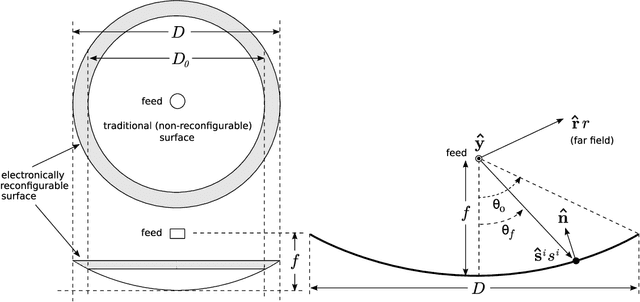
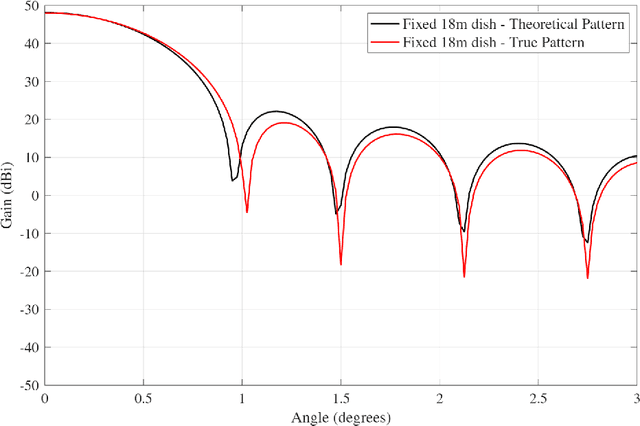
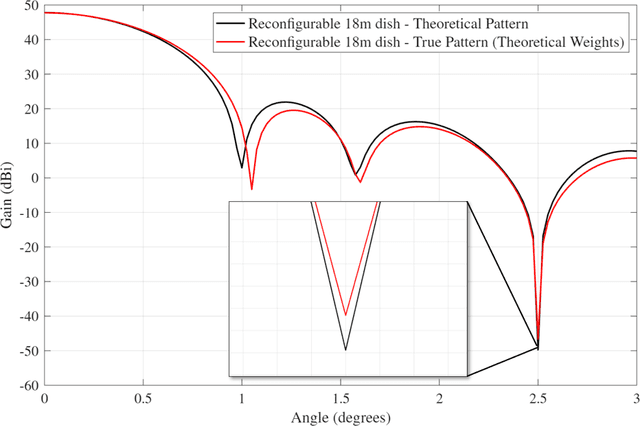
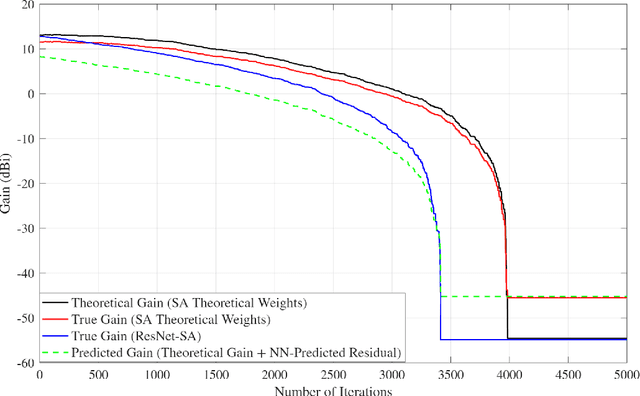
Reconfigurable intelligent surfaces (RIS) have recently been proposed as an effective means for spatial interference suppression in large reflector antenna systems. Existing RIS weight optimization algorithms typically rely on accurate theoretical radiation models. However, in practice, distortions on the reflector antenna may cause mismatches between the theoretical and true antenna patterns, leading to degraded interference cancellation performance when these weights are directly applied. In this report, a residual learning network-assisted simulated annealing (ResNet-SA) framework is proposed to address this mismatch without requiring explicit knowledge of the distorted electric field. By learning the residual difference between the theoretical and true antenna gains, a neural network (NN) is embedded in a heuristic optimization algorithm to find the optimal weight vector. Simulation results demonstrate that the proposed approach achieves improved null depth in the true radiation pattern as compared with conventional methods that optimize weights based solely on the theoretical model, validating the effectiveness of the ResNet-SA algorithm for reflector antenna systems with approximate knowledge of the pattern.
On the Limits of Coherent Time-Domain Cancellation of Radio Frequency Interference
Dec 20, 2025In many sensing (viz., radio astronomy) and radar applications, the received signal of interest (SOI) exhibits a significantly wider bandwidth or weaker power than the interference signal, rendering it indistinguishable from the background noise. Such scenarios arise frequently in applications such as passive radar, cognitive radio, low-probability-of-intercept (LPI) radar, and planetary radar for radio astronomy, where canceling the radio frequency interference (RFI) is critical for uncovering the SOI. In this work, we examine the Demodulation-Remodulation (Demod-Remod) based interference cancellation framework for the RFI. This approach demodulates the unknown interference, creates a noise-free interference replica, and coherently subtracts it from the received signal. To evaluate the performance limits, we employ the performance metric termed \textit{interference rejection ratio} (IRR), which quantifies the interference canceled. We derive the analytical expressions of IRR as a function of the optimal estimation variances of the signal parameters. Simulation results confirm the accuracy of the analytical expression for both single-carrier and multi-carrier interference signals and demonstrate that the method can substantially suppress the interference at a sufficient interference-to-noise ratio (INR), enabling enhanced detection and extraction of the SOI. We further extend the analysis to the scenario where the SOI is above the noise floor, and confirm the validity of the theoretical IRR expression in this scenario. Lastly, we compare the Demod-Remod technique to other time-domain cancellation methods. The result of the comparison identifies the conditions under which each method is preferred, offering practical guidelines for interference mitigation under different scenarios.
RIS-Aided Spatial Nulling: Algorithms, Analysis, and Nulling Limits
Dec 20, 2025Reconfigurable Intelligent Surfaces (RIS) have recently gained attention as a means to dynamically shape the wireless propagation environment through programmable reflection control. Among the numerous applications, an important emerging use case is employing RIS as an auxiliary mechanism for spatial interference nulling, particularly in large ground-based reflector antennas where sidelobe interference can significantly degrade the system performance. With the growing density of satellites and terrestrial emitters, algorithms with faster convergence speed and better performance are needed. This work investigates RIS-equipped reflector antennas as a representative example of RIS-assisted spatial nulling and develop algorithms for sidelobe cancellation at specific directions and frequencies under various constraints. For the continuous-phase case, we adapt the gradient projection (GP) and alternating projection (AP) algorithms for scalability and propose a closed-form near-optimal solution that achieves satisfactory nulling performance with significantly reduced complexity. For the discrete-phase case, we reformulate the problem using a penalty method and solve it via majorization-minimization, outperforming the heuristic methods from our earlier work. Further, we analyze the electric field characteristics across multiple interference directions and frequencies to quantify the nulling capability of the RIS-aided reflectors, and identify a simple criterion for the existence of unimodular weights enabling perfect nulls. Simulation results demonstrate the effectiveness of the proposed methods and confirm the theoretical nulling limits.
Interference Mitigation using U-Net Autoencoder based system
Dec 15, 2025This paper proposes a U-Net-based autoencoder framework for mitigating interference in communication signals corrupted by noise and diverse interference sources. The approach targets scenarios involving both signal-plus-noise and signal-plus-interference-plus-noise mixtures, including sinusoidal interferers, LFM chirps, QPSK interferers with different sampling rates, and modulated interference such as QAM. The U-Net architecture leverages multiscale feature extraction and skip connections to preserve fine-grained temporal structure while suppressing interference components. Performance is evaluated using bit error rate and compared against conventional cancellation methods. Results show that the proposed method consistently outperforms traditional techniques in low- and mid-SIR regimes, while remaining competitive at high SIRs. Additional experiments examine the autoencoder's behavior under model mismatch conditions such as carrier offset and colored noise. The study demonstrates that multiscale neural architectures provide a flexible and effective platform for interference mitigation across a wide range of interference types.
On the Ability of Deep Learning to Detect Signals with Unknown Parameters
Dec 15, 2025In many signal processing applications, including communications, sonar, radar, and localization, a fundamental problem is the detection of a signal of interest in background noise, known as signal detection [1] [2]. A simple version of this problem is the detection of a signal of interest with unknown parameters in Additive White Gaussian Noise (AWGN). When the parameters defining the signal are not known, an optimal detector (in the Neyman-Pearson sense) does not exist. An upper bound on the performance of any detector is the matched filter, which implies perfect sample by sample knowledge of the signal of interest. In recent years Deep Neural Networks (DNNs) have proven to be very effective at hypothesis testing problems such as object detection and image classification. This paper examines the application of DNN-based approaches to the signal detection problem at the raw I/Q level and compares them to statistically based approaches as well as the Matched Filter. These methods aim to maximize the Probability of Detection Pd while maintaining a constant Probability of False Alarm PF A. Two Machine Learning (ML) algorithms are trained and assessed on this signal detection problem, across three signal of interest models. A model was also trained on a unified dataset and assessed across all signals of interest.
Interference Mitigation Recommender System using U-Net Autoencoders
Dec 15, 2025Building on the previous work on interference mitigation, this paper introduces a modular recommender system that automatically selects the most effective interference mitigation strategy based on the interference characteristics present in the received signal. The system integrates three key stages: an SPS classifier module, a SIR predictor, and a bank of specialized U-Net autoencoders designed for different interference conditions. The classification block identifies the parameters required for cancellation. The recommender then directs the signal to the appropriate mitigation model, optionally incorporating SIR-based decisions for scenarios where successive interference cancellation may be advantageous. Experiments conducted across diverse SIR levels and modulation environments show that the recommender strategy improves robustness and reduces BER compared to using any single mitigation method alone. The results demonstrate the potential of adaptive, model-selective architectures to enhance interference resilience in dynamic communication environments.