 Add to Chrome
 Add to Firefox
 Add to Edge
CGFormer: A Cross-Attention Based Grid-Free Transformer for Radio Map Estimation
Mar 22, 2026
Radio map estimation (RME), which predicts wireless signal metrics at unmeasured locations from sparse measurements, has attracted growing attention as a key enabler of intelligent wireless networks. The majority of existing RME techniques employ grid-based strategies to process sparse measurements, where the pursuit of accuracy results in significant computational inefficiency and inflexibility for off-grid prediction. In contrast, grid-free approaches directly exploit coordinate features to capture location-specific spatial dependencies, enabling signal prediction at arbitrary locations without relying on predefined grids. However, current grid-free approaches demand substantial preprocessing overhead for constructing the spatial representation, leading to high complexity and constrained adaptability. To address these limitations, this paper proposes a novel cross-attention grid-free based transformer model for RME. We introduce a lightweight spatial embedding module that incorporates environmental knowledge into high-dimensional feature construction. A cross-attention transformer then models the spatial correlation between target and measurement points. The simulation results demonstrate that our proposed method reduces RMSE by up to 6%, outperforming grid-based and gridfree baselines.

DP-LET: An Efficient Spatio-Temporal Network Traffic Prediction Framework
Apr 04, 2025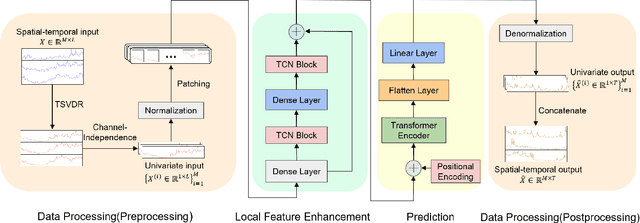
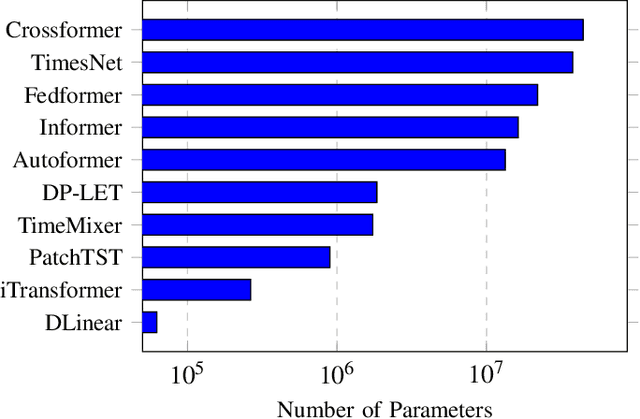


Accurately predicting spatio-temporal network traffic is essential for dynamically managing computing resources in modern communication systems and minimizing energy consumption. Although spatio-temporal traffic prediction has received extensive research attention, further improvements in prediction accuracy and computational efficiency remain necessary. In particular, existing decomposition-based methods or hybrid architectures often incur heavy overhead when capturing local and global feature correlations, necessitating novel approaches that optimize accuracy and complexity. In this paper, we propose an efficient spatio-temporal network traffic prediction framework, DP-LET, which consists of a data processing module, a local feature enhancement module, and a Transformer-based prediction module. The data processing module is designed for high-efficiency denoising of network data and spatial decoupling. In contrast, the local feature enhancement module leverages multiple Temporal Convolutional Networks (TCNs) to capture fine-grained local features. Meanwhile, the prediction module utilizes a Transformer encoder to model long-term dependencies and assess feature relevance. A case study on real-world cellular traffic prediction demonstrates the practicality of DP-LET, which maintains low computational complexity while achieving state-of-the-art performance, significantly reducing MSE by 31.8% and MAE by 23.1% compared to baseline models.