 Add to Chrome
 Add to Firefox
 Add to Edge
Wuying-Browser-Agent: Real-World Centric Fundamental Long-Horizon Browser Agents
Aug 18, 2026
Browser agents perform well on short, clean demonstrations, but real deployment is fundamentally different: agents must sustain dozens of decisions on live websites while recovering from mistakes and navigating complex UIs. We argue that closing this gap requires alignment at every level of the pipeline, including execution, supervision, optimization, and evaluation, rather than scale alone. We present Wuying-Browser-Agent, a unified framework that addresses each of these levels. A structured browser harness provides stable execution primitives and decision-oriented context management. Reflection and UI-specialized Curriculum SFT (RUIC-SFT) explicitly trains on recovery trajectories and complex-UI interactions. Divergence-Aware Online GRPO (DAO-GRPO) improves long-horizon credit assignment through potential-based reward shaping and divergence-aware step weighting. Finally, we introduce BrowserBench, a bilingual real-web benchmark of 350 tasks averaging 37.9 steps, because most existing benchmarks are too short to expose long-horizon failure modes. Wuying-Browser-Agent-27B achieves 80.6\% on WebVoyager, 66.7\% on Online-Mind2Web, and 65.1\% on BrowserBench, establishing a new open-source state of the art on browser-use benchmarks. The same pipeline also transfers beyond browser use, demonstrating strong general agentic ability and reaching an average score of 73.8 on Tau2-Bench, Claw-Eval, and BFCL-v4.

D4: a Chinese Dialogue Dataset for Depression-Diagnosis-Oriented Chat
May 24, 2022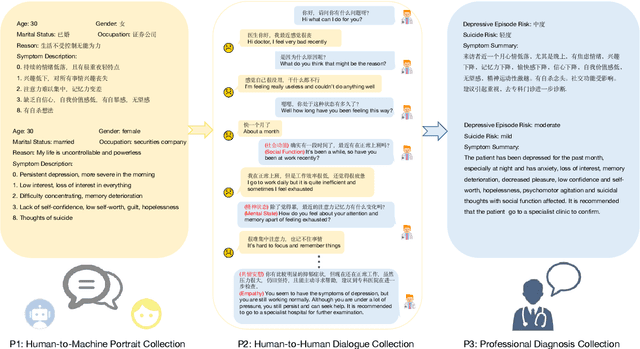
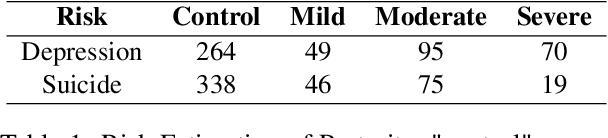
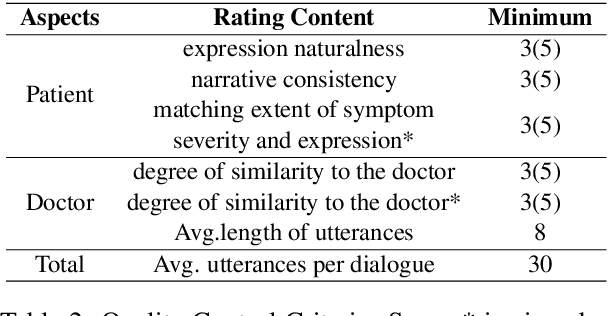
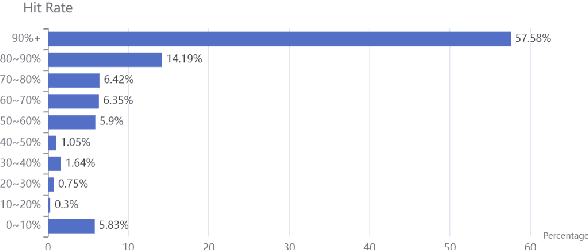
In a depression-diagnosis-directed clinical session, doctors initiate a conversation with ample emotional support that guides the patients to expose their symptoms based on clinical diagnosis criteria. Such a dialog is a combination of task-oriented and chitchat, different from traditional single-purpose human-machine dialog systems. However, due to the social stigma associated with mental illness, the dialogue data related to depression consultation and diagnosis are rarely disclosed. Though automatic dialogue-based diagnosis foresees great application potential, data sparsity has become one of the major bottlenecks restricting research on such task-oriented chat dialogues. Based on clinical depression diagnostic criteria ICD-11 and DSM-5, we construct the D$^4$: a Chinese Dialogue Dataset for Depression-Diagnosis-Oriented Chat which simulates the dialogue between doctors and patients during the diagnosis of depression, including diagnosis results and symptom summary given by professional psychiatrists for each dialogue.Finally, we finetune on state-of-the-art pre-training models and respectively present our dataset baselines on four tasks including response generation, topic prediction, dialog summary, and severity classification of depressive episode and suicide risk. Multi-scale evaluation results demonstrate that a more empathy-driven and diagnostic-accurate consultation dialogue system trained on our dataset can be achieved compared to rule-based bots.