 Add to Chrome
 Add to Firefox
 Add to Edge
Dynamics-Aware Meta-Imitation for Generalization to Unseen Robotic Manipulation
Jul 17, 2026
Imitation Learning aims to learn skills from extensive observations and demonstrations for robots, so it suffers from data scarcity and environment generalization. The existing methods predominantly focus on imitation from in-domain tasks and consequently struggle with generalization to unseen tasks. To bridge this generalization gap, we propose the \textbf{D}ynamics-\textbf{A}ware \textbf{M}eta-\textbf{I}mitation (DAMI) framework. By integrating meta-learning to construct a shared skill space, DAMI equips agents for rapid adaptation to novel tasks. We introduce the Visual-Motor Trajectory (VMT) module to capture complex spatio-temporal dynamics within the task latent space. Furthermore, we propose the Unpaired Unified Task (U2T) block to fuse unstructured multimodal observations. To coordinate these representations, we integrate a Task-Conditioned Feature Modulation (TCFM) mechanism customized for modulating low-level 3D features. By capturing intrinsic dynamics from a random complete reference demonstration, our framework learns the underlying task logic rather than memorizing static cues, ensuring effective generalization. Extensive experiments in both simulation and real-world settings demonstrate that our approach outperforms state-of-the-art baselines regarding direct inference on seen tasks and adaptation to unseen tasks via few-shot fine-tuning.

LEEVLA: Seeing What Matters in Latent Environment Evolution for Vision-Language-Action
Jul 09, 2026Vision-language-action (VLA) models aim to map multimodal inputs to robot actions. However, most existing approaches struggle to cover complex dynamic scenarios due to treating all visual tokens uniformly and reasoning with human-selected factors, which lack mechanisms to emphasize task-critical evidence and ignore underlying factors. To address this issue, we propose LEEVLA, a VLA architecture for seeing what matters in Latent Environment Evolution that explicitly guides the model toward informative regions while preserving the structured evolution of latent world representations. To identify salient and instruction-relevant regions, we introduce drift-guided dynamic prioritization (DGDP), which combines dynamic position prioritization (DPP) with semantic drift guidance (SDG) to guide the VLA agent where to attend during training. On top of this, we introduce structured feature flow generation (SFFG), which models how these prioritized features should evolve in latent space via prototype-to-periphery (P2P) prediction, and a mutual-neighborhood contrastive (MC) loss to maintain topological consistency among neighborhoods. Together, DGDP and SFFG form a task-aware "where-how" training framework. Extensive experiments on VLA benchmarks show that LEEVLA consistently outperforms prior methods, confirming that explicit task-evidence guidance and structured latent reasoning are both crucial for scalable VLA. Our code is available at https://github.com/LyuQi127/LEEVLA.
SAB-LVLM: Significance-Aware Binarization for Large Vision-Language Models
Jul 02, 2026Large Vision-Language Models (LVLMs) have achieved remarkable progress in multimodal understanding, yet their enormous parameter scale and cross-modal computation incur substantial memory and latency overhead, severely limiting real-world deployment on resource-constrained devices. Binarization offers an attractive solution by drastically reducing storage and computational costs. However, existing binarization methods neglect the varying importance of weights across different layers and modalities. This causes parameters irrelevant to downstream tasks to be unnecessarily retained, whereas modality-critical weights may not be adequately optimized, resulting in significant performance degradation. To address these challenges, we develop a novel \underline{S}ignificance-\underline{A}ware \underline{B}inarization for \underline{L}arge \underline{V}ision-\underline{L}anguage \underline{M}odels (SAB-LVLM). Specifically, after constructing Hessian matrices for textual and visual inputs, we propose a spatial significance map to distinguish full-precision weights activated under a single modality from those activated across modalities. We then devise a modality-guided integration strategy to obtain the significance-aware binarization map, which measures weight significance across layers and modalities. Subsequently, this binarization map is incorporated into the binarization objective as an error reweighting term, and binarization fitting is performed through an alternating significance-weighted update scheme. Extensive experiments illustrate the superiority of our SAB-LVLM over existing binary PTQ methods under an approximately 1-bit compression constraint. Our code is accessible at https://github.com/LyuQi127/SAB_LVLM.
Seeing Before Reasoning: Decoupling Perception and Reasoning for Shortcut-Resilient Multimodal On-Policy Self-Distillation
Jun 17, 2026On-policy self-distillation (OPSD) trains a model on its own rollouts and uses a frozen copy to provide dense token-level targets conditioned on a reference target. This works well for LLM reasoning, but a direct extension to multimodal large language models (MLLMs) can create a shortcut: the privileged target may guide tokens mainly based on the text reference target rather than the image. We propose ViGOS, a visually grounded OPSD framework for MLLM post-training. The student first writes a visual description and then reasons toward the final answer. For valid rollouts, an image-only perception teacher supervises the description, while a privileged reasoning teacher supervises the reasoning and final answer on the same student prefix. A reference teacher is used only for invalid rollouts to recover the output format. Across general vision-language, expert reasoning, visual math, spatial grounding, and visual-language-prior benchmarks, ViGOS keeps the main benefits of OPSD and improves image-grounded behavior in shortcut-prone settings.
All-day Multi-scenes Lifelong Vision-and-Language Navigation with Tucker Adaptation
Mar 15, 2026Deploying vision-and-language navigation (VLN) agents requires adaptation across diverse scenes and environments, but fine-tuning on a specific scenario often causes catastrophic forgetting in others, which severely limits flexible long-term deployment. We formalize this challenge as the all-day multi-scenes lifelong VLN (AML-VLN) problem. Existing parameter-efficient adapters (e.g., LoRA and its variants) are limited by their two-dimensional matrix form, which fails to capture the multi-hierarchical navigation knowledge spanning multiple scenes and environments. To address this, we propose Tucker Adaptation (TuKA), which represents the multi-hierarchical navigation knowledge as a high-order tensor and leverages Tucker decomposition to decouple the knowledge into shared subspaces and scenario-specific experts. We further introduce a decoupled knowledge incremental learning strategy to consolidate shared subspaces while constraining specific experts for decoupled lifelong learning. Building on TuKA, we also develop a VLN agent named AlldayWalker, which continually learns across multiple navigation scenarios, achieving all-day multi-scenes navigation. Extensive experiments show that AlldayWalker consistently outperforms state-of-the-art baselines.
Lifelong Language-Conditioned Robotic Manipulation Learning
Mar 05, 2026Traditional language-conditioned manipulation agent sequential adaptation to new manipulation skills leads to catastrophic forgetting of old skills, limiting dynamic scene practical deployment. In this paper, we propose SkillsCrafter, a novel robotic manipulation framework designed to continually learn multiple skills while reducing catastrophic forgetting of old skills. Specifically, we propose a Manipulation Skills Adaptation to retain the old skills knowledge while inheriting the shared knowledge between new and old skills to facilitate learning of new skills. Meanwhile, we perform the singular value decomposition on the diverse skill instructions to obtain common skill semantic subspace projection matrices, thereby recording the essential semantic space of skills. To achieve forget-less and generalization manipulation, we propose a Skills Specialization Aggregation to compute inter-skills similarity in skill semantic subspaces, achieving aggregation of the previously learned skill knowledge for any new or unknown skill. Extensive experiments demonstrate the effectiveness and superiority of our proposed SkillsCrafter.
SeqWalker: Sequential-Horizon Vision-and-Language Navigation with Hierarchical Planning
Jan 08, 2026Sequential-Horizon Vision-and-Language Navigation (SH-VLN) presents a challenging scenario where agents should sequentially execute multi-task navigation guided by complex, long-horizon language instructions. Current vision-and-language navigation models exhibit significant performance degradation with such multi-task instructions, as information overload impairs the agent's ability to attend to observationally relevant details. To address this problem, we propose SeqWalker, a navigation model built on a hierarchical planning framework. Our SeqWalker features: i) A High-Level Planner that dynamically selects global instructions into contextually relevant sub-instructions based on the agent's current visual observations, thus reducing cognitive load; ii) A Low-Level Planner incorporating an Exploration-Verification strategy that leverages the inherent logical structure of instructions for trajectory error correction. To evaluate SH-VLN performance, we also extend the IVLN dataset and establish a new benchmark. Extensive experiments are performed to demonstrate the superiority of the proposed SeqWalker.
CRISP: Contrastive Residual Injection and Semantic Prompting for Continual Video Instance Segmentation
Aug 14, 2025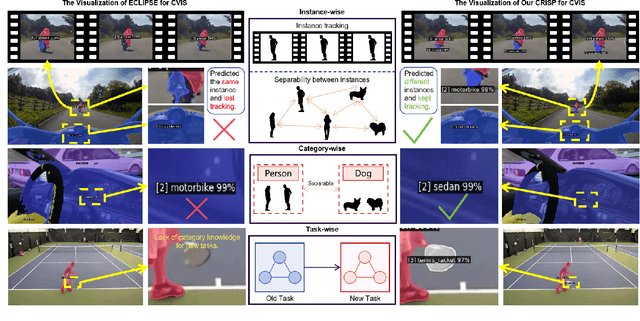
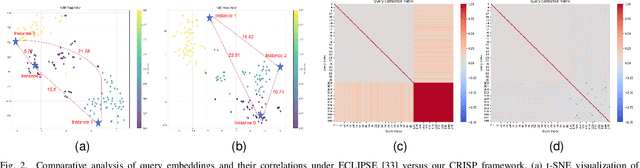
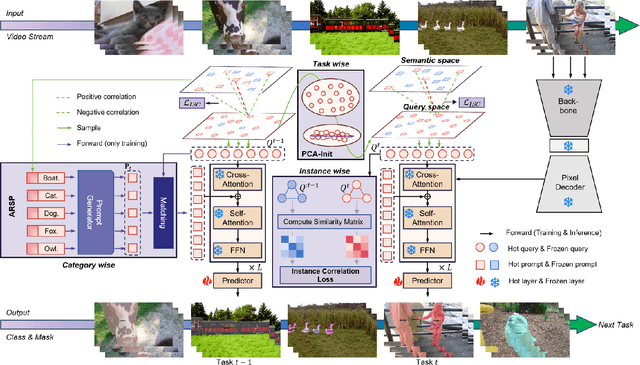
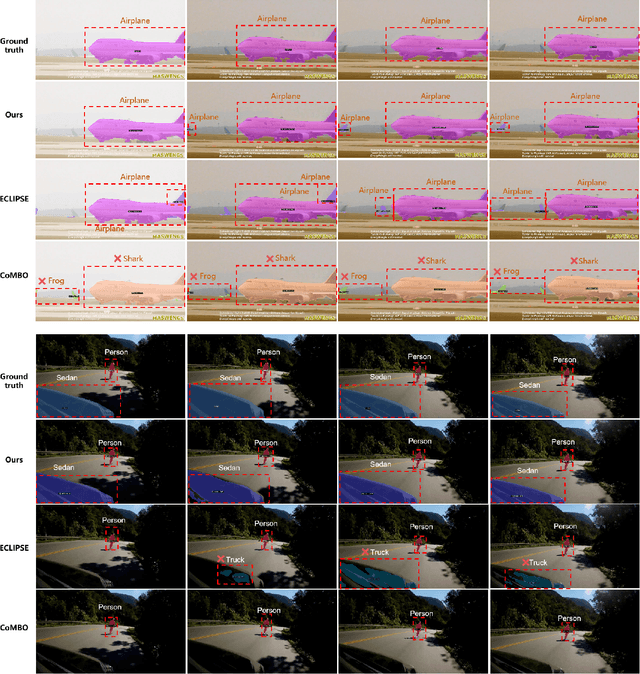
Continual video instance segmentation demands both the plasticity to absorb new object categories and the stability to retain previously learned ones, all while preserving temporal consistency across frames. In this work, we introduce Contrastive Residual Injection and Semantic Prompting (CRISP), an earlier attempt tailored to address the instance-wise, category-wise, and task-wise confusion in continual video instance segmentation. For instance-wise learning, we model instance tracking and construct instance correlation loss, which emphasizes the correlation with the prior query space while strengthening the specificity of the current task query. For category-wise learning, we build an adaptive residual semantic prompt (ARSP) learning framework, which constructs a learnable semantic residual prompt pool generated by category text and uses an adjustive query-prompt matching mechanism to build a mapping relationship between the query of the current task and the semantic residual prompt. Meanwhile, a semantic consistency loss based on the contrastive learning is introduced to maintain semantic coherence between object queries and residual prompts during incremental training. For task-wise learning, to ensure the correlation at the inter-task level within the query space, we introduce a concise yet powerful initialization strategy for incremental prompts. Extensive experiments on YouTube-VIS-2019 and YouTube-VIS-2021 datasets demonstrate that CRISP significantly outperforms existing continual segmentation methods in the long-term continual video instance segmentation task, avoiding catastrophic forgetting and effectively improving segmentation and classification performance. The code is available at https://github.com/01upup10/CRISP.
K2MUSE: A human lower limb multimodal dataset under diverse conditions for facilitating rehabilitation robotics
Apr 20, 2025The natural interaction and control performance of lower limb rehabilitation robots are closely linked to biomechanical information from various human locomotion activities. Multidimensional human motion data significantly deepen the understanding of the complex mechanisms governing neuromuscular alterations, thereby facilitating the development and application of rehabilitation robots in multifaceted real-world environments. However, currently available lower limb datasets are inadequate for supplying the essential multimodal data and large-scale gait samples necessary for effective data-driven approaches, and they neglect the significant effects of acquisition interference in real applications.To fill this gap, we present the K2MUSE dataset, which includes a comprehensive collection of multimodal data, comprising kinematic, kinetic, amplitude-mode ultrasound (AUS), and surface electromyography (sEMG) measurements. The proposed dataset includes lower limb multimodal data from 30 able-bodied participants walking under different inclines (0$^\circ$, $\pm$5$^\circ$, and $\pm$10$^\circ$), various speeds (0.5 m/s, 1.0 m/s, and 1.5 m/s), and different nonideal acquisition conditions (muscle fatigue, electrode shifts, and inter-day differences). The kinematic and ground reaction force data were collected via a Vicon motion capture system and an instrumented treadmill with embedded force plates, whereas the sEMG and AUS data were synchronously recorded for thirteen muscles on the bilateral lower limbs. This dataset offers a new resource for designing control frameworks for rehabilitation robots and conducting biomechanical analyses of lower limb locomotion. The dataset is available at https://k2muse.github.io/.
CAD-Mesher: A Convenient, Accurate, Dense Mesh-based Mapping Module in SLAM for Dynamic Environments
Aug 12, 2024Most LiDAR odometry and SLAM systems construct maps in point clouds, which are discrete and sparse when zoomed in, making them not directly suitable for navigation. Mesh maps represent a dense and continuous map format with low memory consumption, which can approximate complex structures with simple elements, attracting significant attention of researchers in recent years. However, most implementations operate under a static environment assumption. In effect, moving objects cause ghosting, potentially degrading the quality of meshing. To address these issues, we propose a plug-and-play meshing module adapting to dynamic environments, which can easily integrate with various LiDAR odometry to generally improve the pose estimation accuracy of odometry. In our meshing module, a novel two-stage coarse-to-fine dynamic removal method is designed to effectively filter dynamic objects, generating consistent, accurate, and dense mesh maps. To our best know, this is the first mesh construction method with explicit dynamic removal. Additionally, conducive to Gaussian process in mesh construction, sliding window-based keyframe aggregation and adaptive downsampling strategies are used to ensure the uniformity of point cloud. We evaluate the localization and mapping accuracy on five publicly available datasets. Both qualitative and quantitative results demonstrate the superiority of our method compared with the state-of-the-art algorithms. The code and introduction video are publicly available at https://yaepiii.github.io/CAD-Mesher/.