 Add to Chrome
 Add to Firefox
 Add to Edge
CoAdapt-GUI: Joint Workflow Context and Policy Adaptation for Unseen GUI Applications
Aug 12, 2026
Mobile GUI agents remain brittle when deployed to applications absent from source training. We study novel-app generalization under a limited target interaction budget and without target demonstrations. We introduce CoAdapt-GUI, a test-time adaptation (TTA) framework that jointly adapts structured workflow context and policy from the agent's own target-app rollouts and rewards. The workflow context retains transferable procedures, failure modes, and verification rules while excluding app-bound source details. This separation allows reusable workflow knowledge to guide adaptation without transferring source-interface state. For policy adaptation, task-context-matched group-relative optimization updates a LoRA adapter on a frozen vision-language model. Across two unseen-app evaluations, CoAdapt-GUI reaches 45.0% on AndroidWorld-Generalization, compared with 37.5% for the reported Policy-Only TTA baseline, and raises AndroidWorld Plus performance from 38.6% to 52.9%. These results show that transfer-constrained workflow context provides substantial gains and that joint policy adaptation further improves held-out performance.

From Visual Widgets to UI Code: Efficient Tool-Grounded Generation
Aug 12, 2026Existing screenshot-to-code systems face a trade-off between flexibility and controllability. Direct multimodal generation can hallucinate visible details, whereas structured pipelines reduce such errors through component-wise decomposition, predefined templates, and customized intermediate representations. These structures, however, introduce additional generative orchestration and restrict outputs to designs covered by the representation. We investigate whether selective tool grounding can improve the fidelity--efficiency trade-off of direct widget-to-code generation. We introduce \textbf{WidgetGen}, a lightweight tool-grounded framework that extracts observable text and color evidence, performs high-level layout and optional chart reasoning, and directly generates executable JavaScript XML (\emph{JSX}). This design reduces reliance on component-wise generation while avoiding a fixed UI schema. Across six multimodal models and \(1{,}000\) held-out widgets, WidgetGen outperforms direct prompting and the structured Widget2Code pipeline on most visual reconstruction metrics, with consistent gains in area, legibility, and style. Finally, reconstruction-derived image-code pairs improve six Qwen-family open-weight models across every reported metric through supervised fine-tuning. These results establish WidgetGen as a strong lightweight baseline and show that selective evidence grounding offers an effective alternative to extensive representation constraints.
Benchmarking LLM Judges for Mobile Agent Evaluation
Aug 11, 2026Mobile agent benchmarks increasingly rely on LLM-based judges to evaluate task completion, yet the reliability of these judges on mobile agent trajectories remains largely unexamined. We introduce MobileJudgeBench, a benchmark for systematically evaluating LLM-as-judge methods on mobile agent trajectories. Our benchmark comprises 931 human-annotated trajectories spanning 6 mobile agent benchmarks, 4 agent models, and 68 apps. We evaluate 6 judge methods (five adapted from SPA-Bench, A3 with two modes, AndroidArena, and AgentRewardBench, plus a simple baseline we design) across multiple LLM backends. Our experiments reveal three key findings. First, a simple baseline judge with sampled screenshots is competitive with, and often exceeds, purpose-built methods, indicating that more elaborate judge pipelines do not consistently improve judge quality; among competitive methods, the LLM backbone is the primary driver. Second, benchmark quality metrics reliably predict real-world judge utility: they correlate with both agent ranking fidelity for evaluation and downstream performance when judges serve as reward signals for on-policy reinforcement learning. Third, failure analysis across two LLM backends uncovers qualitatively opposite failure profiles, one conservative and the other permissive, linked to the backbone's precision-recall characteristics.
StepReflect: Structured UI Transition Reflection for Mobile GUI Agents
Aug 06, 2026Autonomous mobile GUI agents require accurate action reflection for reliable long-horizon execution. Existing approaches rely on open-ended multimodal reasoning after each action, which is costly and poorly matched to the structured nature of GUI state transitions. We propose StepReflect, which formulates per-step GUI reflection as supervised structured prediction conditioned on explicit transition specifications and paired visual evidence. StepReflect is trained through a staged pipeline combining supervised fine-tuning, teacher-student distillation, and preference- and reward-based refinement. Offline, the resulting 8B model achieves 82.16% transition-level accuracy on AndroidWorld, exceeding zero-shot GPT-5.2 by 11.83 percentage points under the same structured input. Online, across M3A, Agent-SAMA, MAI-UI-8B, and Seed-2.0-Pro, StepReflect achieves higher task success in three of four agent configurations and remains within one successful task of the GPT-5.2 Reflection Agent in the fourth. It also reduces paid API charges relative to GPT-based reflection in all four configurations. These results establish StepReflect as a practical, locally deployable alternative to repeated frontier-model reflection for long-horizon mobile GUI agents.
DA-MergeLoRA: Hypernetwork-Based LoRA Merging for Few-Shot Test-Time Domain Adaptation
Jul 20, 2026Few-shot Test-Time Domain Adaptation (FSTT-DA) seeks to adapt models to novel domains using only a handful of unlabeled target samples. This setting is more realistic than typical domain adaptation setups, which assume access to target data during source training. However, prior FSTT-DA approaches fail to effectively leverage source domain-specific knowledge, relying on shallow batch normalization updates, prompt-based methods that treat the model as a black box, or ensembling strategies that do not capture cross-domain relationships. To address these limitations, we introduce a new FSTT-DA framework that integrates LoRA fine-tuning with model merging. In our approach, separate LoRA modules are fine-tuned on CLIP's vision encoder for each source domain. Since LoRA modifies only a small fraction of the model's parameters, it retains the base model's generalized knowledge while internally learning domain-specific features. To adapt the learned knowledge to a specific target domain, we propose a hypernetwork trained via meta-learning that generates per-column merging factors to combine LoRA modules. Given a small batch of target images, the hypernetwork produces merging weights that fuse source LoRA modules into a single adapted representation. Our results demonstrate state-of-the-art performance across various domain adaptation datasets. Our code is publicly available at https://github.com/nahbois4321/DA-MergeLoRA.
Beyond the GUI Paradigm: Do Mobile Agents Need the Phone Screen?
Jun 16, 2026Recent advances in mobile agents are dominated by the GUI paradigm, in which agents perceive UI information and emit screen interactions. However, mobile platforms also expose a command-line interface (CLI) that provides direct access to device services and data. We argue CLI deserves first-class consideration alongside GUI. We evaluate three coding agents (Claude Code, Terminus-2, mini-swe-agent) across four model APIs on AndroidWorld and MobileWorld without any mobile-specific post-training, comparing against three reproducible GUI baselines (GUI-Owl-1.5-32B, MAI-UI, Qwen3-VL-32B). Claude Code (Opus 4.7) reaches 71.8\% and 51.9\%, outperforming every reproducible GUI baseline (69.3/68.1/57.8\% on AndroidWorld; 43.2/26.3/13.3\% on MobileWorld), while every other CLI configuration remains competitive. To establish the paradigm's ceiling, we provide oracle CLI solutions that reach 88.8\% on AndroidWorld (103/116 tasks CLI-solvable) and 86.3\% on MobileWorld (101/117 tasks CLI-solvable), indicating substantial room for future improvement. To cover everyday user intents beyond the GUI scope, we introduce the \textbf{CLI-Advantage Task Suite}, comprising 45 templates across five categories: bulk operations, multi-condition filtering, aggregation, cross-app workflows, and hidden device state. Every CLI agent outperforms every GUI baseline in all five categories, with substantially fewer steps per task (10.7 vs.\ 18.6). To support future research on mobile CLI agents, we will open-source agent implementations, oracle solutions, the CLI-Advantage suite, and evaluation infrastructure.
ETR: Entropy Trend Reward for Efficient Chain-of-Thought Reasoning
Apr 07, 2026Chain-of-thought (CoT) reasoning improves large language model performance on complex tasks, but often produces excessively long and inefficient reasoning traces. Existing methods shorten CoTs using length penalties or global entropy reduction, implicitly assuming that low uncertainty is desirable throughout reasoning. We show instead that reasoning efficiency is governed by the trajectory of uncertainty. CoTs with dominant downward entropy trends are substantially shorter. Motivated by this insight, we propose Entropy Trend Reward (ETR), a trajectory-aware objective that encourages progressive uncertainty reduction while allowing limited local exploration. We integrate ETR into Group Relative Policy Optimization (GRPO) and evaluate it across multiple reasoning models and challenging benchmarks. ETR consistently achieves a superior accuracy-efficiency tradeoff, improving DeepSeek-R1-Distill-7B by 9.9% in accuracy while reducing CoT length by 67% across four benchmarks. Code is available at https://github.com/Xuan1030/ETR
Widget2Code: From Visual Widgets to UI Code via Multimodal LLMs
Dec 22, 2025User interface to code (UI2Code) aims to generate executable code that can faithfully reconstruct a given input UI. Prior work focuses largely on web pages and mobile screens, leaving app widgets underexplored. Unlike web or mobile UIs with rich hierarchical context, widgets are compact, context-free micro-interfaces that summarize key information through dense layouts and iconography under strict spatial constraints. Moreover, while (image, code) pairs are widely available for web or mobile UIs, widget designs are proprietary and lack accessible markup. We formalize this setting as the Widget-to-Code (Widget2Code) and introduce an image-only widget benchmark with fine-grained, multi-dimensional evaluation metrics. Benchmarking shows that although generalized multimodal large language models (MLLMs) outperform specialized UI2Code methods, they still produce unreliable and visually inconsistent code. To address these limitations, we develop a baseline that jointly advances perceptual understanding and structured code generation. At the perceptual level, we follow widget design principles to assemble atomic components into complete layouts, equipped with icon retrieval and reusable visualization modules. At the system level, we design an end-to-end infrastructure, WidgetFactory, which includes a framework-agnostic widget-tailored domain-specific language (WidgetDSL) and a compiler that translates it into multiple front-end implementations (e.g., React, HTML/CSS). An adaptive rendering module further refines spatial dimensions to satisfy compactness constraints. Together, these contributions substantially enhance visual fidelity, establishing a strong baseline and unified infrastructure for future Widget2Code research.
MetaWriter: Personalized Handwritten Text Recognition Using Meta-Learned Prompt Tuning
May 26, 2025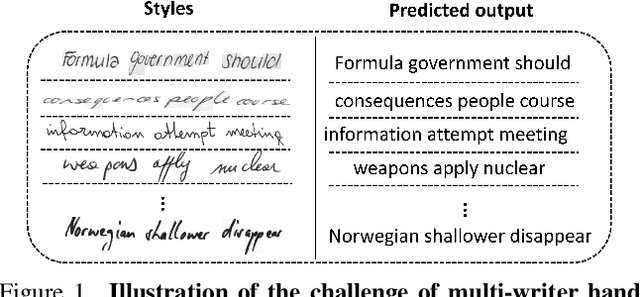
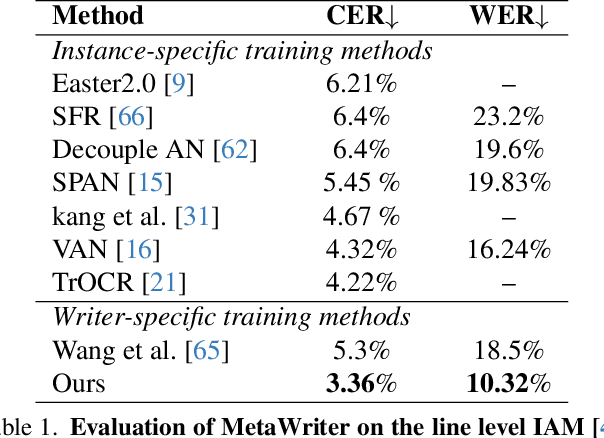
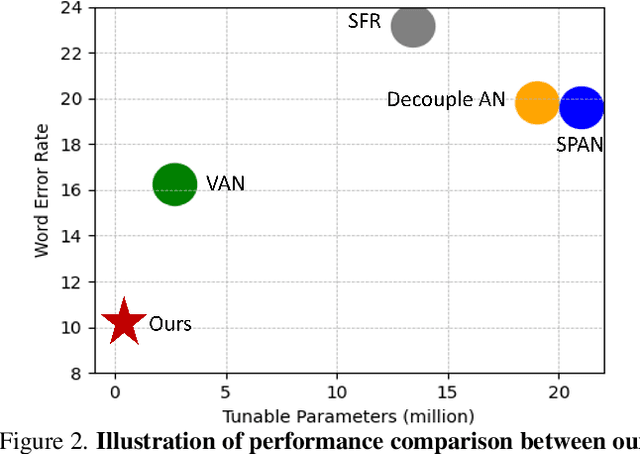
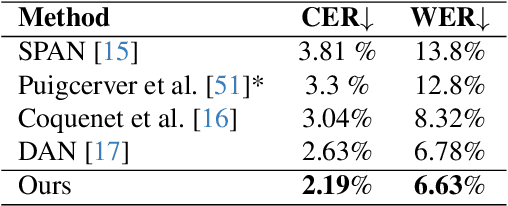
Recent advancements in handwritten text recognition (HTR) have enabled the effective conversion of handwritten text to digital formats. However, achieving robust recognition across diverse writing styles remains challenging. Traditional HTR methods lack writer-specific personalization at test time due to limitations in model architecture and training strategies. Existing attempts to bridge this gap, through gradient-based meta-learning, still require labeled examples and suffer from parameter-inefficient fine-tuning, leading to substantial computational and memory overhead. To overcome these challenges, we propose an efficient framework that formulates personalization as prompt tuning, incorporating an auxiliary image reconstruction task with a self-supervised loss to guide prompt adaptation with unlabeled test-time examples. To ensure self-supervised loss effectively minimizes text recognition error, we leverage meta-learning to learn the optimal initialization of the prompts. As a result, our method allows the model to efficiently capture unique writing styles by updating less than 1% of its parameters and eliminating the need for time-intensive annotation processes. We validate our approach on the RIMES and IAM Handwriting Database benchmarks, where it consistently outperforms previous state-of-the-art methods while using 20x fewer parameters. We believe this represents a significant advancement in personalized handwritten text recognition, paving the way for more reliable and practical deployment in resource-constrained scenarios.
Distribution Alignment for Fully Test-Time Adaptation with Dynamic Online Data Streams
Jul 16, 2024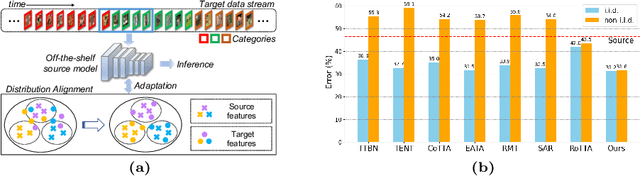
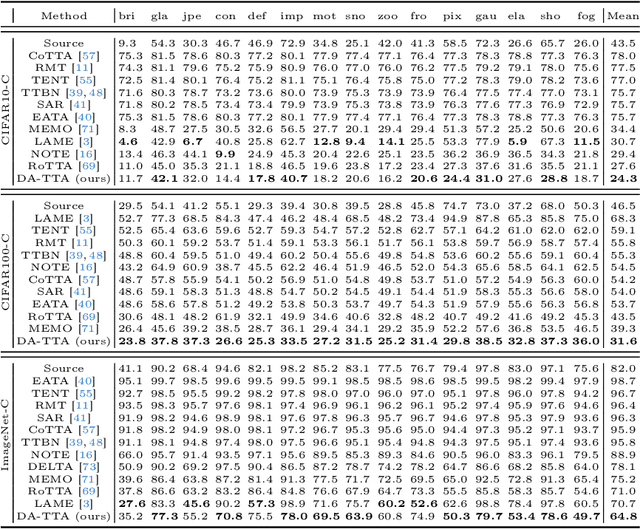

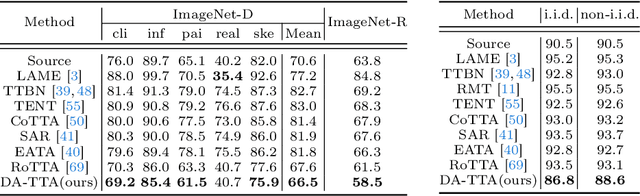
Given a model trained on source data, Test-Time Adaptation (TTA) enables adaptation and inference in test data streams with domain shifts from the source. Current methods predominantly optimize the model for each incoming test data batch using self-training loss. While these methods yield commendable results in ideal test data streams, where batches are independently and identically sampled from the target distribution, they falter under more practical test data streams that are not independent and identically distributed (non-i.i.d.). The data batches in a non-i.i.d. stream display prominent label shifts relative to each other. It leads to conflicting optimization objectives among batches during the TTA process. Given the inherent risks of adapting the source model to unpredictable test-time distributions, we reverse the adaptation process and propose a novel Distribution Alignment loss for TTA. This loss guides the distributions of test-time features back towards the source distributions, which ensures compatibility with the well-trained source model and eliminates the pitfalls associated with conflicting optimization objectives. Moreover, we devise a domain shift detection mechanism to extend the success of our proposed TTA method in the continual domain shift scenarios. Our extensive experiments validate the logic and efficacy of our method. On six benchmark datasets, we surpass existing methods in non-i.i.d. scenarios and maintain competitive performance under the ideal i.i.d. assumption.