 Add to Chrome
 Add to Firefox
 Add to Edge
CoAdapt-GUI: Joint Workflow Context and Policy Adaptation for Unseen GUI Applications
Aug 12, 2026
Mobile GUI agents remain brittle when deployed to applications absent from source training. We study novel-app generalization under a limited target interaction budget and without target demonstrations. We introduce CoAdapt-GUI, a test-time adaptation (TTA) framework that jointly adapts structured workflow context and policy from the agent's own target-app rollouts and rewards. The workflow context retains transferable procedures, failure modes, and verification rules while excluding app-bound source details. This separation allows reusable workflow knowledge to guide adaptation without transferring source-interface state. For policy adaptation, task-context-matched group-relative optimization updates a LoRA adapter on a frozen vision-language model. Across two unseen-app evaluations, CoAdapt-GUI reaches 45.0% on AndroidWorld-Generalization, compared with 37.5% for the reported Policy-Only TTA baseline, and raises AndroidWorld Plus performance from 38.6% to 52.9%. These results show that transfer-constrained workflow context provides substantial gains and that joint policy adaptation further improves held-out performance.

DA-MergeLoRA: Hypernetwork-Based LoRA Merging for Few-Shot Test-Time Domain Adaptation
Jul 20, 2026Few-shot Test-Time Domain Adaptation (FSTT-DA) seeks to adapt models to novel domains using only a handful of unlabeled target samples. This setting is more realistic than typical domain adaptation setups, which assume access to target data during source training. However, prior FSTT-DA approaches fail to effectively leverage source domain-specific knowledge, relying on shallow batch normalization updates, prompt-based methods that treat the model as a black box, or ensembling strategies that do not capture cross-domain relationships. To address these limitations, we introduce a new FSTT-DA framework that integrates LoRA fine-tuning with model merging. In our approach, separate LoRA modules are fine-tuned on CLIP's vision encoder for each source domain. Since LoRA modifies only a small fraction of the model's parameters, it retains the base model's generalized knowledge while internally learning domain-specific features. To adapt the learned knowledge to a specific target domain, we propose a hypernetwork trained via meta-learning that generates per-column merging factors to combine LoRA modules. Given a small batch of target images, the hypernetwork produces merging weights that fuse source LoRA modules into a single adapted representation. Our results demonstrate state-of-the-art performance across various domain adaptation datasets. Our code is publicly available at https://github.com/nahbois4321/DA-MergeLoRA.
AACLiteNet: A Lightweight Model for Detection of Fine-Grained Abdominal Aortic Calcification
Sep 25, 2024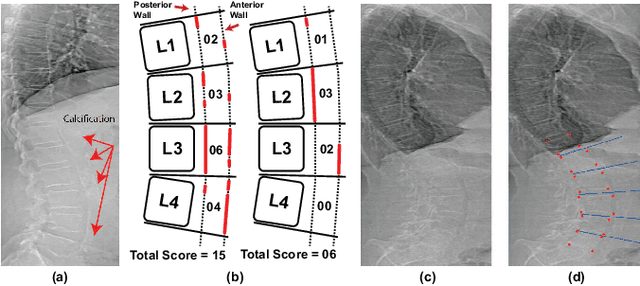
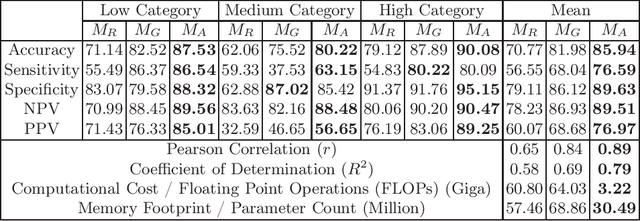
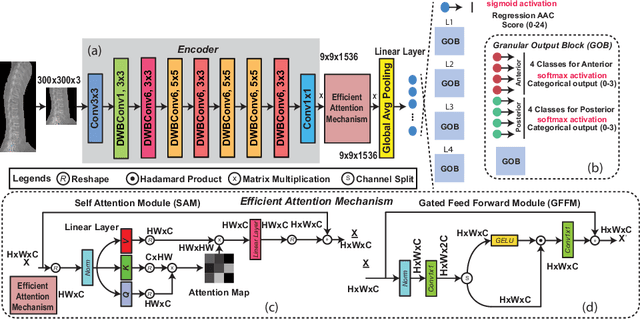
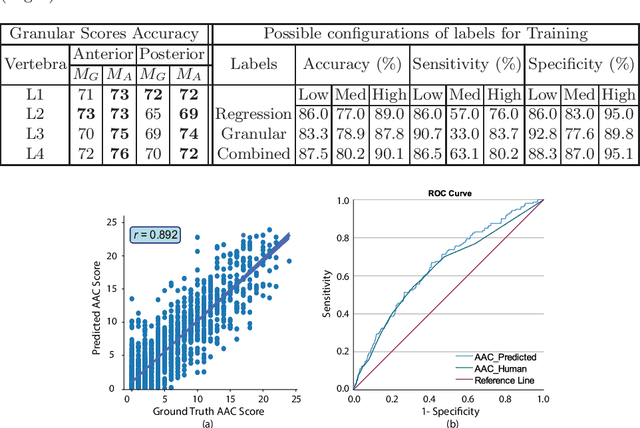
Cardiovascular Diseases (CVDs) are the leading cause of death worldwide, taking 17.9 million lives annually. Abdominal Aortic Calcification (AAC) is an established marker for CVD, which can be observed in lateral view Vertebral Fracture Assessment (VFA) scans, usually done for vertebral fracture detection. Early detection of AAC may help reduce the risk of developing clinical CVDs by encouraging preventive measures. Manual analysis of VFA scans for AAC measurement is time consuming and requires trained human assessors. Recently, efforts have been made to automate the process, however, the proposed models are either low in accuracy, lack granular level score prediction, or are too heavy in terms of inference time and memory footprint. Considering all these shortcomings of existing algorithms, we propose 'AACLiteNet', a lightweight deep learning model that predicts both cumulative and granular level AAC scores with high accuracy, and also has a low memory footprint, and computation cost (Floating Point Operations (FLOPs)). The AACLiteNet achieves a significantly improved one-vs-rest average accuracy of 85.94% as compared to the previous best 81.98%, with 19.88 times less computational cost and 2.26 times less memory footprint, making it implementable on portable computing devices.
SCOL: Supervised Contrastive Ordinal Loss for Abdominal Aortic Calcification Scoring on Vertebral Fracture Assessment Scans
Jul 22, 2023Abdominal Aortic Calcification (AAC) is a known marker of asymptomatic Atherosclerotic Cardiovascular Diseases (ASCVDs). AAC can be observed on Vertebral Fracture Assessment (VFA) scans acquired using Dual-Energy X-ray Absorptiometry (DXA) machines. Thus, the automatic quantification of AAC on VFA DXA scans may be used to screen for CVD risks, allowing early interventions. In this research, we formulate the quantification of AAC as an ordinal regression problem. We propose a novel Supervised Contrastive Ordinal Loss (SCOL) by incorporating a label-dependent distance metric with existing supervised contrastive loss to leverage the ordinal information inherent in discrete AAC regression labels. We develop a Dual-encoder Contrastive Ordinal Learning (DCOL) framework that learns the contrastive ordinal representation at global and local levels to improve the feature separability and class diversity in latent space among the AAC-24 genera. We evaluate the performance of the proposed framework using two clinical VFA DXA scan datasets and compare our work with state-of-the-art methods. Furthermore, for predicted AAC scores, we provide a clinical analysis to predict the future risk of a Major Acute Cardiovascular Event (MACE). Our results demonstrate that this learning enhances inter-class separability and strengthens intra-class consistency, which results in predicting the high-risk AAC classes with high sensitivity and high accuracy.