 Add to Chrome
 Add to Firefox
 Add to Edge
From Visual Widgets to UI Code: Efficient Tool-Grounded Generation
Aug 12, 2026
Existing screenshot-to-code systems face a trade-off between flexibility and controllability. Direct multimodal generation can hallucinate visible details, whereas structured pipelines reduce such errors through component-wise decomposition, predefined templates, and customized intermediate representations. These structures, however, introduce additional generative orchestration and restrict outputs to designs covered by the representation. We investigate whether selective tool grounding can improve the fidelity--efficiency trade-off of direct widget-to-code generation. We introduce \textbf{WidgetGen}, a lightweight tool-grounded framework that extracts observable text and color evidence, performs high-level layout and optional chart reasoning, and directly generates executable JavaScript XML (\emph{JSX}). This design reduces reliance on component-wise generation while avoiding a fixed UI schema. Across six multimodal models and \(1{,}000\) held-out widgets, WidgetGen outperforms direct prompting and the structured Widget2Code pipeline on most visual reconstruction metrics, with consistent gains in area, legibility, and style. Finally, reconstruction-derived image-code pairs improve six Qwen-family open-weight models across every reported metric through supervised fine-tuning. These results establish WidgetGen as a strong lightweight baseline and show that selective evidence grounding offers an effective alternative to extensive representation constraints.

Self-Supervised Representation-Guided Generative Dataset Distillation
Aug 04, 2026Dataset distillation compresses a large training set into a compact synthetic set while retaining its downstream utility. Most existing methods target randomly initialized networks, whereas modern vision systems often adapt frozen pretrained encoders with lightweight modules. Distilled samples should therefore preserve the discriminative geometry of the pretrained representation space, which existing generative objectives do not explicitly consider. We propose self-supervised representation-guided generative dataset distillation (SRG), a framework that translates the SSL geometry into diffusion guidance. Specifically, SRG constructs class-wise prototypes from real-image SSL representations and performs guidance through three SSL-space objectives for prototype alignment, inter-class discrimination, and intra-class assignment. During diffusion sampling, it adopts a stage-wise guidance strategy: early denoising is anchored to the latent of the real image whose SSL representation is nearest to the assigned prototype, whereas later denoising is guided by the SSL-space objectives. This division preserves the visual realism provided by the generative prior while progressively steering samples toward representative and class-discriminative regions of the SSL representation space. SRG consistently outperforms the evaluated generative baselines across multiple datasets and IPC settings. A cross-encoder evaluation further indicates transfer across pretrained representation spaces. These results demonstrate the effectiveness of representation-guided generation for dataset distillation with pretrained SSL models.
Difficulty-guided Sampling: Bridging the Target Gap between Dataset Distillation and Downstream Tasks
Jan 15, 2026In this paper, we propose difficulty-guided sampling (DGS) to bridge the target gap between the distillation objective and the downstream task, therefore improving the performance of dataset distillation. Deep neural networks achieve remarkable performance but have time and storage-consuming training processes. Dataset distillation is proposed to generate compact, high-quality distilled datasets, enabling effective model training while maintaining downstream performance. Existing approaches typically focus on features extracted from the original dataset, overlooking task-specific information, which leads to a target gap between the distillation objective and the downstream task. We propose leveraging characteristics that benefit the downstream training into data distillation to bridge this gap. Focusing on the downstream task of image classification, we introduce the concept of difficulty and propose DGS as a plug-in post-stage sampling module. Following the specific target difficulty distribution, the final distilled dataset is sampled from image pools generated by existing methods. We also propose difficulty-aware guidance (DAG) to explore the effect of difficulty in the generation process. Extensive experiments across multiple settings demonstrate the effectiveness of the proposed methods. It also highlights the broader potential of difficulty for diverse downstream tasks.
Normalized Conditional Mutual Information Surrogate Loss for Deep Neural Classifiers
Jan 05, 2026In this paper, we propose a novel information theoretic surrogate loss; normalized conditional mutual information (NCMI); as a drop in alternative to the de facto cross-entropy (CE) for training deep neural network (DNN) based classifiers. We first observe that the model's NCMI is inversely proportional to its accuracy. Building on this insight, we introduce an alternating algorithm to efficiently minimize the NCMI. Across image recognition and whole-slide imaging (WSI) subtyping benchmarks, NCMI-trained models surpass state of the art losses by substantial margins at a computational cost comparable to that of CE. Notably, on ImageNet, NCMI yields a 2.77% top-1 accuracy improvement with ResNet-50 comparing to the CE; on CAMELYON-17, replacing CE with NCMI improves the macro-F1 by 8.6% over the strongest baseline. Gains are consistent across various architectures and batch sizes, suggesting that NCMI is a practical and competitive alternative to CE.
Widget2Code: From Visual Widgets to UI Code via Multimodal LLMs
Dec 22, 2025User interface to code (UI2Code) aims to generate executable code that can faithfully reconstruct a given input UI. Prior work focuses largely on web pages and mobile screens, leaving app widgets underexplored. Unlike web or mobile UIs with rich hierarchical context, widgets are compact, context-free micro-interfaces that summarize key information through dense layouts and iconography under strict spatial constraints. Moreover, while (image, code) pairs are widely available for web or mobile UIs, widget designs are proprietary and lack accessible markup. We formalize this setting as the Widget-to-Code (Widget2Code) and introduce an image-only widget benchmark with fine-grained, multi-dimensional evaluation metrics. Benchmarking shows that although generalized multimodal large language models (MLLMs) outperform specialized UI2Code methods, they still produce unreliable and visually inconsistent code. To address these limitations, we develop a baseline that jointly advances perceptual understanding and structured code generation. At the perceptual level, we follow widget design principles to assemble atomic components into complete layouts, equipped with icon retrieval and reusable visualization modules. At the system level, we design an end-to-end infrastructure, WidgetFactory, which includes a framework-agnostic widget-tailored domain-specific language (WidgetDSL) and a compiler that translates it into multiple front-end implementations (e.g., React, HTML/CSS). An adaptive rendering module further refines spatial dimensions to satisfy compactness constraints. Together, these contributions substantially enhance visual fidelity, establishing a strong baseline and unified infrastructure for future Widget2Code research.
JPEG Compliant Compression for Both Human and Machine, A Report
Mar 13, 2025Deep Neural Networks (DNNs) have become an integral part of our daily lives, especially in vision-related applications. However, the conventional lossy image compression algorithms are primarily designed for the Human Vision System (HVS), which can non-trivially compromise the DNNs' validation accuracy after compression, as noted in \cite{liu2018deepn}. Thus developing an image compression algorithm for both human and machine (DNNs) is on the horizon. To address the challenge mentioned above, in this paper, we first formulate the image compression as a multi-objective optimization problem which take both human and machine prespectives into account, then we solve it by linear combination, and proposed a novel distortion measure for both human and machine, dubbed Human and Machine-Oriented Error (HMOE). After that, we develop Human And Machine Oriented Soft Decision Quantization (HMOSDQ) based on HMOE, a lossy image compression algorithm for both human and machine (DNNs), and fully complied with JPEG format. In order to evaluate the performance of HMOSDQ, finally we conduct the experiments for two pre-trained well-known DNN-based image classifiers named Alexnet \cite{Alexnet} and VGG-16 \cite{simonyan2014VGG} on two subsets of the ImageNet \cite{deng2009imagenet} validation set: one subset included images with shorter side in the range of 496 to 512, while the other included images with shorter side in the range of 376 to 384. Our results demonstrate that HMOSDQ outperforms the default JPEG algorithm in terms of rate-accuracy and rate-distortion performance. For the Alexnet comparing with the default JPEG algorithm, HMOSDQ can improve the validation accuracy by more than $0.81\%$ at $0.61$ BPP, or equivalently reduce the compression rate of default JPEG by $9.6\times$ while maintaining the same validation accuracy.
Distributed Quasi-Newton Method for Fair and Fast Federated Learning
Jan 18, 2025Federated learning (FL) is a promising technology that enables edge devices/clients to collaboratively and iteratively train a machine learning model under the coordination of a central server. The most common approach to FL is first-order methods, where clients send their local gradients to the server in each iteration. However, these methods often suffer from slow convergence rates. As a remedy, second-order methods, such as quasi-Newton, can be employed in FL to accelerate its convergence. Unfortunately, similarly to the first-order FL methods, the application of second-order methods in FL can lead to unfair models, achieving high average accuracy while performing poorly on certain clients' local datasets. To tackle this issue, in this paper we introduce a novel second-order FL framework, dubbed \textbf{d}istributed \textbf{q}uasi-\textbf{N}ewton \textbf{fed}erated learning (DQN-Fed). This approach seeks to ensure fairness while leveraging the fast convergence properties of quasi-Newton methods in the FL context. Specifically, DQN-Fed helps the server update the global model in such a way that (i) all local loss functions decrease to promote fairness, and (ii) the rate of change in local loss functions aligns with that of the quasi-Newton method. We prove the convergence of DQN-Fed and demonstrate its \textit{linear-quadratic} convergence rate. Moreover, we validate the efficacy of DQN-Fed across a range of federated datasets, showing that it surpasses state-of-the-art fair FL methods in fairness, average accuracy and convergence speed.
How to Train the Teacher Model for Effective Knowledge Distillation
Jul 25, 2024Recently, it was shown that the role of the teacher in knowledge distillation (KD) is to provide the student with an estimate of the true Bayes conditional probability density (BCPD). Notably, the new findings propose that the student's error rate can be upper-bounded by the mean squared error (MSE) between the teacher's output and BCPD. Consequently, to enhance KD efficacy, the teacher should be trained such that its output is close to BCPD in MSE sense. This paper elucidates that training the teacher model with MSE loss equates to minimizing the MSE between its output and BCPD, aligning with its core responsibility of providing the student with a BCPD estimate closely resembling it in MSE terms. In this respect, through a comprehensive set of experiments, we demonstrate that substituting the conventional teacher trained with cross-entropy loss with one trained using MSE loss in state-of-the-art KD methods consistently boosts the student's accuracy, resulting in improvements of up to 2.6\%.
Adversarial Training via Adaptive Knowledge Amalgamation of an Ensemble of Teachers
May 22, 2024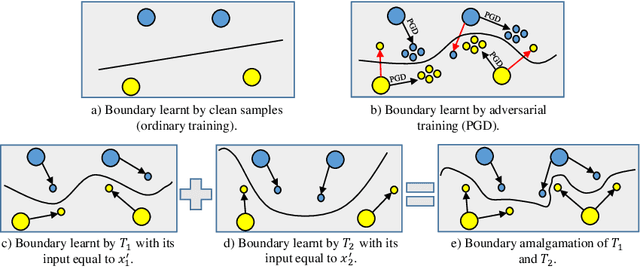
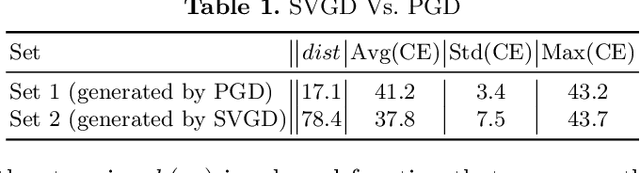

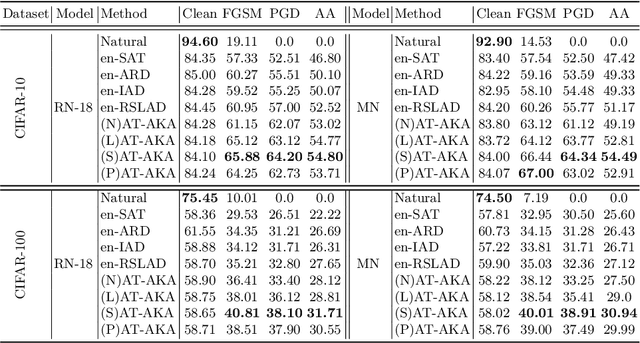
Adversarial training (AT) is a popular method for training robust deep neural networks (DNNs) against adversarial attacks. Yet, AT suffers from two shortcomings: (i) the robustness of DNNs trained by AT is highly intertwined with the size of the DNNs, posing challenges in achieving robustness in smaller models; and (ii) the adversarial samples employed during the AT process exhibit poor generalization, leaving DNNs vulnerable to unforeseen attack types. To address these dual challenges, this paper introduces adversarial training via adaptive knowledge amalgamation of an ensemble of teachers (AT-AKA). In particular, we generate a diverse set of adversarial samples as the inputs to an ensemble of teachers; and then, we adaptively amalgamate the logtis of these teachers to train a generalized-robust student. Through comprehensive experiments, we illustrate the superior efficacy of AT-AKA over existing AT methods and adversarial robustness distillation techniques against cutting-edge attacks, including AutoAttack.
Robustness Against Adversarial Attacks via Learning Confined Adversarial Polytopes
Jan 20, 2024Deep neural networks (DNNs) could be deceived by generating human-imperceptible perturbations of clean samples. Therefore, enhancing the robustness of DNNs against adversarial attacks is a crucial task. In this paper, we aim to train robust DNNs by limiting the set of outputs reachable via a norm-bounded perturbation added to a clean sample. We refer to this set as adversarial polytope, and each clean sample has a respective adversarial polytope. Indeed, if the respective polytopes for all the samples are compact such that they do not intersect the decision boundaries of the DNN, then the DNN is robust against adversarial samples. Hence, the inner-working of our algorithm is based on learning \textbf{c}onfined \textbf{a}dversarial \textbf{p}olytopes (CAP). By conducting a thorough set of experiments, we demonstrate the effectiveness of CAP over existing adversarial robustness methods in improving the robustness of models against state-of-the-art attacks including AutoAttack.