 Add to Chrome
 Add to Firefox
 Add to Edge
FragFuse: Bypassing Access Control of Large Language Model Agents via Memory-Based Query Fragmentation and Fusion
Jun 14, 2026
Large language model (LLM) agents increasingly rely on long-term memory to support complex task execution, user personalization, and domain adaptation. Meanwhile, emerging access-control mechanisms for LLM agents are being explored to block policy-violating requests and prevent misuse. We reveal a novel attack surface arising from agent memory operations: prohibited content that would trigger access control can be fragmented across interactions, stored in long-term memory in benign-appearing form, and later reconstructed through memory retrieval without appearing explicitly in the final user query. We propose FragFuse, the first attack that enables unprivileged users to bypass agent access control by exploiting this temporal channel introduced by long-term memory. FragFuse operates in three stages: (1) identifying rejection-responsive fragments via black-box adaptive querying with fragment masking; (2) injecting these fragments into memory using marker carrier queries; and (3) retrieving and fusing the stored fragments through a follow-up attack query. Although FragFuse can be instantiated manually for individual agents, we further develop a surrogate-based optimization scheme that tunes fusion instructions and marker designs, enabling automated attack generation without violating the attacker's threat-model assumptions. We evaluate FragFuse across four representative agent settings and task domains, covering three state-of-the-art agent access-control mechanisms. FragFuse achieves an average bypass success rate of 86.3% and an average end-to-end harmful task success rate of 41.1% across all settings, with only 4.4% average task-success degradation compared with configurations without access control. We also show that alternative defenses, including state-of-the-art prompt-injection detectors and perplexity detectors, do not effectively address this attack.

LLMs for Coding and Robotics Education
Feb 09, 2024
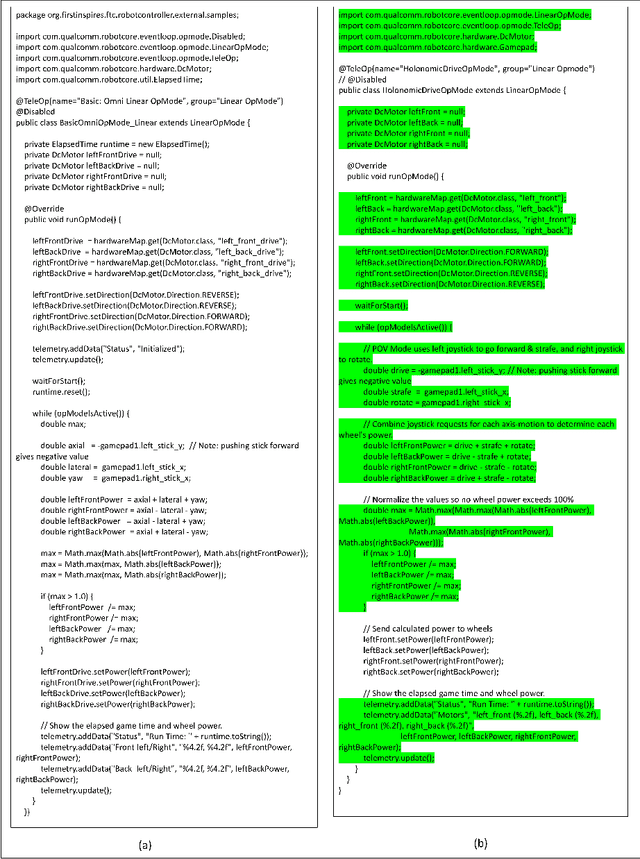

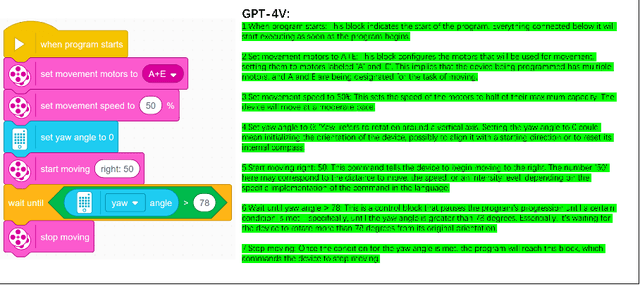
Large language models and multimodal large language models have revolutionized artificial intelligence recently. An increasing number of regions are now embracing these advanced technologies. Within this context, robot coding education is garnering increasing attention. To teach young children how to code and compete in robot challenges, large language models are being utilized for robot code explanation, generation, and modification. In this paper, we highlight an important trend in robot coding education. We test several mainstream large language models on both traditional coding tasks and the more challenging task of robot code generation, which includes block diagrams. Our results show that GPT-4V outperforms other models in all of our tests but struggles with generating block diagram images.
Towards Artificial General Intelligence (AGI) in the Internet of Things (IoT): Opportunities and Challenges
Sep 14, 2023
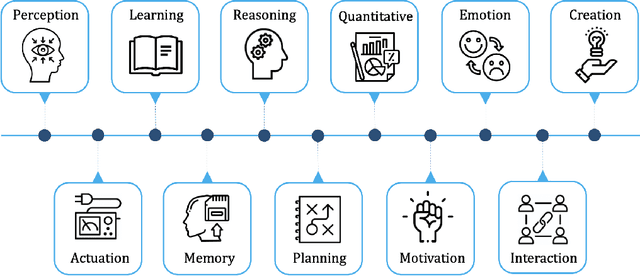
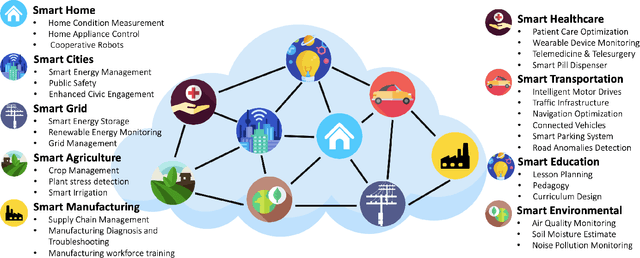
Artificial General Intelligence (AGI), possessing the capacity to comprehend, learn, and execute tasks with human cognitive abilities, engenders significant anticipation and intrigue across scientific, commercial, and societal arenas. This fascination extends particularly to the Internet of Things (IoT), a landscape characterized by the interconnection of countless devices, sensors, and systems, collectively gathering and sharing data to enable intelligent decision-making and automation. This research embarks on an exploration of the opportunities and challenges towards achieving AGI in the context of the IoT. Specifically, it starts by outlining the fundamental principles of IoT and the critical role of Artificial Intelligence (AI) in IoT systems. Subsequently, it delves into AGI fundamentals, culminating in the formulation of a conceptual framework for AGI's seamless integration within IoT. The application spectrum for AGI-infused IoT is broad, encompassing domains ranging from smart grids, residential environments, manufacturing, and transportation to environmental monitoring, agriculture, healthcare, and education. However, adapting AGI to resource-constrained IoT settings necessitates dedicated research efforts. Furthermore, the paper addresses constraints imposed by limited computing resources, intricacies associated with large-scale IoT communication, as well as the critical concerns pertaining to security and privacy.