 Add to Chrome
 Add to Firefox
 Add to Edge
WearVox: An Egocentric Multichannel Voice Assistant Benchmark for Wearables
Dec 25, 2025
Wearable devices such as AI glasses are transforming voice assistants into always-available, hands-free collaborators that integrate seamlessly with daily life, but they also introduce challenges like egocentric audio affected by motion and noise, rapid micro-interactions, and the need to distinguish device-directed speech from background conversations. Existing benchmarks largely overlook these complexities, focusing instead on clean or generic conversational audio. To bridge this gap, we present WearVox, the first benchmark designed to rigorously evaluate voice assistants in realistic wearable scenarios. WearVox comprises 3,842 multi-channel, egocentric audio recordings collected via AI glasses across five diverse tasks including Search-Grounded QA, Closed-Book QA, Side-Talk Rejection, Tool Calling, and Speech Translation, spanning a wide range of indoor and outdoor environments and acoustic conditions. Each recording is accompanied by rich metadata, enabling nuanced analysis of model performance under real-world constraints. We benchmark leading proprietary and open-source speech Large Language Models (SLLMs) and find that most real-time SLLMs achieve accuracies on WearVox ranging from 29% to 59%, with substantial performance degradation on noisy outdoor audio, underscoring the difficulty and realism of the benchmark. Additionally, we conduct a case study with two new SLLMs that perform inference with single-channel and multi-channel audio, demonstrating that multi-channel audio inputs significantly enhance model robustness to environmental noise and improve discrimination between device-directed and background speech. Our results highlight the critical importance of spatial audio cues for context-aware voice assistants and establish WearVox as a comprehensive testbed for advancing wearable voice AI research.

Stream RAG: Instant and Accurate Spoken Dialogue Systems with Streaming Tool Usage
Oct 02, 2025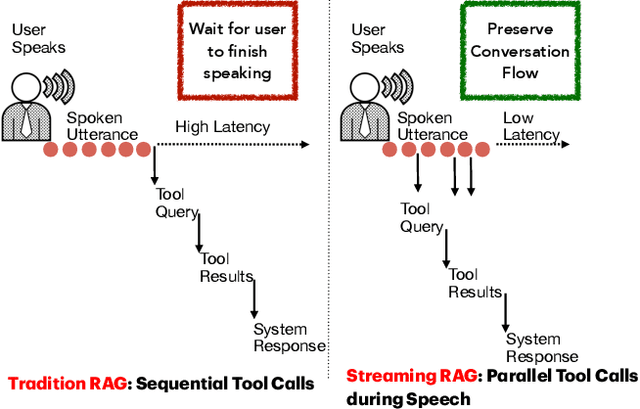
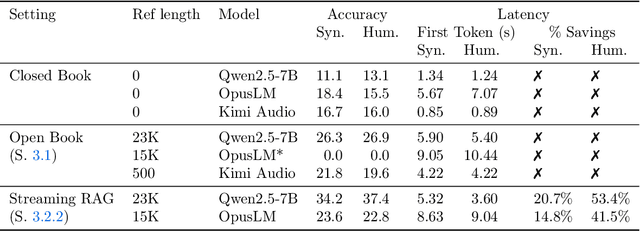
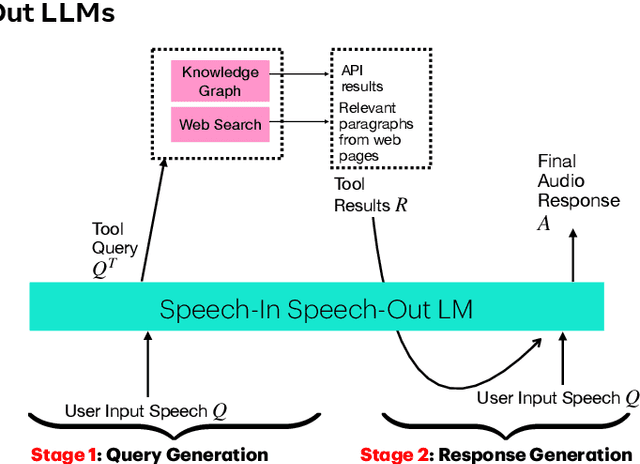
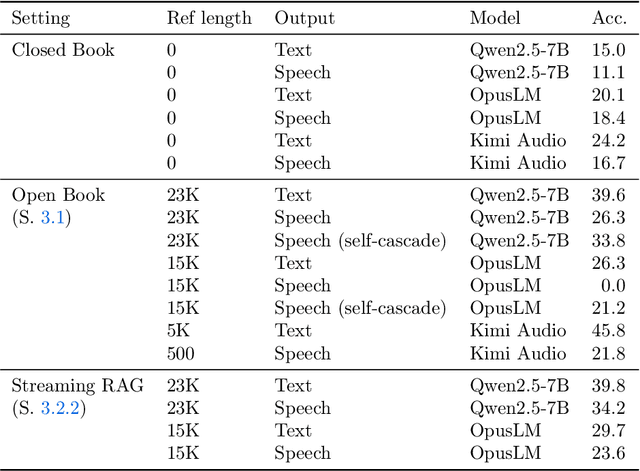
End-to-end speech-in speech-out dialogue systems are emerging as a powerful alternative to traditional ASR-LLM-TTS pipelines, generating more natural, expressive responses with significantly lower latency. However, these systems remain prone to hallucinations due to limited factual grounding. While text-based dialogue systems address this challenge by integrating tools such as web search and knowledge graph APIs, we introduce the first approach to extend tool use directly into speech-in speech-out systems. A key challenge is that tool integration substantially increases response latency, disrupting conversational flow. To mitigate this, we propose Streaming Retrieval-Augmented Generation (Streaming RAG), a novel framework that reduces user-perceived latency by predicting tool queries in parallel with user speech, even before the user finishes speaking. Specifically, we develop a post-training pipeline that teaches the model when to issue tool calls during ongoing speech and how to generate spoken summaries that fuse audio queries with retrieved text results, thereby improving both accuracy and responsiveness. To evaluate our approach, we construct AudioCRAG, a benchmark created by converting queries from the publicly available CRAG dataset into speech form. Experimental results demonstrate that our streaming RAG approach increases QA accuracy by up to 200% relative (from 11.1% to 34.2% absolute) and further enhances user experience by reducing tool use latency by 20%. Importantly, our streaming RAG approach is modality-agnostic and can be applied equally to typed input, paving the way for more agentic, real-time AI assistants.
UPSCALE: Unconstrained Channel Pruning
Jul 17, 2023As neural networks grow in size and complexity, inference speeds decline. To combat this, one of the most effective compression techniques -- channel pruning -- removes channels from weights. However, for multi-branch segments of a model, channel removal can introduce inference-time memory copies. In turn, these copies increase inference latency -- so much so that the pruned model can be slower than the unpruned model. As a workaround, pruners conventionally constrain certain channels to be pruned together. This fully eliminates memory copies but, as we show, significantly impairs accuracy. We now have a dilemma: Remove constraints but increase latency, or add constraints and impair accuracy. In response, our insight is to reorder channels at export time, (1) reducing latency by reducing memory copies and (2) improving accuracy by removing constraints. Using this insight, we design a generic algorithm UPSCALE to prune models with any pruning pattern. By removing constraints from existing pruners, we improve ImageNet accuracy for post-training pruned models by 2.1 points on average -- benefiting DenseNet (+16.9), EfficientNetV2 (+7.9), and ResNet (+6.2). Furthermore, by reordering channels, UPSCALE improves inference speeds by up to 2x over a baseline export.
AutoFocusFormer: Image Segmentation off the Grid
Apr 24, 2023Real world images often have highly imbalanced content density. Some areas are very uniform, e.g., large patches of blue sky, while other areas are scattered with many small objects. Yet, the commonly used successive grid downsampling strategy in convolutional deep networks treats all areas equally. Hence, small objects are represented in very few spatial locations, leading to worse results in tasks such as segmentation. Intuitively, retaining more pixels representing small objects during downsampling helps to preserve important information. To achieve this, we propose AutoFocusFormer (AFF), a local-attention transformer image recognition backbone, which performs adaptive downsampling by learning to retain the most important pixels for the task. Since adaptive downsampling generates a set of pixels irregularly distributed on the image plane, we abandon the classic grid structure. Instead, we develop a novel point-based local attention block, facilitated by a balanced clustering module and a learnable neighborhood merging module, which yields representations for our point-based versions of state-of-the-art segmentation heads. Experiments show that our AutoFocusFormer (AFF) improves significantly over baseline models of similar sizes.
Active Learning and Best-Response Dynamics
Jun 25, 2014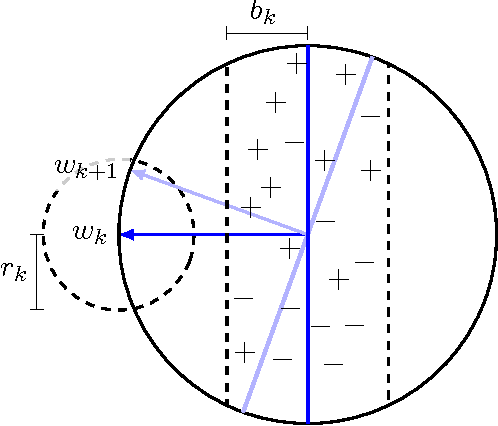
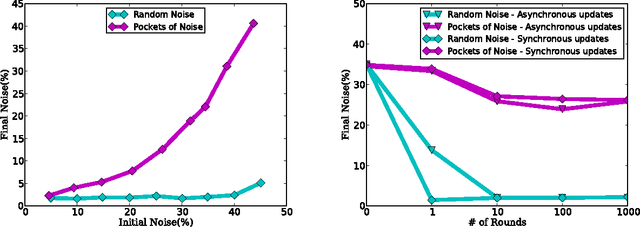
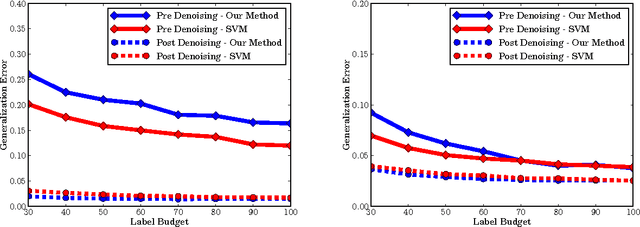
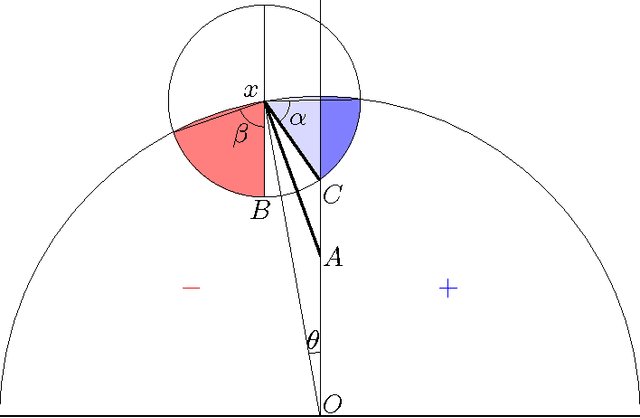
We examine an important setting for engineered systems in which low-power distributed sensors are each making highly noisy measurements of some unknown target function. A center wants to accurately learn this function by querying a small number of sensors, which ordinarily would be impossible due to the high noise rate. The question we address is whether local communication among sensors, together with natural best-response dynamics in an appropriately-defined game, can denoise the system without destroying the true signal and allow the center to succeed from only a small number of active queries. By using techniques from game theory and empirical processes, we prove positive (and negative) results on the denoising power of several natural dynamics. We then show experimentally that when combined with recent agnostic active learning algorithms, this process can achieve low error from very few queries, performing substantially better than active or passive learning without these denoising dynamics as well as passive learning with denoising.