 Add to Chrome
 Add to Firefox
 Add to Edge
Gradient-free Task-Conditioned Retrieval for On-Device In-Context Learning
Jul 30, 2026
On-device in-context learning (ICL) relies on pre-inference retrieval to select demonstrations for useful context before downstream model inference. This retrieval must exploit task-specific information while operating over local memories under limited computation, memory, and data-exposure budgets. We propose Conditional Retrieval Alignment (CoRA), a gradient-free framework that converts a frozen encoder into a task-conditioned retriever using paired candidate inputs and outputs. CoRA selects complementary encoder layers, constructs an output-derived conditioning space from candidate memory, and aligns candidate input representations to this space through closed-form ridge regression. Low-rank factorization then produces a compact retrieval basis where candidate outputs are used only during offline index construction, whereas query-time retrieval requires only the query input and precomputed index. We show that CoRA's rank-constrained basis is the optimal low-rank compression of the output-conditioned fitted representation, and derive an exact two-pass streaming construction that avoids materializing the full fitted matrix. We further extend the framework to multimodal exemplar retrieval by incorporating visual representations into the conditioning and retrieval spaces. Experiments across ten textual datasets and four multimodal benchmarks with Llama-3.2-1B, MobileLLM-Pro, OpenFlamingo-3B, and Qwen3.5-2B, as well as end-to-end Raspberry Pi~5 deployment demonstrate that CoRA supports effective task-conditioned retrieval without retriever fine-tuning, backpropagation, or target-model calls.

A 32-Channel 3.53-μW Per Channel Brain-Machine Interface SoC Featuring Dual-Threshold Delta-modulation, In-Memory Spike Detection and Bi-SNN Based Motor Decoding
Jun 01, 2026With the scaling of sensor channel counts, systems confront challenges in frontend data sensing and on-implant data processing. This work presents a 32-channel fully event-based iBMI SoC in 65nm CMOS for an efficient neuromorphic signal processing pipeline. The SoC integrates a 32-channel dual-threshold delta modulation (DTDM) frontend array that provides up to 26x data compression at the frontend, an in-memory computing (IMC) spike detector (SPD) for efficient in-pixel spike detection, and a bipolar LIF-based spiking neural network (Bi-SNN) decoder for on-chip motor intention decoding (MID). Consuming only 3.53 μW per channel and achieving ~0.62 decoding R2 with a compact 0.034 mm2 per-channel area, the chip enables high-efficiency signal recording, processing, and decoding for implantable devices.
SRAM-Based Compute-in-Memory Accelerator for Linear-decay Spiking Neural Networks
Mar 13, 2026Spiking Neural Networks (SNNs) have emerged as a biologically inspired alternative to conventional deep networks, offering event-driven and energy-efficient computation. However, their throughput remains constrained by the serial update of neuron membrane states. While many hardware accelerators and Compute-in-Memory (CIM) architectures efficiently parallelize the synaptic operation (W x I) achieving O(1) complexity for matrix-vector multiplication, the subsequent state update step still requires O(N) time to refresh all neuron membrane potentials. This mismatch makes state update the dominant latency and energy bottleneck in SNN inference. To address this challenge, we propose an SRAM-based CIM for SNN with Linear Decay Leaky Integrate-and-Fire (LD-LIF) Neuron that co-optimizes algorithm and hardware. At the algorithmic level, we replace the conventional exponential membrane decay with a linear decay approximation, converting costly multiplications into simple additions while accuracy drops only around 1%. At the architectural level, we introduce an in-memory parallel update scheme that performs in-place decay directly within the SRAM array, eliminating the need for global sequential updates. Evaluated on benchmark SNN workloads, the proposed method achieves a 1.1 x to 16.7 x reduction of SOP energy consumption, while providing 15.9 x to 69 x more energy efficiency, with negligible accuracy loss relative to original decay models. This work highlights that beyond accelerating the (W x I) computation, optimizing state-update dynamics within CIM architectures is essential for scalable, low-power, and real-time neuromorphic processing.
An Event-Driven E-Skin System with Dynamic Binary Scanning and real time SNN Classification
Mar 11, 2026This paper presents a novel hardware system for high-speed, event-sparse sampling-based electronic skin (e-skin)that integrates sensing and neuromorphic computing. The system is built around a 16x16 piezoresistive tactile array with front end and introduces a event-based binary scan search strategy to classify the digits. This event-driven strategy achieves a 12.8x reduction in scan counts, a 38.2x data compression rate and a 28.4x equivalent dynamic range, a 99% data sparsity, drastically reducing the data acquisition overhead. The resulting sparse data stream is processed by a multi-layer convolutional spiking neural network (Conv-SNN) implemented on an FPGA, which requires only 65% of the computation and 15.6% of the weight storage relative to a CNN. Despite these significant efficiency gains, the system maintains a high classification accuracy of 92.11% for real-time handwritten digit recognition. Furthermore, a real neuromorphic tactile dataset using Address Event Representation (AER) is constructed. This work demonstrates a fully integrated, event-driven pipeline from analog sensing to neuromorphic classification, offering an efficient solution for robotic perception and human-computer interaction.
1024-Channel 0.8V 23.9-nW/Channel Event-based Compute In-memory Neural Spike Detector
Dec 09, 2025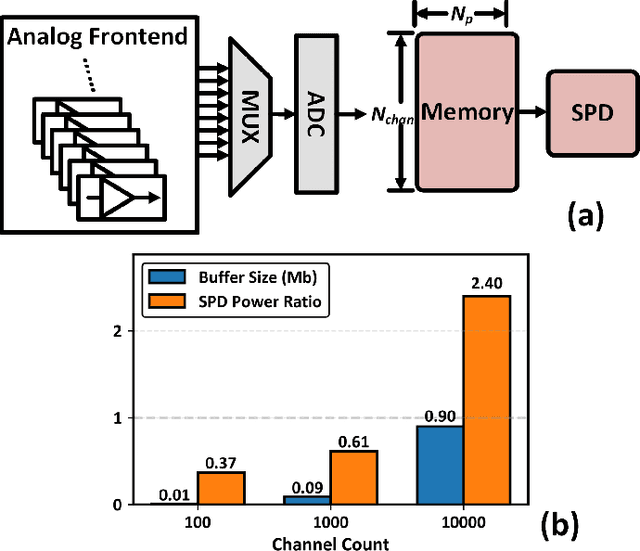
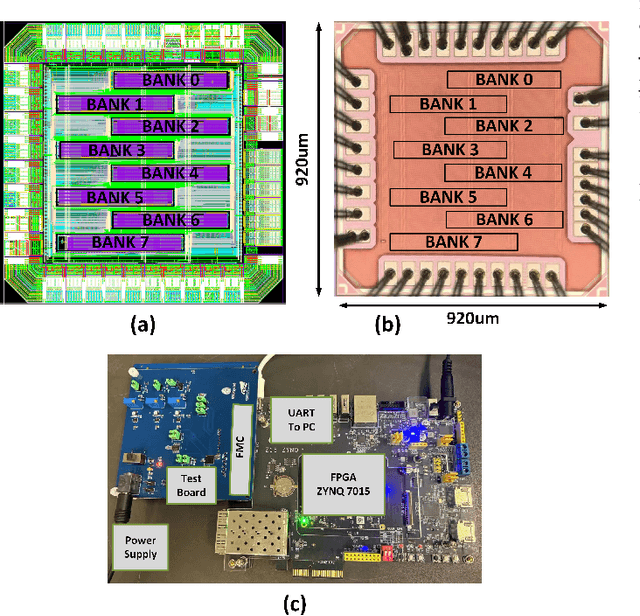
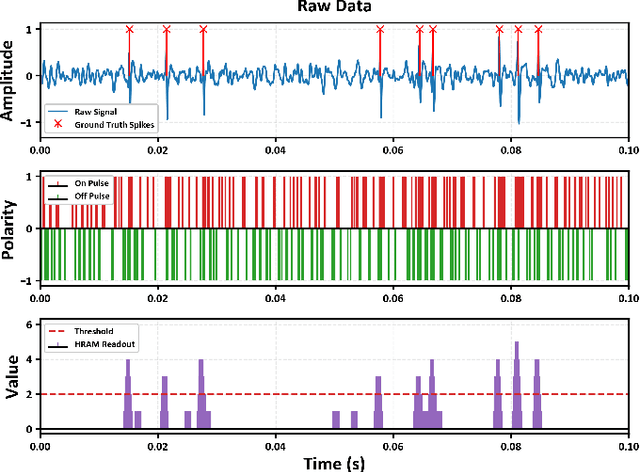
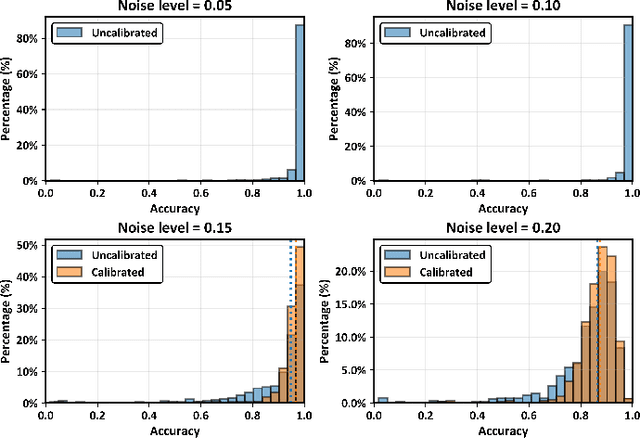
The increasing data rate has become a major issue confronting next-generation intracortical brain-machine interfaces (iBMIs). The scaling number of recording sites requires complex analog wiring and lead to huge digitization power consumption. Compressive event-based neural frontends have been used in high-density neural implants to support the simultaneous recording of more channels. Event-based frontends (EBF) convert recorded signals into asynchronous digital events via delta modulation and can inherently achieve considerable compression. But EBFs are prone to false events that do not correspond to neural spikes. Spike detection (SPD) is a key process in the iBMI pipeline to detect neural spikes and further reduce the data rate. However, conventional digital SPD suffers from the increasing buffer size and frequent memory access power, and conventional spike emphasizers are not compatible with EBFs. In this work we introduced an event-based spike detection (Ev-SPD) algorithm for scalable compressive EBFs. To implement the algorithm effectively, we proposed a novel low-power 10-T eDRAM-SRAM hybrid random-access memory in-memory computing bitcell for event processing. We fabricated the proposed 1024-channel IMC SPD macro in a 65nm process and tested the macro with both synthetic dataset and Neuropixel recordings. The proposed macro achieved a high spike detection accuracy of 96.06% on a synthetic dataset and 95.08% similarity and 0.05 firing pattern MAE on Neuropixel recordings. Our event-based IMC SPD macro achieved a high per channel spike detection energy efficiency of 23.9 nW per channel and an area efficiency of 375 um^2 per channel. Our work presented a SPD scheme compatible with compressive EBFs for high-density iBMIs, achieving ultra-low power consumption with an IMC architecture while maintaining considerable accuracy.
Deep Learning for Joint Design of Pilot, Channel Feedback, and Hybrid Beamforming in FDD Massive MIMO-OFDM Systems
Dec 10, 2023


This letter considers the transceiver design in frequency division duplex (FDD) massive multiple-input multiple-output (MIMO) orthogonal frequency division multiplexing (OFDM) systems for high-quality data transmission. We propose a novel deep learning based framework where the procedures of pilot design, channel feedback, and hybrid beamforming are realized by carefully crafted deep neural networks. All the considered modules are jointly learned in an end-to-end manner, and a graph neural network is adopted to effectively capture interactions between beamformers based on the built graphical representation. Numerical results validate the effectiveness of our method.
Hierarchical Beam Alignment for Millimeter-Wave Communication Systems: A Deep Learning Approach
Aug 23, 2023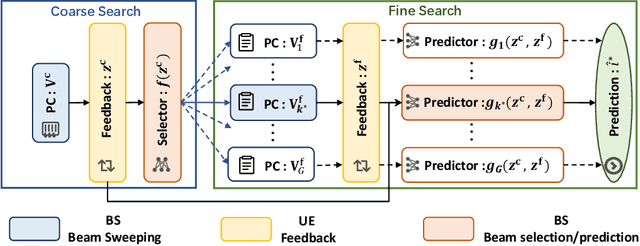
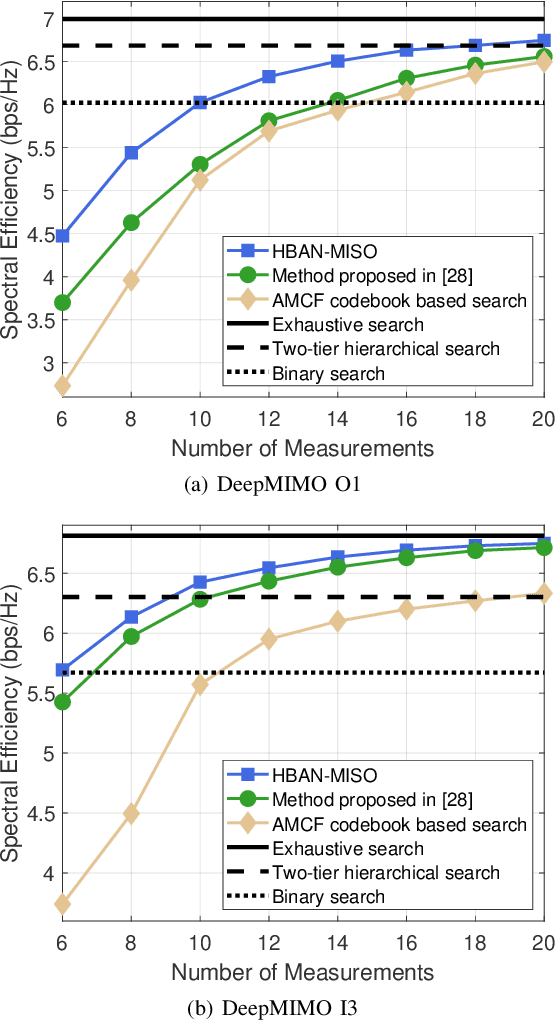
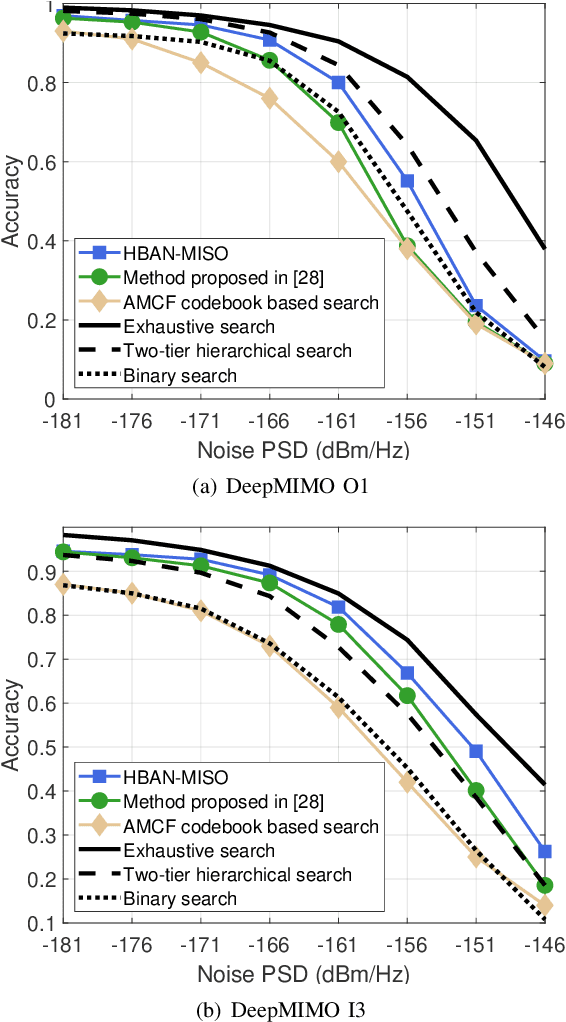
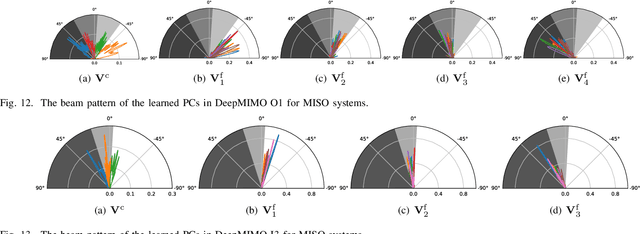
Fast and precise beam alignment is crucial for high-quality data transmission in millimeter-wave (mmWave) communication systems, where large-scale antenna arrays are utilized to overcome the severe propagation loss. To tackle the challenging problem, we propose a novel deep learning-based hierarchical beam alignment method for both multiple-input single-output (MISO) and multiple-input multiple-output (MIMO) systems, which learns two tiers of probing codebooks (PCs) and uses their measurements to predict the optimal beam in a coarse-to-fine search manner. Specifically, a hierarchical beam alignment network (HBAN) is developed for MISO systems, which first performs coarse channel measurement using a tier-1 PC, then selects a tier-2 PC for fine channel measurement, and finally predicts the optimal beam based on both coarse and fine measurements. The propounded HBAN is trained in two steps: the tier-1 PC and the tier-2 PC selector are first trained jointly, followed by the joint training of all the tier-2 PCs and beam predictors. Furthermore, an HBAN for MIMO systems is proposed to directly predict the optimal beam pair without performing beam alignment individually at the transmitter and receiver. Numerical results demonstrate that the proposed HBANs are superior to the state-of-art methods in both alignment accuracy and signaling overhead reduction.
Deep Learning for Hierarchical Beam Alignment in mmWave Communication Systems
Sep 08, 2022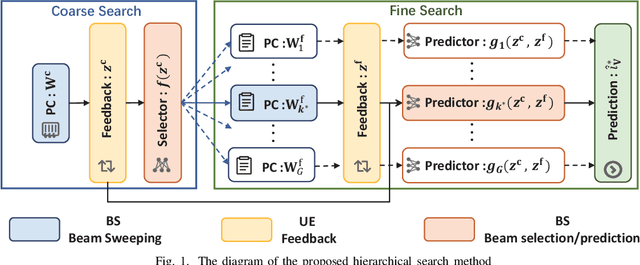
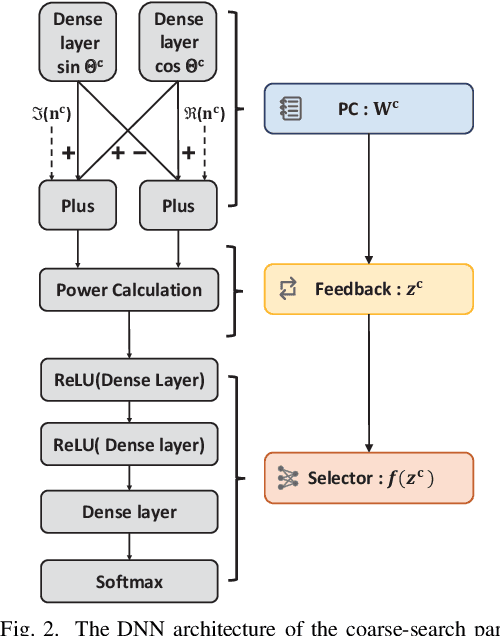
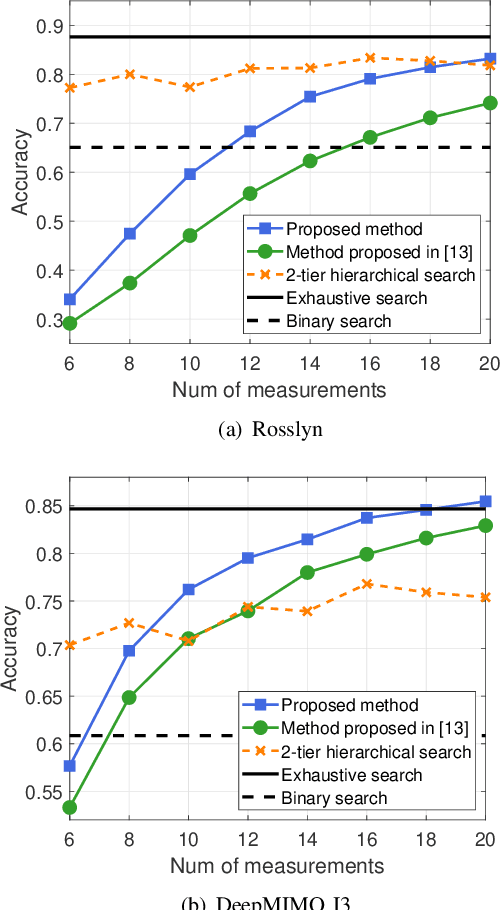
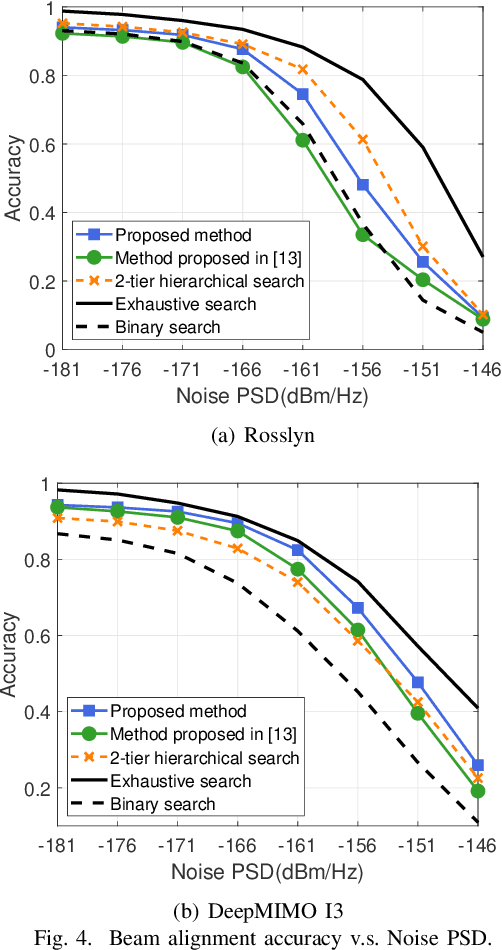
Fast and precise beam alignment is crucial to support high-quality data transmission in millimeter wave (mmWave) communication systems. In this work, we propose a novel deep learning based hierarchical beam alignment method that learns two tiers of probing codebooks (PCs) and uses their measurements to predict the optimal beam in a coarse-to-fine searching manner. Specifically, the proposed method first performs coarse channel measurement using the tier-1 PC, then selects a tier-2 PC for fine channel measurement, and finally predicts the optimal beam based on both coarse and fine measurements. The proposed deep neural network (DNN) architecture is trained in two steps. First, the tier-1 PC and the tier-2 PC selector are trained jointly. After that, all the tier-2 PCs together with the optimal beam predictors are trained jointly. The learned hierarchical PCs can capture the features of propagation environment. Numerical results based on realistic ray-tracing datasets demonstrate that the proposed method is superior to the state-of-art beam alignment methods in both alignment accuracy and sweeping overhead.
LEO Satellite Access Network (LEO-SAN) Towards 6G: Challenges and Approaches
Jul 25, 2022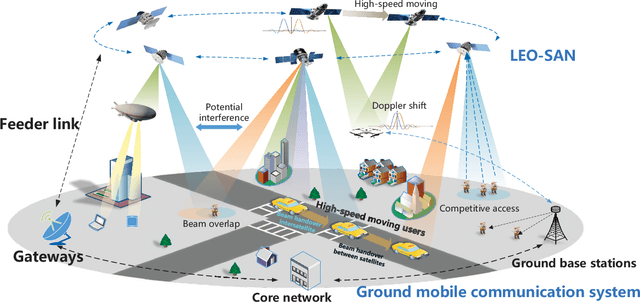
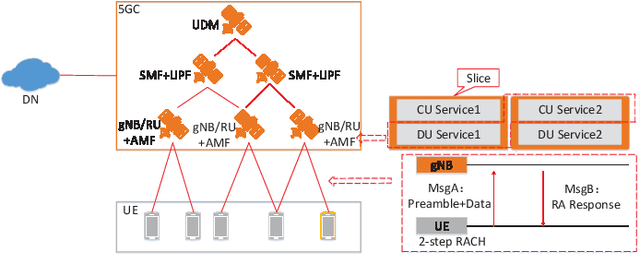
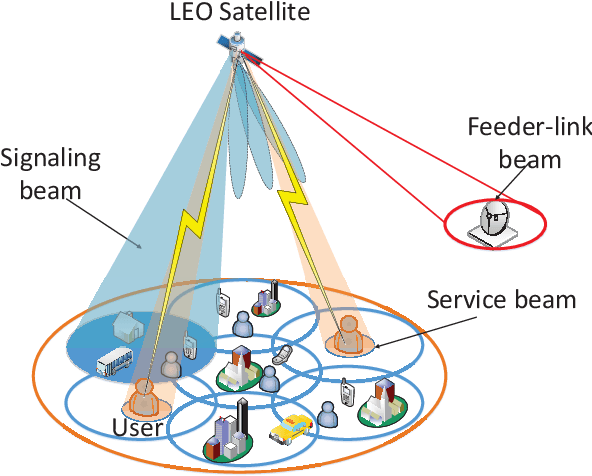
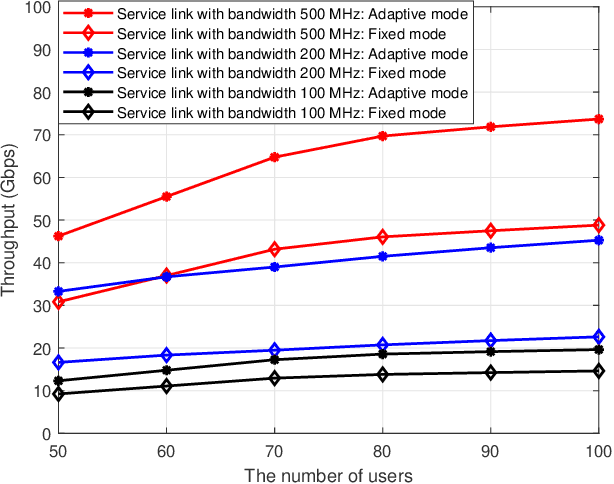
With the rapid development of satellite communication technologies, the space-based access network has been envisioned as a promising complementary part of the future 6G network. Aside from terrestrial base stations, satellite nodes, especially the low-earth-orbit (LEO) satellites, can also serve as base stations for Internet access, and constitute the LEO-satellite-based access network (LEO-SAN). LEO-SAN is expected to provide seamless massive access and extended coverage with high signal quality. However, its practical implementation still faces significant technical challenges, e.g., high mobility and limited budget for communication payloads of LEO satellite nodes. This paper aims at revealing the main technical issues that have not been fully addressed by the existing LEO-SAN designs, from three aspects namely random access, beam management and Doppler-resistant transmission technologies. More specifically, the critical issues of random access in LEO-SAN are discussed regarding low flexibility, long transmission delay, and inefficient handshakes. Then the beam management for LEO-SAN is investigated in complex propagation environments under the constraints of high mobility and limited payload budget. Furthermore, the influence of Doppler shifts on LEO-SAN is explored. Correspondingly, promising technologies to address these challenges are also discussed, respectively. Finally, the future research directions are envisioned.
Image Restoration Using Deep Regulated Convolutional Networks
Oct 19, 2019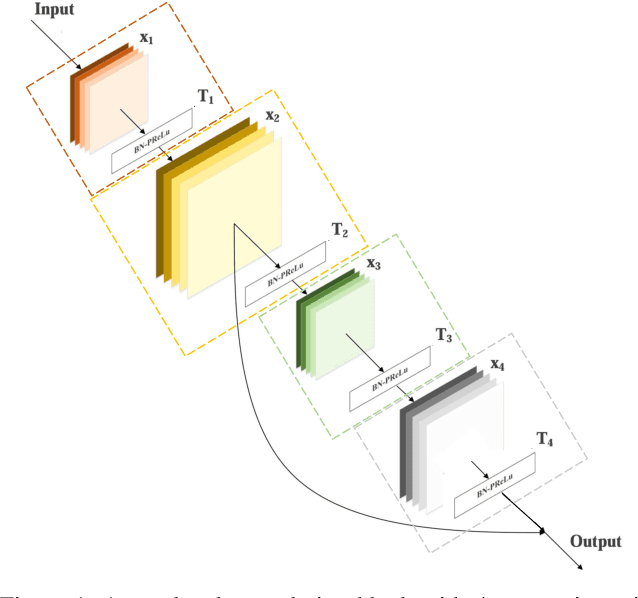
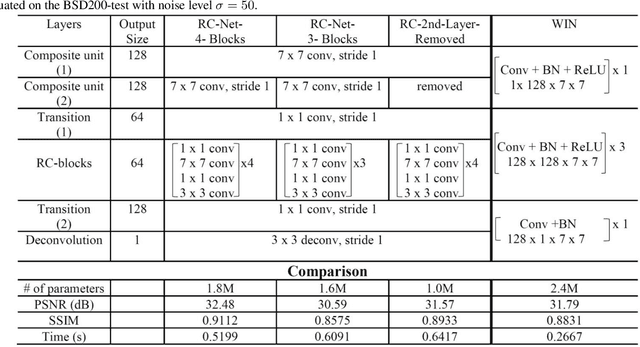
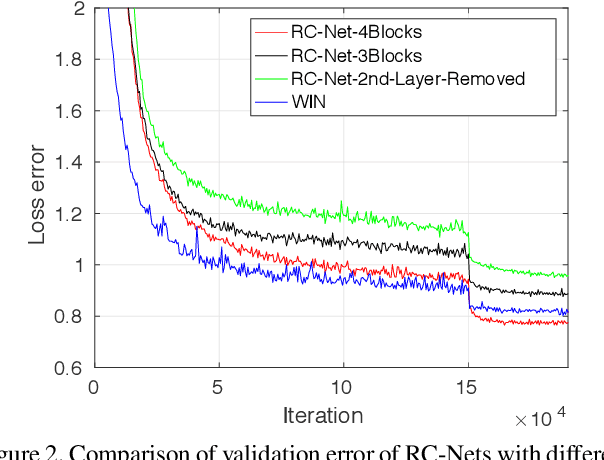

While the depth of convolutional neural networks has attracted substantial attention in the deep learning research, the width of these networks has recently received greater interest. The width of networks, defined as the size of the receptive fields and the density of the channels, has demonstrated crucial importance in low-level vision tasks such as image denoising and restoration. However, the limited generalization ability, due to the increased width of networks, creates a bottleneck in designing wider networks. In this paper, we propose the Deep Regulated Convolutional Network (RC-Net), a deep network composed of regulated sub-network blocks cascaded by skip-connections, to overcome this bottleneck. Specifically, the Regulated Convolution block (RC-block), featured by a combination of large and small convolution filters, balances the effectiveness of prominent feature extraction and the generalization ability of the network. RC-Nets have several compelling advantages: they embrace diversified features through large-small filter combinations, alleviate the hazy boundary and blurred details in image denoising and super-resolution problems, and stabilize the learning process. Our proposed RC-Nets outperform state-of-the-art approaches with significant performance gains in various image restoration tasks while demonstrating promising generalization ability. The code is available at https://github.com/cswin/RC-Nets.