 Add to Chrome
 Add to Firefox
 Add to Edge
A 32-Channel 3.53-μW Per Channel Brain-Machine Interface SoC Featuring Dual-Threshold Delta-modulation, In-Memory Spike Detection and Bi-SNN Based Motor Decoding
Jun 01, 2026
With the scaling of sensor channel counts, systems confront challenges in frontend data sensing and on-implant data processing. This work presents a 32-channel fully event-based iBMI SoC in 65nm CMOS for an efficient neuromorphic signal processing pipeline. The SoC integrates a 32-channel dual-threshold delta modulation (DTDM) frontend array that provides up to 26x data compression at the frontend, an in-memory computing (IMC) spike detector (SPD) for efficient in-pixel spike detection, and a bipolar LIF-based spiking neural network (Bi-SNN) decoder for on-chip motor intention decoding (MID). Consuming only 3.53 μW per channel and achieving ~0.62 decoding R2 with a compact 0.034 mm2 per-channel area, the chip enables high-efficiency signal recording, processing, and decoding for implantable devices.

An Event-Driven E-Skin System with Dynamic Binary Scanning and real time SNN Classification
Mar 11, 2026This paper presents a novel hardware system for high-speed, event-sparse sampling-based electronic skin (e-skin)that integrates sensing and neuromorphic computing. The system is built around a 16x16 piezoresistive tactile array with front end and introduces a event-based binary scan search strategy to classify the digits. This event-driven strategy achieves a 12.8x reduction in scan counts, a 38.2x data compression rate and a 28.4x equivalent dynamic range, a 99% data sparsity, drastically reducing the data acquisition overhead. The resulting sparse data stream is processed by a multi-layer convolutional spiking neural network (Conv-SNN) implemented on an FPGA, which requires only 65% of the computation and 15.6% of the weight storage relative to a CNN. Despite these significant efficiency gains, the system maintains a high classification accuracy of 92.11% for real-time handwritten digit recognition. Furthermore, a real neuromorphic tactile dataset using Address Event Representation (AER) is constructed. This work demonstrates a fully integrated, event-driven pipeline from analog sensing to neuromorphic classification, offering an efficient solution for robotic perception and human-computer interaction.
STEMNIST: Spiking Tactile Extended MNIST Neuromorphic Dataset
Jan 04, 2026Tactile sensing is essential for robotic manipulation, prosthetics and assistive technologies, yet neuromorphic tactile datasets remain limited compared to their visual counterparts. We introduce STEMNIST, a large-scale neuromorphic tactile dataset extending ST-MNIST from 10 digits to 35 alphanumeric classes (uppercase letters A--Z and digits 1--9), providing a challenging benchmark for event-based haptic recognition. The dataset comprises 7,700 samples collected from 34 participants using a custom \(16\times 16\) tactile sensor array operating at 120 Hz, encoded as 1,005,592 spike events through adaptive temporal differentiation. Following EMNIST's visual character recognition protocol, STEMNIST addresses the critical gap between simplified digit classification and real-world tactile interaction scenarios requiring alphanumeric discrimination. Baseline experiments using conventional CNNs (90.91% test accuracy) and spiking neural networks (89.16%) establish performance benchmarks. The dataset's event-based format, unrestricted spatial variability and rich temporal structure makes it suitable for testing neuromorphic hardware and bio-inspired learning algorithms. STEMNIST enables reproducible evaluation of tactile recognition systems and provides a foundation for advancing energy-efficient neuromorphic perception in robotics, biomedical engineering and human-machine interfaces. The dataset, documentation and codes are publicly available to accelerate research in neuromorphic tactile computing.
1024-Channel 0.8V 23.9-nW/Channel Event-based Compute In-memory Neural Spike Detector
Dec 09, 2025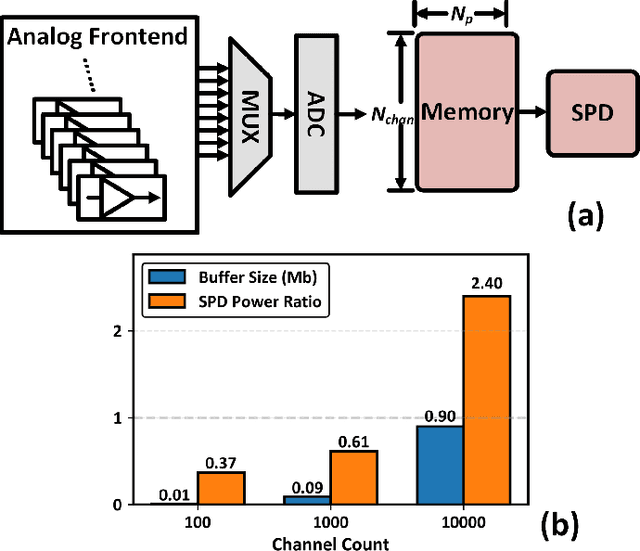
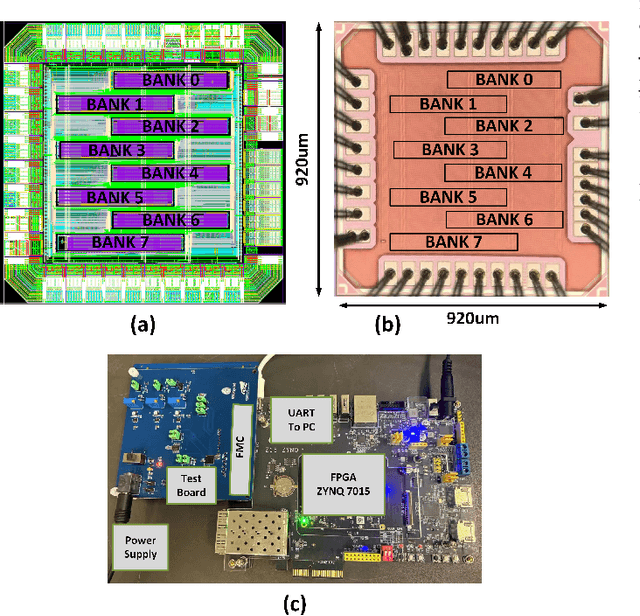
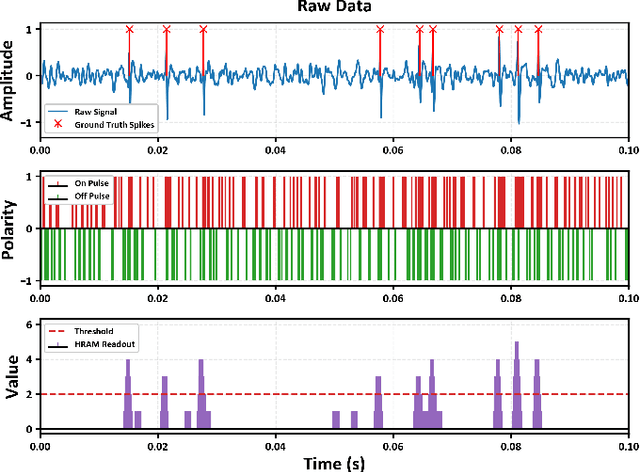
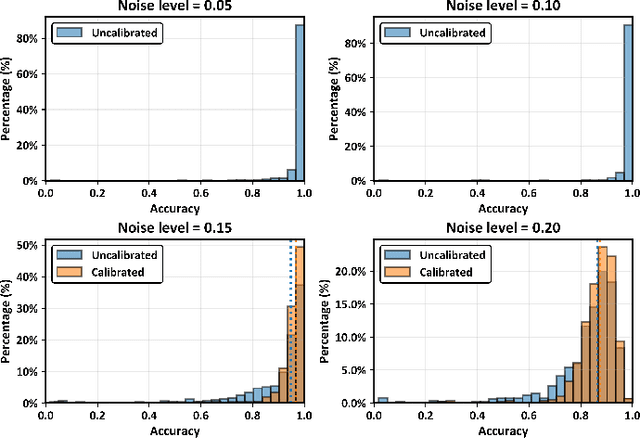
The increasing data rate has become a major issue confronting next-generation intracortical brain-machine interfaces (iBMIs). The scaling number of recording sites requires complex analog wiring and lead to huge digitization power consumption. Compressive event-based neural frontends have been used in high-density neural implants to support the simultaneous recording of more channels. Event-based frontends (EBF) convert recorded signals into asynchronous digital events via delta modulation and can inherently achieve considerable compression. But EBFs are prone to false events that do not correspond to neural spikes. Spike detection (SPD) is a key process in the iBMI pipeline to detect neural spikes and further reduce the data rate. However, conventional digital SPD suffers from the increasing buffer size and frequent memory access power, and conventional spike emphasizers are not compatible with EBFs. In this work we introduced an event-based spike detection (Ev-SPD) algorithm for scalable compressive EBFs. To implement the algorithm effectively, we proposed a novel low-power 10-T eDRAM-SRAM hybrid random-access memory in-memory computing bitcell for event processing. We fabricated the proposed 1024-channel IMC SPD macro in a 65nm process and tested the macro with both synthetic dataset and Neuropixel recordings. The proposed macro achieved a high spike detection accuracy of 96.06% on a synthetic dataset and 95.08% similarity and 0.05 firing pattern MAE on Neuropixel recordings. Our event-based IMC SPD macro achieved a high per channel spike detection energy efficiency of 23.9 nW per channel and an area efficiency of 375 um^2 per channel. Our work presented a SPD scheme compatible with compressive EBFs for high-density iBMIs, achieving ultra-low power consumption with an IMC architecture while maintaining considerable accuracy.