 Add to Chrome
 Add to Firefox
 Add to Edge
1024-Channel 0.8V 23.9-nW/Channel Event-based Compute In-memory Neural Spike Detector
Paper and Code
Dec 09, 2025
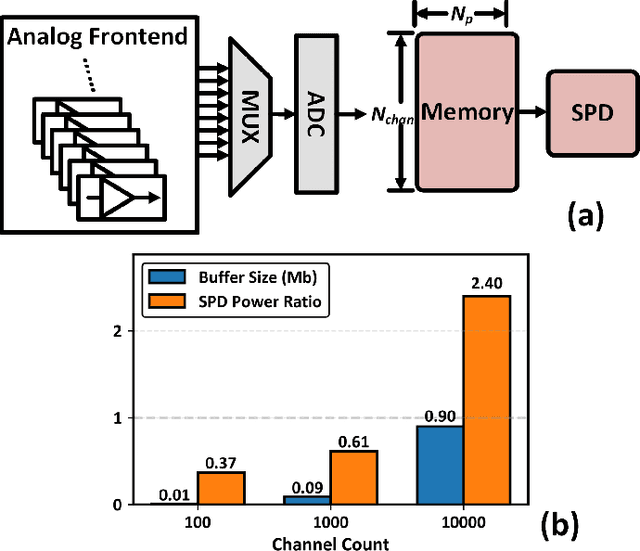
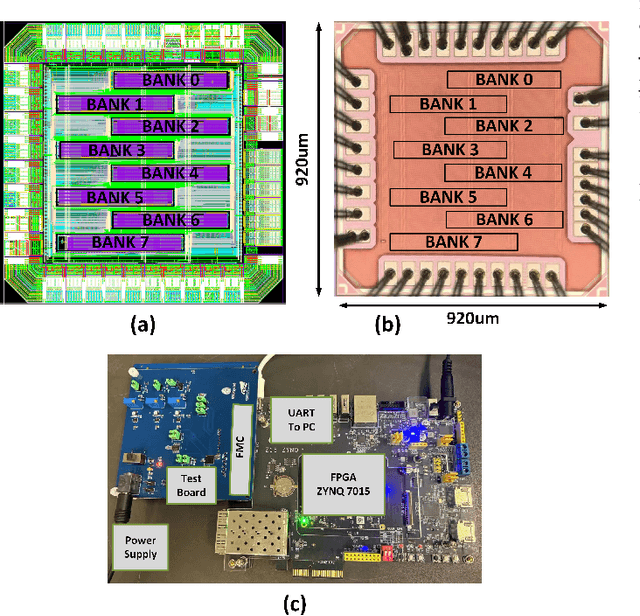
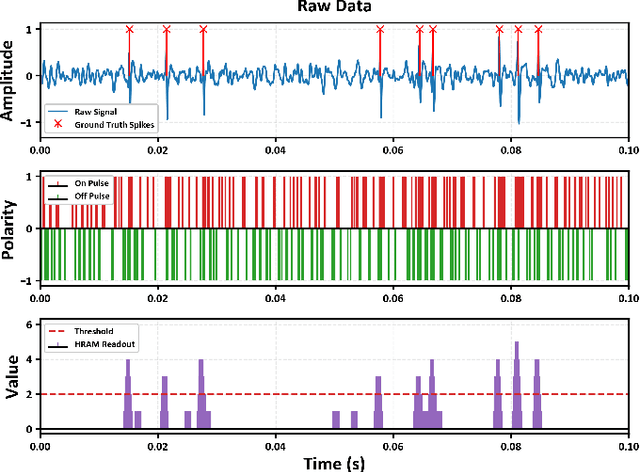
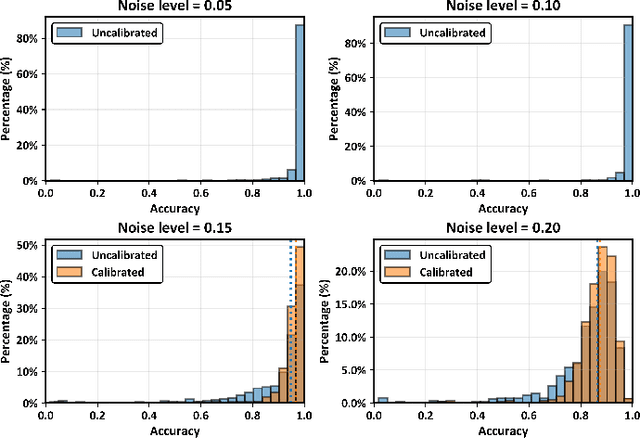
The increasing data rate has become a major issue confronting next-generation intracortical brain-machine interfaces (iBMIs). The scaling number of recording sites requires complex analog wiring and lead to huge digitization power consumption. Compressive event-based neural frontends have been used in high-density neural implants to support the simultaneous recording of more channels. Event-based frontends (EBF) convert recorded signals into asynchronous digital events via delta modulation and can inherently achieve considerable compression. But EBFs are prone to false events that do not correspond to neural spikes. Spike detection (SPD) is a key process in the iBMI pipeline to detect neural spikes and further reduce the data rate. However, conventional digital SPD suffers from the increasing buffer size and frequent memory access power, and conventional spike emphasizers are not compatible with EBFs. In this work we introduced an event-based spike detection (Ev-SPD) algorithm for scalable compressive EBFs. To implement the algorithm effectively, we proposed a novel low-power 10-T eDRAM-SRAM hybrid random-access memory in-memory computing bitcell for event processing. We fabricated the proposed 1024-channel IMC SPD macro in a 65nm process and tested the macro with both synthetic dataset and Neuropixel recordings. The proposed macro achieved a high spike detection accuracy of 96.06% on a synthetic dataset and 95.08% similarity and 0.05 firing pattern MAE on Neuropixel recordings. Our event-based IMC SPD macro achieved a high per channel spike detection energy efficiency of 23.9 nW per channel and an area efficiency of 375 um^2 per channel. Our work presented a SPD scheme compatible with compressive EBFs for high-density iBMIs, achieving ultra-low power consumption with an IMC architecture while maintaining considerable accuracy.
