 Add to Chrome
 Add to Firefox
 Add to Edge
TactX: Learning Shared Tactile Representations Across Diverse Sensors
Jun 30, 2026
Tactile sensors provide critical information for contact-rich manipulation, yet tactile representations and policies remain tightly coupled to each specific sensor, limiting transferability across robots and hardware platforms. We propose TactX, a framework for learning a transferable tactile representation across sensors spanning three fundamentally different transduction modalities: resistive, magnetic, and vision-based. TactX maps heterogeneous tactile observations into a shared latent space through modality-specific encoders trained on paired contact data. Such paired interactions provide a natural alignment signal across modalities, and the encoders are jointly trained across all sensor pairs, inducing a consistent latent space for all sensor types. Our experiments show that TactX aligns tactile representations across sensors while preserving object-level contact information, as evidenced by sensor-identity prediction and object classification in the learned latent space. We evaluate TactX on four contact-rich manipulation tasks: pick-and-place, plug insertion, board wiping, and object reorientation, and show that policies trained with one sensor transfer zero-shot to physically distinct sensors through the shared latent. This improves the average success rate from 27.5% for vision-only policy to 45.9%, providing a step toward sensor-agnostic tactile manipulation.

TacO: Benchmarking Tactile Sensors for Object Manipulation
May 21, 2026Vision-based learning from demonstrations has achieved remarkable success in enabling robots to perform manipulation tasks and high-level semantic reasoning, yet it remains insufficient for complex, contact-rich manipulation. While there is broad agreement that tactile sensing improves manipulation, there is no empirical guidance on which tactile sensors are best suited for which manipulation tasks. In this paper, we provide a systematic, task-driven evaluation of tactile sensors for robot manipulation and propose a framework for selecting and evaluating sensors based on manipulation policy performance. Separate manipulation policies are trained for tactile sensors of four distinct modalities: visual, acoustic, magnetic, and resistive, across three tasks: pick-and-place with unknown mass, object reorientation, and plug insertion. For each task, an analysis of how sensor properties such as spatial resolution, shear sensing, and tactile representation, and the inherent material friction affect task performances is done. Rather than tactile sensing being universally beneficial in the same way, our results show that the usefulness of tactile information depends strongly on sensor modality, material properties, and the specific manipulation tasks. All of the tactile sensors, code, data, and hardware setup will be publicly available on the project website.
Grounding Driving VLA via Inverse Kinematics
May 20, 2026Existing Driving VLAs predict trajectories while largely ignoring their visual tokens -- a phenomenon we trace not to insufficient training but to a structurally ill-posed task formulation. We show that trajectory recovery, when viewed through the lens of inverse kinematics, requires both a current and a future visual state as boundary conditions; existing VLAs supply only the former, which encourages the model to shortcut through ego status and text commands alone. To address this, we re-design Driving VLA in the style of an inverse kinematics solver. First, a next visual state prediction objective that requires the LLM to predict the future visual scene provides dense visual supervision and suppresses shortcut paths. Second, a separate Inverse Kinematics Network (a cross-attention-based conditional diffusion model) that takes only the current and future visual states as input is designed to suppress reliance on ego status and textual shortcuts during trajectory decoding. With this simple prescription alone, our 0.5B-scale model recovers visual grounding and reaches trajectory planning performance comparable to 7B--8B VLAs more than an order of magnitude larger, on both the closed-loop NAVSIM-v2 and the nuScenes benchmarks. Extensive analysis further shows that this improvement stems from a recovered ability to exploit visual features, with the effect being most pronounced in dynamic driving situations such as turning.
Contextualized Visual Personalization in Vision-Language Models
Feb 03, 2026Despite recent progress in vision-language models (VLMs), existing approaches often fail to generate personalized responses based on the user's specific experiences, as they lack the ability to associate visual inputs with a user's accumulated visual-textual context. We newly formalize this challenge as contextualized visual personalization, which requires the visual recognition and textual retrieval of personalized visual experiences by VLMs when interpreting new images. To address this issue, we propose CoViP, a unified framework that treats personalized image captioning as a core task for contextualized visual personalization and improves this capability through reinforcement-learning-based post-training and caption-augmented generation. We further introduce diagnostic evaluations that explicitly rule out textual shortcut solutions and verify whether VLMs truly leverage visual context. Extensive experiments demonstrate that existing open-source and proprietary VLMs exhibit substantial limitations, while CoViP not only improves personalized image captioning but also yields holistic gains across downstream personalization tasks. These results highlight CoViP as a crucial stage for enabling robust and generalizable contextualized visual personalization.
The RoboSense Challenge: Sense Anything, Navigate Anywhere, Adapt Across Platforms
Jan 08, 2026Autonomous systems are increasingly deployed in open and dynamic environments -- from city streets to aerial and indoor spaces -- where perception models must remain reliable under sensor noise, environmental variation, and platform shifts. However, even state-of-the-art methods often degrade under unseen conditions, highlighting the need for robust and generalizable robot sensing. The RoboSense 2025 Challenge is designed to advance robustness and adaptability in robot perception across diverse sensing scenarios. It unifies five complementary research tracks spanning language-grounded decision making, socially compliant navigation, sensor configuration generalization, cross-view and cross-modal correspondence, and cross-platform 3D perception. Together, these tasks form a comprehensive benchmark for evaluating real-world sensing reliability under domain shifts, sensor failures, and platform discrepancies. RoboSense 2025 provides standardized datasets, baseline models, and unified evaluation protocols, enabling large-scale and reproducible comparison of robust perception methods. The challenge attracted 143 teams from 85 institutions across 16 countries, reflecting broad community engagement. By consolidating insights from 23 winning solutions, this report highlights emerging methodological trends, shared design principles, and open challenges across all tracks, marking a step toward building robots that can sense reliably, act robustly, and adapt across platforms in real-world environments.
Robust Driving QA through Metadata-Grounded Context and Task-Specific Prompts
Oct 21, 2025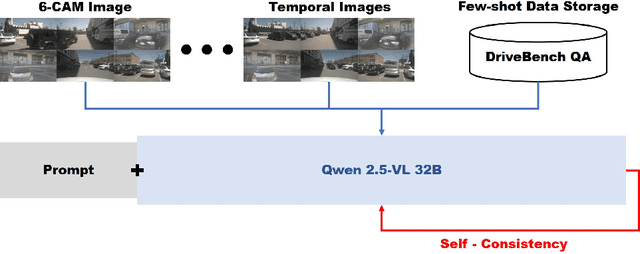
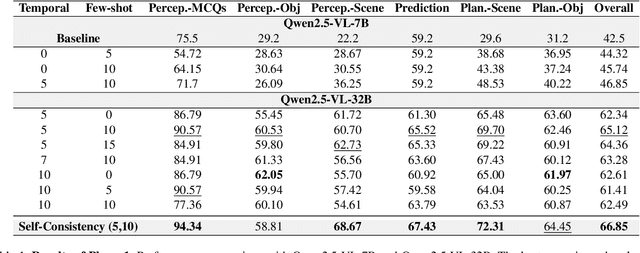
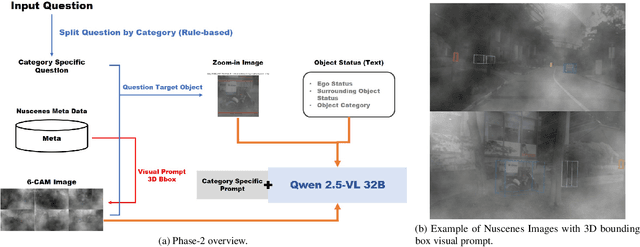

We present a two-phase vision-language QA system for autonomous driving that answers high-level perception, prediction, and planning questions. In Phase-1, a large multimodal LLM (Qwen2.5-VL-32B) is conditioned on six-camera inputs, a short temporal window of history, and a chain-of-thought prompt with few-shot exemplars. A self-consistency ensemble (multiple sampled reasoning chains) further improves answer reliability. In Phase-2, we augment the prompt with nuScenes scene metadata (object annotations, ego-vehicle state, etc.) and category-specific question instructions (separate prompts for perception, prediction, planning tasks). In experiments on a driving QA benchmark, our approach significantly outperforms the baseline Qwen2.5 models. For example, using 5 history frames and 10-shot prompting in Phase-1 yields 65.1% overall accuracy (vs.62.61% with zero-shot); applying self-consistency raises this to 66.85%. Phase-2 achieves 67.37% overall. Notably, the system maintains 96% accuracy under severe visual corruption. These results demonstrate that carefully engineered prompts and contextual grounding can greatly enhance high-level driving QA with pretrained vision-language models.
3D-Aware Vision-Language Models Fine-Tuning with Geometric Distillation
Jun 11, 2025Vision-Language Models (VLMs) have shown remarkable performance on diverse visual and linguistic tasks, yet they remain fundamentally limited in their understanding of 3D spatial structures. We propose Geometric Distillation, a lightweight, annotation-free fine-tuning framework that injects human-inspired geometric cues into pretrained VLMs without modifying their architecture. By distilling (1) sparse correspondences, (2) relative depth relations, and (3) dense cost volumes from off-the-shelf 3D foundation models (e.g., MASt3R, VGGT), our method shapes representations to be geometry-aware while remaining compatible with natural image-text inputs. Through extensive evaluations on 3D vision-language reasoning and 3D perception benchmarks, our method consistently outperforms prior approaches, achieving improved 3D spatial reasoning with significantly lower computational cost. Our work demonstrates a scalable and efficient path to bridge 2D-trained VLMs with 3D understanding, opening up wider use in spatially grounded multimodal tasks.
No Thing, Nothing: Highlighting Safety-Critical Classes for Robust LiDAR Semantic Segmentation in Adverse Weather
Mar 20, 2025Existing domain generalization methods for LiDAR semantic segmentation under adverse weather struggle to accurately predict "things" categories compared to "stuff" categories. In typical driving scenes, "things" categories can be dynamic and associated with higher collision risks, making them crucial for safe navigation and planning. Recognizing the importance of "things" categories, we identify their performance drop as a serious bottleneck in existing approaches. We observed that adverse weather induces degradation of semantic-level features and both corruption of local features, leading to a misprediction of "things" as "stuff". To mitigate these corruptions, we suggest our method, NTN - segmeNt Things for No-accident. To address semantic-level feature corruption, we bind each point feature to its superclass, preventing the misprediction of things classes into visually dissimilar categories. Additionally, to enhance robustness against local corruption caused by adverse weather, we define each LiDAR beam as a local region and propose a regularization term that aligns the clean data with its corrupted counterpart in feature space. NTN achieves state-of-the-art performance with a +2.6 mIoU gain on the SemanticKITTI-to-SemanticSTF benchmark and +7.9 mIoU on the SemanticPOSS-to-SemanticSTF benchmark. Notably, NTN achieves a +4.8 and +7.9 mIoU improvement on "things" classes, respectively, highlighting its effectiveness.
Know "No" Better: A Data-Driven Approach for Enhancing Negation Awareness in CLIP
Jan 19, 2025While CLIP has significantly advanced multimodal understanding by bridging vision and language, the inability to grasp negation - such as failing to differentiate concepts like "parking" from "no parking" - poses substantial challenges. By analyzing the data used in the public CLIP model's pre-training, we posit this limitation stems from a lack of negation-inclusive data. To address this, we introduce data generation pipelines that employ a large language model (LLM) and a multimodal LLM to produce negation-inclusive captions. Fine-tuning CLIP with data generated from our pipelines, we develop NegationCLIP, which enhances negation awareness while preserving the generality. Moreover, to enable a comprehensive evaluation of negation understanding, we propose NegRefCOCOg-a benchmark tailored to test VLMs' ability to interpret negation across diverse expressions and positions within a sentence. Experiments on various CLIP architectures validate the effectiveness of our data generation pipelines in enhancing CLIP's ability to perceive negation accurately. Additionally, NegationCLIP's enhanced negation awareness has practical applications across various multimodal tasks, demonstrated by performance gains in text-to-image generation and referring image segmentation.
Unleashing Multi-Hop Reasoning Potential in Large Language Models through Repetition of Misordered Context
Oct 09, 2024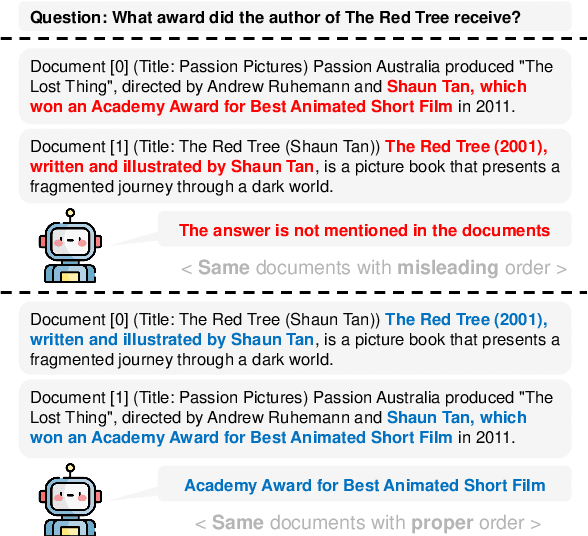

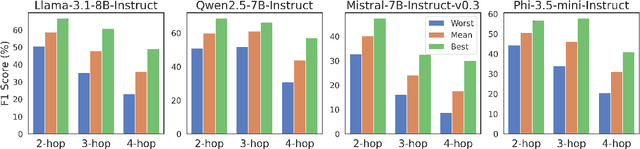

Multi-hop reasoning, which requires multi-step reasoning based on the supporting documents within a given context, remains challenging for large language models (LLMs). LLMs often struggle to filter out irrelevant documents within the context, and their performance is sensitive to the position of supporting documents within that context. In this paper, we identify an additional challenge: LLMs' performance is also sensitive to the order in which the supporting documents are presented. We refer to this as the misordered context problem. To address this issue, we propose a simple yet effective method called context repetition (CoRe), which involves prompting the model by repeatedly presenting the context to ensure the supporting documents are presented in the optimal order for the model. Using CoRe, we improve the F1 score by up to 30%p on multi-hop QA tasks and increase accuracy by up to 70%p on a synthetic task. Additionally, CoRe helps mitigate the well-known "lost-in-the-middle" problem in LLMs and can be effectively combined with retrieval-based approaches utilizing Chain-of-Thought (CoT) reasoning.