 Add to Chrome
 Add to Firefox
 Add to Edge
TactX: Learning Shared Tactile Representations Across Diverse Sensors
Jun 30, 2026
Tactile sensors provide critical information for contact-rich manipulation, yet tactile representations and policies remain tightly coupled to each specific sensor, limiting transferability across robots and hardware platforms. We propose TactX, a framework for learning a transferable tactile representation across sensors spanning three fundamentally different transduction modalities: resistive, magnetic, and vision-based. TactX maps heterogeneous tactile observations into a shared latent space through modality-specific encoders trained on paired contact data. Such paired interactions provide a natural alignment signal across modalities, and the encoders are jointly trained across all sensor pairs, inducing a consistent latent space for all sensor types. Our experiments show that TactX aligns tactile representations across sensors while preserving object-level contact information, as evidenced by sensor-identity prediction and object classification in the learned latent space. We evaluate TactX on four contact-rich manipulation tasks: pick-and-place, plug insertion, board wiping, and object reorientation, and show that policies trained with one sensor transfer zero-shot to physically distinct sensors through the shared latent. This improves the average success rate from 27.5% for vision-only policy to 45.9%, providing a step toward sensor-agnostic tactile manipulation.

TacO: Benchmarking Tactile Sensors for Object Manipulation
May 21, 2026Vision-based learning from demonstrations has achieved remarkable success in enabling robots to perform manipulation tasks and high-level semantic reasoning, yet it remains insufficient for complex, contact-rich manipulation. While there is broad agreement that tactile sensing improves manipulation, there is no empirical guidance on which tactile sensors are best suited for which manipulation tasks. In this paper, we provide a systematic, task-driven evaluation of tactile sensors for robot manipulation and propose a framework for selecting and evaluating sensors based on manipulation policy performance. Separate manipulation policies are trained for tactile sensors of four distinct modalities: visual, acoustic, magnetic, and resistive, across three tasks: pick-and-place with unknown mass, object reorientation, and plug insertion. For each task, an analysis of how sensor properties such as spatial resolution, shear sensing, and tactile representation, and the inherent material friction affect task performances is done. Rather than tactile sensing being universally beneficial in the same way, our results show that the usefulness of tactile information depends strongly on sensor modality, material properties, and the specific manipulation tasks. All of the tactile sensors, code, data, and hardware setup will be publicly available on the project website.
Bin-picking of novel objects through category-agnostic-segmentation: RGB matters
Dec 27, 2023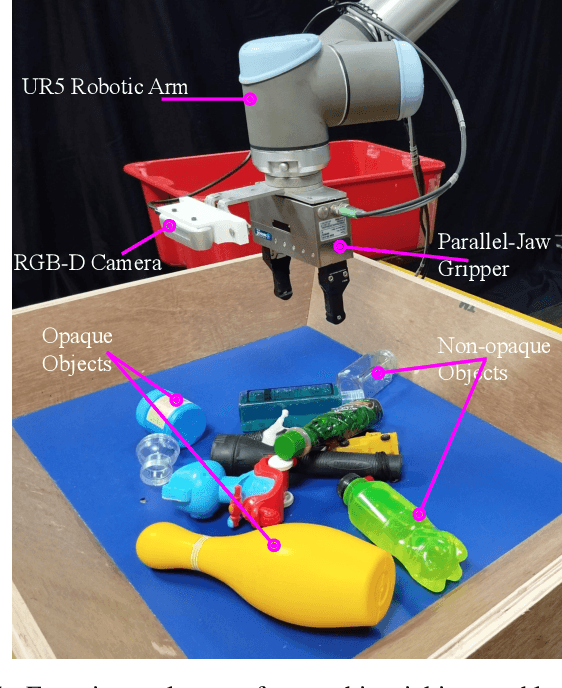
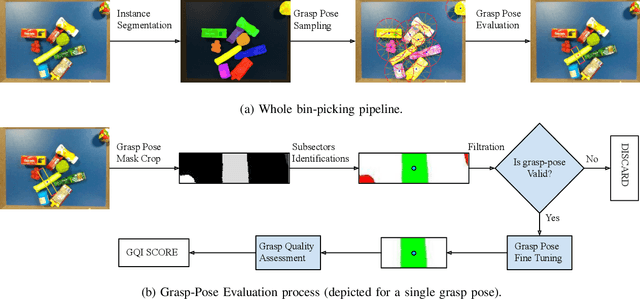
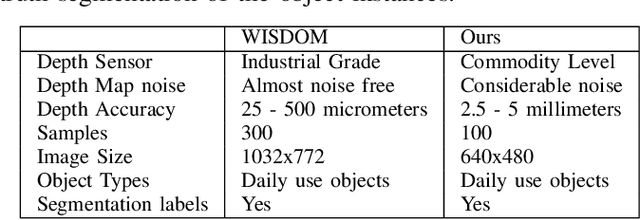
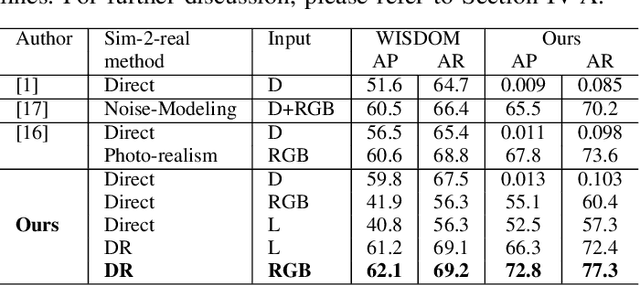
This paper addresses category-agnostic instance segmentation for robotic manipulation, focusing on segmenting objects independent of their class to enable versatile applications like bin-picking in dynamic environments. Existing methods often lack generalizability and object-specific information, leading to grasp failures. We present a novel approach leveraging object-centric instance segmentation and simulation-based training for effective transfer to real-world scenarios. Notably, our strategy overcomes challenges posed by noisy depth sensors, enhancing the reliability of learning. Our solution accommodates transparent and semi-transparent objects which are historically difficult for depth-based grasping methods. Contributions include domain randomization for successful transfer, our collected dataset for warehouse applications, and an integrated framework for efficient bin-picking. Our trained instance segmentation model achieves state-of-the-art performance over WISDOM public benchmark [1] and also over the custom-created dataset. In a real-world challenging bin-picking setup our bin-picking framework method achieves 98% accuracy for opaque objects and 97% accuracy for non-opaque objects, outperforming the state-of-the-art baselines with a greater margin.