 Add to Chrome
 Add to Firefox
 Add to Edge
Rollout-Level Advantage-Prioritized Experience Replay for GRPO
Jun 04, 2026
Reinforcement learning from verifiable rewards with GRPO is a standard approach for post-training reasoning LLMs. It remains sample inefficient. Each rollout is used for a single gradient update and then discarded. Naive replay is not well suited in this setting because LLM policies drift quickly per gradient step. Stored rollouts therefore become stale and can destabilize training. We propose a rollout-level replay buffer for GRPO that stores and samples individual rollouts rather than whole groups. The buffer bounds staleness through age eviction. Any rollout older than tau_max training steps is removed. The buffer also preserves on-policy data via fresh-anchored composition. Each batch keeps its fresh on-policy rollouts and then concatenates replay rollouts drawn separately from the buffer. We prioritize replay by per-rollout advantage magnitude and recycle individual rollouts whose advantages are large. Across three Qwen3-Base scales on five math benchmarks, our method outperforms GRPO and naive replay baselines. Gains are positive at every scale and grow with model size. The largest gain is +4.35 pp on the five-benchmark average at 4B. Under an AES metric that jointly measures accuracy and token efficiency, the efficiency margin over GRPO is again largest at 4B, at +0.579.

Mirroring the Mind: Distilling Human-Like Metacognitive Strategies into Large Language Models
Feb 26, 2026Large Reasoning Models (LRMs) often exhibit structural fragility in complex reasoning tasks, failing to produce correct answers even after successfully deriving valid intermediate steps. Through systematic analysis, we observe that these failures frequently stem not from a lack of reasoning capacity, but from a deficiency in self-regulatory control, where valid logic is destabilized by uncontrolled exploration or the failure to recognize logical sufficiency. Motivated by this observation, we propose Metacognitive Behavioral Tuning (MBT), a post-training framework that explicitly injects metacognitive behaviors into the model's thought process. MBT implements this via two complementary formulations: (1) MBT-S, which synthesizes rigorous reasoning traces from scratch, and (2) MBT-R, which rewrites the student's initial traces to stabilize intrinsic exploration patterns. Experiments across multi-hop QA benchmarks demonstrate that MBT consistently outperforms baselines, achieving notable gains on challenging benchmarks. By effectively eliminating reasoning collapse, MBT achieves higher accuracy with significantly reduced token consumption, demonstrating that internalizing metacognitive strategies leads to more stable and robust reasoning.
Knowledge Integration Decay in Search-Augmented Reasoning of Large Language Models
Feb 10, 2026Modern Large Language Models (LLMs) have demonstrated remarkable capabilities in complex tasks by employing search-augmented reasoning to incorporate external knowledge into long chains of thought. However, we identify a critical yet underexplored bottleneck in this paradigm, termed Knowledge Integration Decay (KID). Specifically, we observe that as the length of reasoning generated before search grows, models increasingly fail to integrate retrieved evidence into subsequent reasoning steps, limiting performance even when relevant information is available. To address this, we propose Self-Anchored Knowledge Encoding (SAKE), a training-free inference-time strategy designed to stabilize knowledge utilization. By anchoring retrieved knowledge at both the beginning and end of the reasoning process, SAKE prevents it from being overshadowed by prior context, thereby preserving its semantic integrity. Extensive experiments on multi-hop QA and complex reasoning benchmarks demonstrate that SAKE significantly mitigates KID and improves performance, offering a lightweight yet effective solution for knowledge integration in agentic LLMs.
Unleashing Multi-Hop Reasoning Potential in Large Language Models through Repetition of Misordered Context
Oct 09, 2024

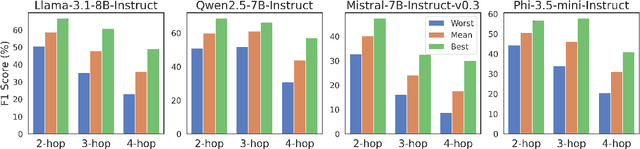

Multi-hop reasoning, which requires multi-step reasoning based on the supporting documents within a given context, remains challenging for large language models (LLMs). LLMs often struggle to filter out irrelevant documents within the context, and their performance is sensitive to the position of supporting documents within that context. In this paper, we identify an additional challenge: LLMs' performance is also sensitive to the order in which the supporting documents are presented. We refer to this as the misordered context problem. To address this issue, we propose a simple yet effective method called context repetition (CoRe), which involves prompting the model by repeatedly presenting the context to ensure the supporting documents are presented in the optimal order for the model. Using CoRe, we improve the F1 score by up to 30%p on multi-hop QA tasks and increase accuracy by up to 70%p on a synthetic task. Additionally, CoRe helps mitigate the well-known "lost-in-the-middle" problem in LLMs and can be effectively combined with retrieval-based approaches utilizing Chain-of-Thought (CoT) reasoning.