 Add to Chrome
 Add to Firefox
 Add to Edge
Spark-to-Paper: End-to-End Research Paper Generation as a Composable Skill
Aug 12, 2026
Turning a research idea into a complete paper requires more than text generation: the system must retrieve literature, design and execute experiments, revise claims according to evidence, produce publication-ready figures, and maintain consistency across a long generation process. We present Spark-to-Paper, an end-to-end research paper generation system implemented as thirteen composable skills inside an existing coding assistant, without requiring a separate agent platform or orchestration service. Spark-to-Paper separates model-based judgment from deterministic operations that can be directly executed and checked. It further separates experiment planning from reporting, so that required evidence is specified before results are observed and manuscript claims are revised according to measured outcomes. To improve reliability over long research trajectories, the system combines deterministic integrity checks with self-critique and bounds a failure mode we call the Self-Refutation Loop, in which repeated experiments continue to reject the original research objective. Spark-to-Paper also produces editable vector figures through programmatic plotting for experimental results and code-based reconstruction for generated method diagrams. Across eight controlled research topics, Spark-to-Paper achieves 99.5% citation validity and 96.4% figure editability. A controlled ablation increases fabrication detection from 14% for a single-pass draft to 92% with the full integrity and review stack, while adversarial review achieves 74% precision. The full system uses 11.9M tokens, costs $8.1 per manuscript, and requires 3.2 hours on average. These results show that end-to-end research paper generation can be implemented as a lightweight, composable workflow inside existing coding assistants while keeping experimental evidence central to how claims are accepted, revised, or abandoned.

MotionMAR: Multi-scale Auto-Regressive Human Motion Reconstruction from Sparse Observations
Jun 22, 2026Human motion follows a temporal hierarchical structure, transitioning from low-frequency global trajectories to high-frequency details. Inspired by the success of multi-level autoregressive models in computer vision, we propose MotionMAR, a coarse-to-fine framework for motion reconstruction from sparse observations. It first estimates the global trajectory of human motion and then gradually refines the temporal details. This architecture consists of four integrated components. The Temporal Multi-scale Tokenization (TMT) VQ-VAE encodes the data at multiple temporal resolutions, separating semantic motion from minor jitters. The Motion Autoregressive Network (MAN) operates in this latent space, predicting motion across scales. It first establishes the global structure through coarse indices and then generates finer indices to recover specific details. Meanwhile, the Scale-Aware Control (SAC) module integrates sparse tracking data to ensure the generated output aligns with actual observations. The Motion Refinement Network (MRN) subsequently smooths consecutive poses and eliminates quantization artifacts. Experiments show that MotionMAR achieves state-of-the-art accuracy on the AMASS dataset, providing a reliable and structure-aware approach for motion reconstruction. The source code is publicly available at http://www.lidarhumanmotion.net/motionmar/.
MDistMult: A Multiple Scoring Functions Model for Link Prediction on Antiviral Drugs Knowledge Graph
Nov 29, 2021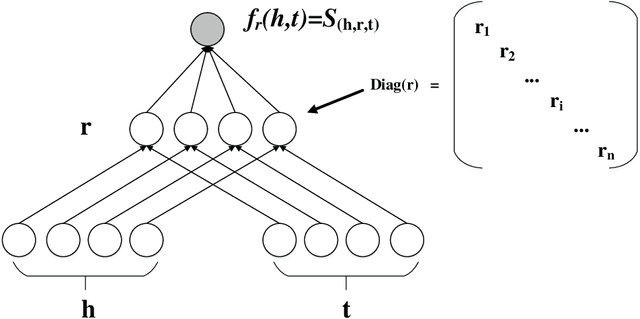
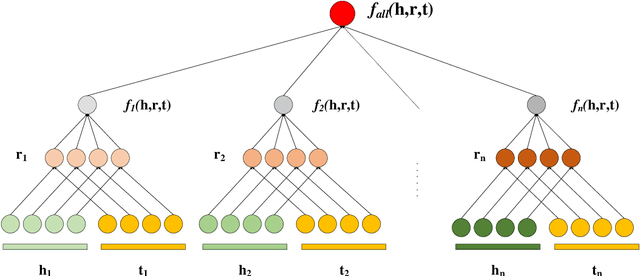
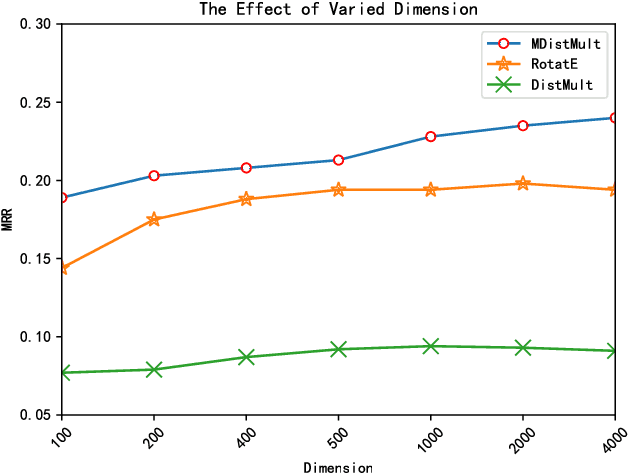
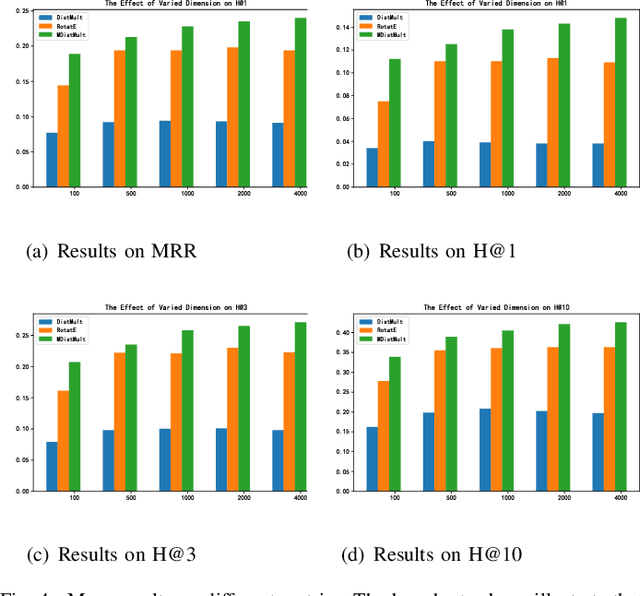
Knowledge graphs (KGs) on COVID-19 have been constructed to accelerate the research process of COVID-19. However, KGs are always incomplete, especially the new constructed COVID-19 KGs. Link prediction task aims to predict missing entities for (e, r, t) or (h, r, e), where h and t are certain entities, e is an entity that needs to be predicted and r is a relation. This task also has the potential to solve COVID-19 related KGs' incomplete problem. Although various knowledge graph embedding (KGE) approaches have been proposed to the link prediction task, these existing methods suffer from the limitation of using a single scoring function, which fails to capture rich features of COVID-19 KGs. In this work, we propose the MDistMult model that leverages multiple scoring functions to extract more features from existing triples. We employ experiments on the CCKS2020 COVID-19 Antiviral Drugs Knowledge Graph (CADKG). The experimental results demonstrate that our MDistMult achieves state-of-the-art performance in link prediction task on the CADKG dataset
Topological Centrality and Its Applications
Feb 11, 2009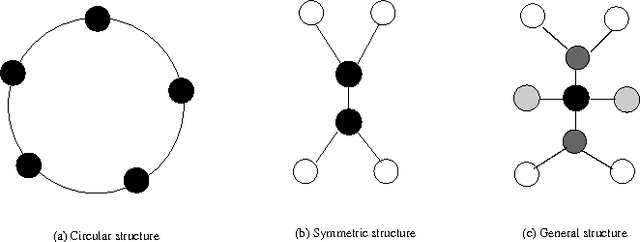
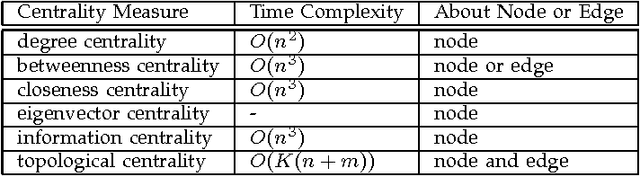
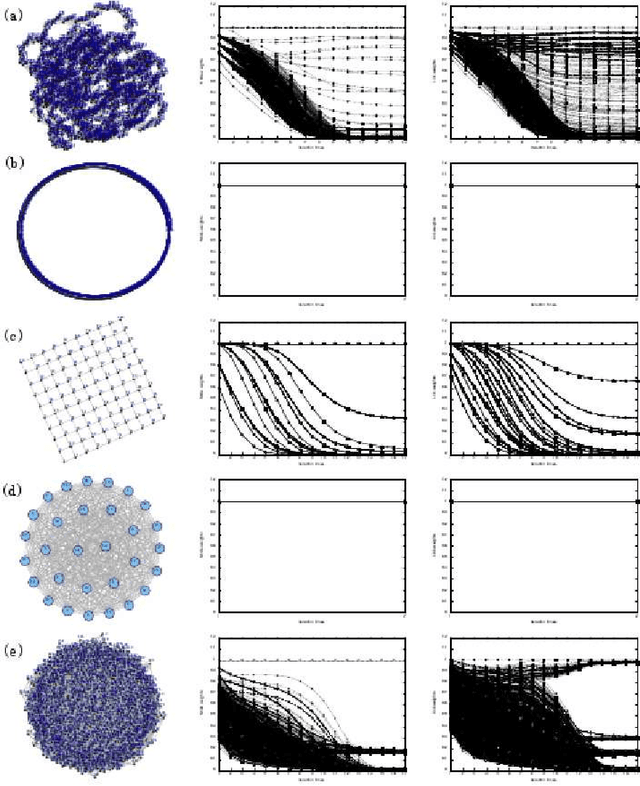
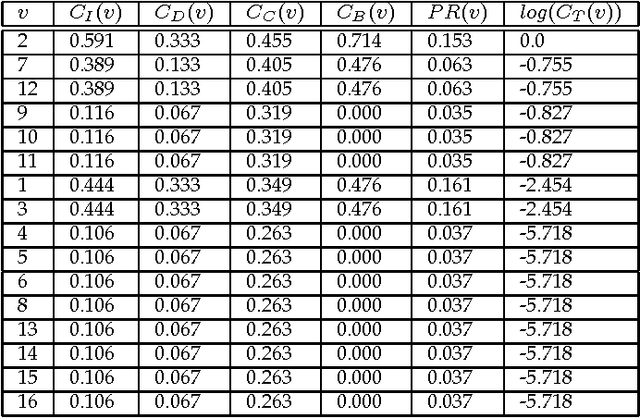
Recent development of network structure analysis shows that it plays an important role in characterizing complex system of many branches of sciences. Different from previous network centrality measures, this paper proposes the notion of topological centrality (TC) reflecting the topological positions of nodes and edges in general networks, and proposes an approach to calculating the topological centrality. The proposed topological centrality is then used to discover communities and build the backbone network. Experiments and applications on research network show the significance of the proposed approach.