 Add to Chrome
 Add to Firefox
 Add to Edge
CARE: Controlling LLM-Generated Policies through Auditable Review of Evidence in Scientific Experimentation
Jun 12, 2026
Granting LLMs direct control over costly, irreversible scientific experiments leads to unsafe exploration and unstable performance, but discarding LLM creativity entirely sacrifices significant optimization potential. We introduce CARE (Controlling LLM-Generated Policies through Auditable Review of Evidence in Scientific Experimentation), an auditable controller for high-throughput experimentation (HTE) optimization that keeps a non-LLM incumbent optimizer as the default action path while using LLMs to revise challenger ranking policies. Before each outcome is revealed, a public-evidence intervention gate compares the challenger with the incumbent. It authorizes the challenger's selection only when the evidence available before selection supports the change, with the decision recorded in the audit log. CARE outperforms all other evaluated methods on Minerva/Olympus and ChemLex benchmarks, with final-best improving from 80.0 to 88.5 on Minerva/Olympus and from 83.9 to 92.1 on ChemLex, relative to the public incumbent. Our experiments indicate that LLM self-evolution is more reliable when it expands the proposal space under an auditable controller, rather than directly choosing experiments.

See, Infer, Intervene: Proactive World Modeling for Goal-Oriented Social Intelligence
Jun 02, 2026Multimodal retail agents should not only recognize what a customer is doing, but also decide whether and how to assist before an explicit request is made. We study this setting through the See--Infer--Intervene (SII) framework, where a device must see pre-interaction behavior, infer latent customer intent, and act by selecting an appropriate service intervention or choosing to wait. We instantiate SII with the Proactive Intent World Model (PIWM), which represents customer state with AIDA (Attention, Interest, Desire, Action) purchasing phases and BDI (belief, desire, intention) psychological fields, predicts action-conditioned intent transitions, and selects from five response classes: Greet, Elicit, Inform, Recommend, and Hold. We further construct GuidanceSalesBench, a smart-retail benchmark containing state manifests, pre-interaction videos, candidate responses, action-conditioned outcomes, and best-action labels. When conditioned on ground-truth customer state to isolate action selection, PIWM achieves 0.641 macro F1 on 30 held-out target videos, outperforming a zero-shot Qwen2.5-VL-7B baseline and training variants without balanced action supervision; end-to-end video-only selection drops to 0.295, below the 5-class balanced random baseline of 0.414, identifying video-to-state grounding as the dominant deployment-time bottleneck. A preliminary staged real-store pilot (recorded with paid participants performing scripted customer behaviors) reaches 0.579 action macro F1 on 20 fully annotated videos, with 10 additional accessible videos released with index-level labels.
Adaptive Detector-Verifier Framework for Zero-Shot Polyp Detection in Open-World Settings
Dec 16, 2025Polyp detectors trained on clean datasets often underperform in real-world endoscopy, where illumination changes, motion blur, and occlusions degrade image quality. Existing approaches struggle with the domain gap between controlled laboratory conditions and clinical practice, where adverse imaging conditions are prevalent. In this work, we propose AdaptiveDetector, a novel two-stage detector-verifier framework comprising a YOLOv11 detector with a vision-language model (VLM) verifier. The detector adaptively adjusts per-frame confidence thresholds under VLM guidance, while the verifier is fine-tuned with Group Relative Policy Optimization (GRPO) using an asymmetric, cost-sensitive reward function specifically designed to discourage missed detections -- a critical clinical requirement. To enable realistic assessment under challenging conditions, we construct a comprehensive synthetic testbed by systematically degrading clean datasets with adverse conditions commonly encountered in clinical practice, providing a rigorous benchmark for zero-shot evaluation. Extensive zero-shot evaluation on synthetically degraded CVC-ClinicDB and Kvasir-SEG images demonstrates that our approach improves recall by 14 to 22 percentage points over YOLO alone, while precision remains within 0.7 points below to 1.7 points above the baseline. This combination of adaptive thresholding and cost-sensitive reinforcement learning achieves clinically aligned, open-world polyp detection with substantially fewer false negatives, thereby reducing the risk of missed precancerous polyps and improving patient outcomes.
Generation of Chinese classical poetry based on pre-trained model
Nov 04, 2022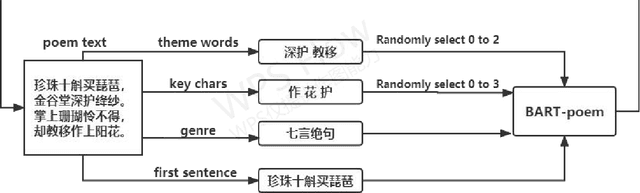
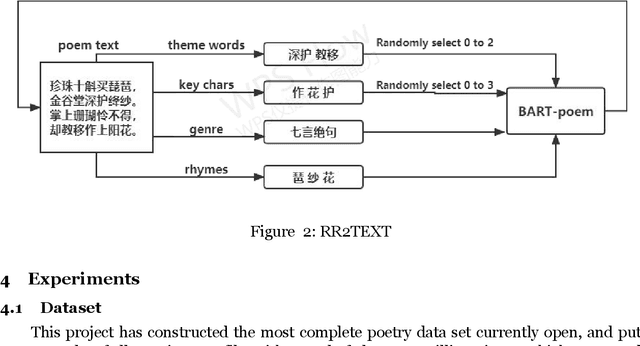
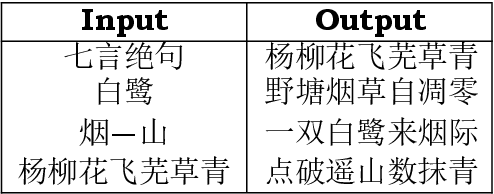
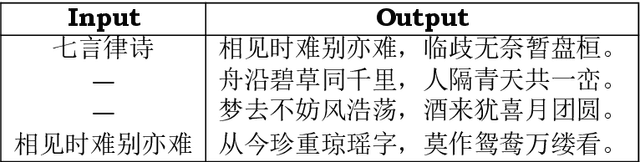
In order to test whether artificial intelligence can create qualified classical poetry like humans, the author proposes a study of Chinese classical poetry generation based on a pre-trained model. This paper mainly tries to use BART and other pre training models, proposes FS2TEXT and RR2TEXT to generate metrical poetry text and even specific style poetry text, and solves the problem that the user's writing intention gradually reduces the relevance of the generated poetry text. In order to test the model's results, the authors selected ancient poets, by combining it with BART's poetic model work, developed a set of AI poetry Turing problems, it was reviewed by a group of poets and poetry writing researchers. There were more than 600 participants, and the final results showed that, high-level poetry lovers can't distinguish between AI activity and human activity, this indicates that the author's working methods are not significantly different from human activities. The model of poetry generation studied by the author generalizes works that cannot be distinguished from those of advanced scholars. The number of modern Chinese poets has reached 5 million. However, many modern Chinese poets lack language ability and skills as a result of their childhood learning. However, many modern poets have no creative inspiration, and the author's model can help them. They can look at this model when they choose words and phrases and they can write works based on the poems they already have, and they can write their own poems. The importance of poetry lies in the author's thoughts and reflections. It doesn't matter how good AI poetry is. The only thing that matters is for people to see and inspire them.