 Add to Chrome
 Add to Firefox
 Add to Edge
What Really Improves Mathematical Reasoning: Structured Reasoning Signals Beyond Pure Code
May 19, 2026
Code has become a standard component of modern foundation language model (LM) training, yet its role beyond programming remains unclear. We revisit the claim that code improves reasoning through controlled pretraining experiments on a 10T-token corpus with fine-grained domain separation. Our findings are threefold. First, when code is restricted to standalone executable programs and Code-NL data are controlled for, code substantially improves programming ability but does not act as a general reasoning enhancer; instead, it competes with knowledge-intensive tasks, especially complex mathematical reasoning. Second, the reasoning gains often attributed to code are better explained by cross-domain structured reasoning traces, such as code-text and math-text mixtures, rather than by executable code alone. Third, increasing the density of structured math-domain samples within a fixed math budget yields substantial gains on difficult mathematical reasoning while largely preserving programming performance, suggesting that cognitive scaffolds offer a targeted way to mitigate cross-domain trade-offs. Finally, routing analyses show that data-composition effects are reflected in expert-activation patterns, providing mechanism-level evidence for competitive and synergistic interactions across domains. Our results clarify which data characteristics transfer across capability dimensions and point to more precise data-centric optimization strategies.

Every FLOP Counts: Scaling a 300B Mixture-of-Experts LING LLM without Premium GPUs
Mar 07, 2025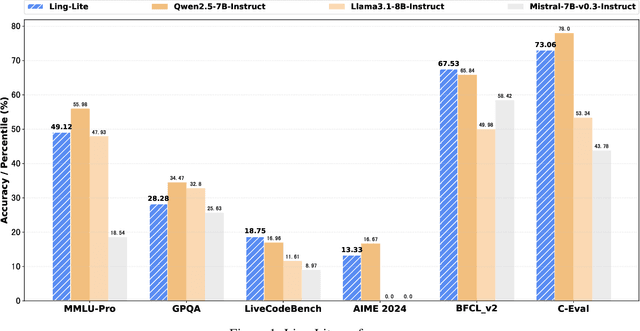
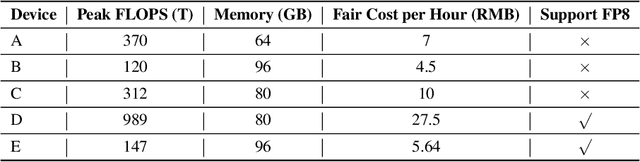
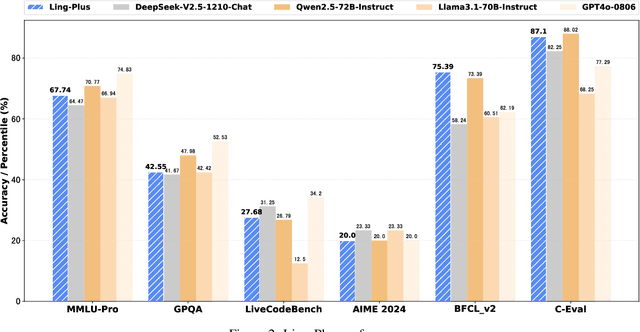
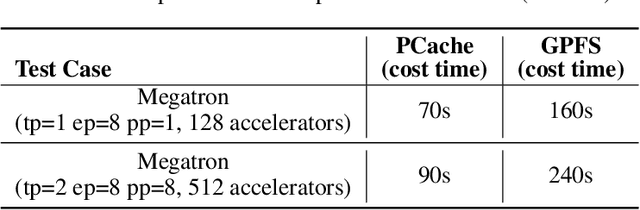
In this technical report, we tackle the challenges of training large-scale Mixture of Experts (MoE) models, focusing on overcoming cost inefficiency and resource limitations prevalent in such systems. To address these issues, we present two differently sized MoE large language models (LLMs), namely Ling-Lite and Ling-Plus (referred to as "Bailing" in Chinese, spelled B\v{a}il\'ing in Pinyin). Ling-Lite contains 16.8 billion parameters with 2.75 billion activated parameters, while Ling-Plus boasts 290 billion parameters with 28.8 billion activated parameters. Both models exhibit comparable performance to leading industry benchmarks. This report offers actionable insights to improve the efficiency and accessibility of AI development in resource-constrained settings, promoting more scalable and sustainable technologies. Specifically, to reduce training costs for large-scale MoE models, we propose innovative methods for (1) optimization of model architecture and training processes, (2) refinement of training anomaly handling, and (3) enhancement of model evaluation efficiency. Additionally, leveraging high-quality data generated from knowledge graphs, our models demonstrate superior capabilities in tool use compared to other models. Ultimately, our experimental findings demonstrate that a 300B MoE LLM can be effectively trained on lower-performance devices while achieving comparable performance to models of a similar scale, including dense and MoE models. Compared to high-performance devices, utilizing a lower-specification hardware system during the pre-training phase demonstrates significant cost savings, reducing computing costs by approximately 20%. The models can be accessed at https://huggingface.co/inclusionAI.