 Add to Chrome
 Add to Firefox
 Add to Edge
Learning to Factorize and Adapt: A Versatile Approach Toward Universal Spatio-Temporal Foundation Models
Jan 17, 2026
Spatio-Temporal (ST) Foundation Models (STFMs) promise cross-dataset generalization, yet joint ST pretraining is computationally expensive and grapples with the heterogeneity of domain-specific spatial patterns. Substantially extending our preliminary conference version, we present FactoST-v2, an enhanced factorized framework redesigned for full weight transfer and arbitrary-length generalization. FactoST-v2 decouples universal temporal learning from domain-specific spatial adaptation. The first stage pretrains a minimalist encoder-only backbone using randomized sequence masking to capture invariant temporal dynamics, enabling probabilistic quantile prediction across variable horizons. The second stage employs a streamlined adapter to rapidly inject spatial awareness via meta adaptive learning and prompting. Comprehensive evaluations across diverse domains demonstrate that FactoST-v2 achieves state-of-the-art accuracy with linear efficiency - significantly outperforming existing foundation models in zero-shot and few-shot scenarios while rivaling domain-specific expert baselines. This factorized paradigm offers a practical, scalable path toward truly universal STFMs. Code is available at https://github.com/CityMind-Lab/FactoST.

Second-order Gaussian directional derivative representations for image high-resolution corner detection
Jan 13, 2026Corner detection is widely used in various computer vision tasks, such as image matching and 3D reconstruction. Our research indicates that there are theoretical flaws in Zhang et al.'s use of a simple corner model to obtain a series of corner characteristics, as the grayscale information of two adjacent corners can affect each other. In order to address the above issues, a second-order Gaussian directional derivative (SOGDD) filter is used in this work to smooth two typical high-resolution angle models (i.e. END-type and L-type models). Then, the SOGDD representations of these two corner models were derived separately, and many characteristics of high-resolution corners were discovered, which enabled us to demonstrate how to select Gaussian filtering scales to obtain intensity variation information from images, accurately depicting adjacent corners. In addition, a new high-resolution corner detection method for images has been proposed for the first time, which can accurately detect adjacent corner points. The experimental results have verified that the proposed method outperforms state-of-the-art methods in terms of localization error, robustness to image blur transformation, image matching, and 3D reconstruction.
DeepSeek-V3 Technical Report
Dec 27, 2024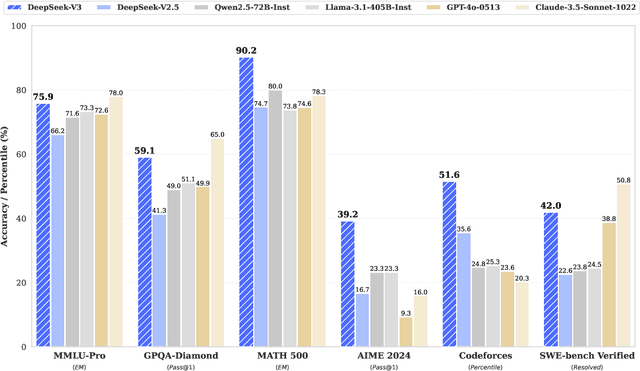


We present DeepSeek-V3, a strong Mixture-of-Experts (MoE) language model with 671B total parameters with 37B activated for each token. To achieve efficient inference and cost-effective training, DeepSeek-V3 adopts Multi-head Latent Attention (MLA) and DeepSeekMoE architectures, which were thoroughly validated in DeepSeek-V2. Furthermore, DeepSeek-V3 pioneers an auxiliary-loss-free strategy for load balancing and sets a multi-token prediction training objective for stronger performance. We pre-train DeepSeek-V3 on 14.8 trillion diverse and high-quality tokens, followed by Supervised Fine-Tuning and Reinforcement Learning stages to fully harness its capabilities. Comprehensive evaluations reveal that DeepSeek-V3 outperforms other open-source models and achieves performance comparable to leading closed-source models. Despite its excellent performance, DeepSeek-V3 requires only 2.788M H800 GPU hours for its full training. In addition, its training process is remarkably stable. Throughout the entire training process, we did not experience any irrecoverable loss spikes or perform any rollbacks. The model checkpoints are available at https://github.com/deepseek-ai/DeepSeek-V3.
Fire-Flyer AI-HPC: A Cost-Effective Software-Hardware Co-Design for Deep Learning
Aug 26, 2024


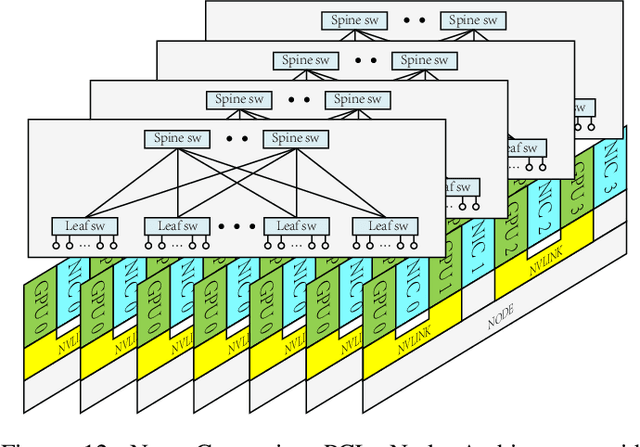
The rapid progress in Deep Learning (DL) and Large Language Models (LLMs) has exponentially increased demands of computational power and bandwidth. This, combined with the high costs of faster computing chips and interconnects, has significantly inflated High Performance Computing (HPC) construction costs. To address these challenges, we introduce the Fire-Flyer AI-HPC architecture, a synergistic hardware-software co-design framework and its best practices. For DL training, we deployed the Fire-Flyer 2 with 10,000 PCIe A100 GPUs, achieved performance approximating the DGX-A100 while reducing costs by half and energy consumption by 40%. We specifically engineered HFReduce to accelerate allreduce communication and implemented numerous measures to keep our Computation-Storage Integrated Network congestion-free. Through our software stack, including HaiScale, 3FS, and HAI-Platform, we achieved substantial scalability by overlapping computation and communication. Our system-oriented experience from DL training provides valuable insights to drive future advancements in AI-HPC.
DeepSeek LLM: Scaling Open-Source Language Models with Longtermism
Jan 05, 2024
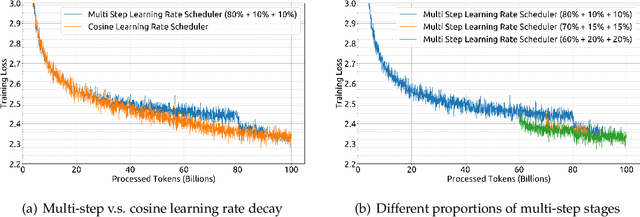


The rapid development of open-source large language models (LLMs) has been truly remarkable. However, the scaling law described in previous literature presents varying conclusions, which casts a dark cloud over scaling LLMs. We delve into the study of scaling laws and present our distinctive findings that facilitate scaling of large scale models in two commonly used open-source configurations, 7B and 67B. Guided by the scaling laws, we introduce DeepSeek LLM, a project dedicated to advancing open-source language models with a long-term perspective. To support the pre-training phase, we have developed a dataset that currently consists of 2 trillion tokens and is continuously expanding. We further conduct supervised fine-tuning (SFT) and Direct Preference Optimization (DPO) on DeepSeek LLM Base models, resulting in the creation of DeepSeek Chat models. Our evaluation results demonstrate that DeepSeek LLM 67B surpasses LLaMA-2 70B on various benchmarks, particularly in the domains of code, mathematics, and reasoning. Furthermore, open-ended evaluations reveal that DeepSeek LLM 67B Chat exhibits superior performance compared to GPT-3.5.