 Add to Chrome
 Add to Firefox
 Add to Edge
ProphetKV: User-Query-Driven Selective Recomputation for Efficient KV Cache Reuse in Retrieval-Augmented Generation
Jan 31, 2026
The prefill stage of long-context Retrieval-Augmented Generation (RAG) is severely bottlenecked by computational overhead. To mitigate this, recent methods assemble pre-calculated KV caches of retrieved RAG documents (by a user query) and reprocess selected tokens to recover cross-attention between these pre-calculated KV caches. However, we identify a fundamental "crowding-out effect" in current token selection criteria: globally salient but user-query-irrelevant tokens saturate the limited recomputation budget, displacing the tokens truly essential for answering the user query and degrading inference accuracy. We propose ProphetKV, a user-query-driven KV Cache reuse method for RAG scenarios. ProphetKV dynamically prioritizes tokens based on their semantic relevance to the user query and employs a dual-stage recomputation pipeline to fuse layer-wise attention metrics into a high-utility set. By ensuring the recomputation budget is dedicated to bridging the informational gap between retrieved context and the user query, ProphetKV achieves high-fidelity attention recovery with minimal overhead. Our extensive evaluation results show that ProphetKV retains 96%-101% of full-prefill accuracy with only a 20% recomputation ratio, while achieving accuracy improvements of 8.8%-24.9% on RULER and 18.6%-50.9% on LongBench over the state-of-the-art approaches (e.g., CacheBlend, EPIC, and KVShare).

VisionFM: a Multi-Modal Multi-Task Vision Foundation Model for Generalist Ophthalmic Artificial Intelligence
Oct 08, 2023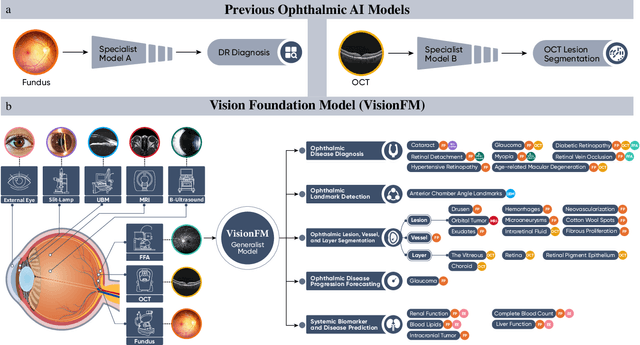
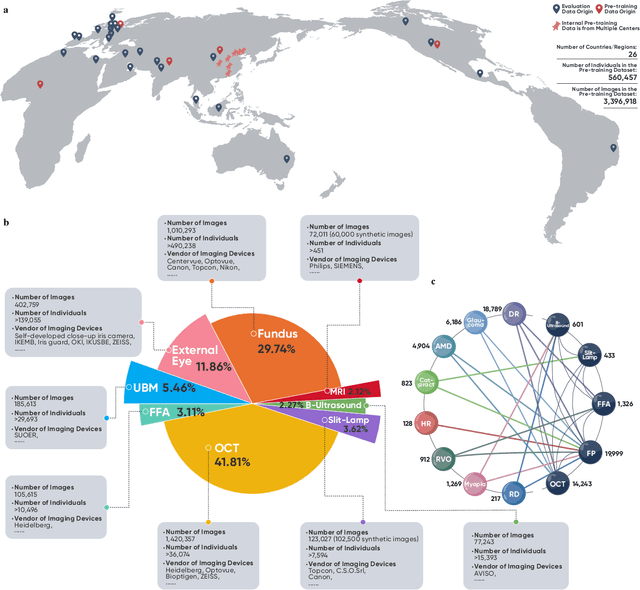
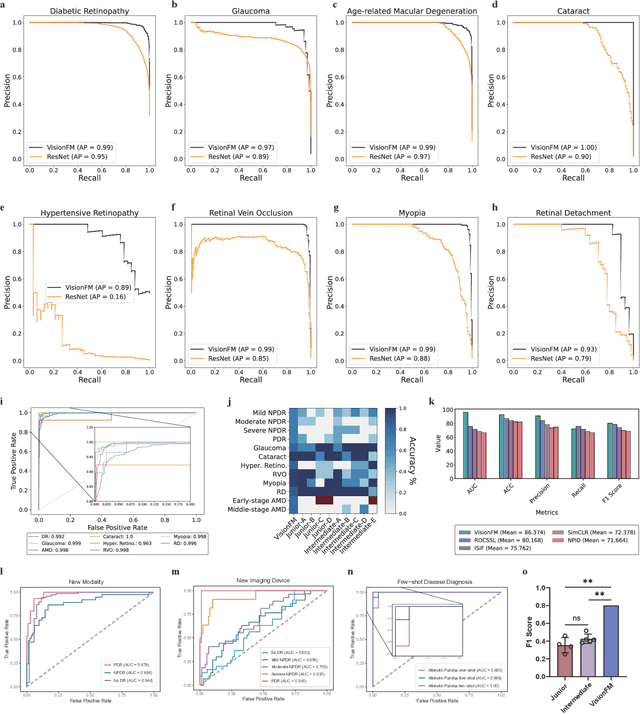
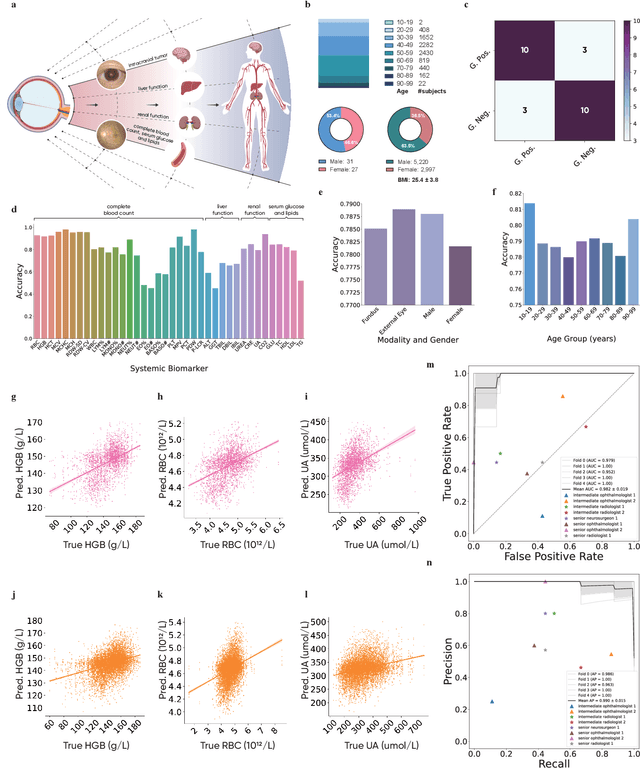
We present VisionFM, a foundation model pre-trained with 3.4 million ophthalmic images from 560,457 individuals, covering a broad range of ophthalmic diseases, modalities, imaging devices, and demography. After pre-training, VisionFM provides a foundation to foster multiple ophthalmic artificial intelligence (AI) applications, such as disease screening and diagnosis, disease prognosis, subclassification of disease phenotype, and systemic biomarker and disease prediction, with each application enhanced with expert-level intelligence and accuracy. The generalist intelligence of VisionFM outperformed ophthalmologists with basic and intermediate levels in jointly diagnosing 12 common ophthalmic diseases. Evaluated on a new large-scale ophthalmic disease diagnosis benchmark database, as well as a new large-scale segmentation and detection benchmark database, VisionFM outperformed strong baseline deep neural networks. The ophthalmic image representations learned by VisionFM exhibited noteworthy explainability, and demonstrated strong generalizability to new ophthalmic modalities, disease spectrum, and imaging devices. As a foundation model, VisionFM has a large capacity to learn from diverse ophthalmic imaging data and disparate datasets. To be commensurate with this capacity, in addition to the real data used for pre-training, we also generated and leveraged synthetic ophthalmic imaging data. Experimental results revealed that synthetic data that passed visual Turing tests, can also enhance the representation learning capability of VisionFM, leading to substantial performance gains on downstream ophthalmic AI tasks. Beyond the ophthalmic AI applications developed, validated, and demonstrated in this work, substantial further applications can be achieved in an efficient and cost-effective manner using VisionFM as the foundation.