 Add to Chrome
 Add to Firefox
 Add to Edge
Do All Visual Tokens Matter Equally? Object-Evidence Preserving Token Merging for Vision-Language Retrieval
Jul 06, 2026
Multi-vector vision-language retrieval preserves fine-grained visual evidence through maximum-similarity late interaction, but dense image-side tokens make storage and scoring expensive. Existing token compression methods reduce this cost, yet they can remove or collapse object- and region-level evidence that future query tokens may need to select. We propose SaMer, an object-aware token merging framework that compresses image-side post-projector tokens into $K$ representative centroids while preserving the original late-interaction interface. SaMer uses object annotations only during training as a merge prior to discourage cross-instance mixing, requires no ground-truth bounding boxes or detectors at inference time, and adapts only the shared projection layer with frozen vision and language backbones. With $K=64$, SaMer removes more than 93% of image-side tokens and reduces ColPali storage by $16.09\times$, while improving R@1 on Flickr30K and MSCOCO. These gains arise because object-aware merging preserves query-selectable object evidence that pruning or feature-only pooling can remove or collapse. SaMer also outperforms compression baselines and shows stronger phrase-level grounding, suggesting that efficient multi-vector retrieval depends not only on reducing token count, but on preserving the evidence future query tokens need to select.

RLDX-1 Technical Report
May 05, 2026While Vision-Language-Action models (VLAs) have shown remarkable progress toward human-like generalist robotic policies through the versatile intelligence (i.e. broad scene understanding and language-conditioned generalization) inherited from pre-trained Vision-Language Models, they still struggle with complex real-world tasks requiring broader functional capabilities (e.g. motion awareness, memory-aware decision making, and physical sensing). To address this, we introduce RLDX-1, a general-purpose robotic policy for dexterous manipulation built on the Multi-Stream Action Transformer (MSAT), an architecture that unifies these capabilities by integrating heterogeneous modalities through modality-specific streams with cross-modal joint self-attention. RLDX-1 further combines this architecture with system-level design choices, including synthesizing training data for rare manipulation scenarios, learning procedures specialized for human-like manipulation, and inference optimizations for real-time deployment. Through empirical evaluation, we show that RLDX-1 consistently outperforms recent frontier VLAs (e.g. $π_{0.5}$ and GR00T N1.6) across both simulation benchmarks and real-world tasks that require broad functional capabilities beyond general versatility. In particular, RLDX-1 shows superiority in ALLEX humanoid tasks by achieving success rates of 86.8% while $π_{0.5}$ and GR00T N1.6 achieve around 40%, highlighting the ability of RLDX-1 to control a high-DoF humanoid robot under diverse functional demands. Together, these results position RLDX-1 as a promising step toward reliable VLAs for complex, contact-rich, and dynamic real-world dexterous manipulation.
Modular Sensory Stream for Integrating Physical Feedback in Vision-Language-Action Models
Apr 25, 2026Humans understand and interact with the real world by relying on diverse physical feedback beyond visual perception. Motivated by this, recent approaches attempt to incorporate physical sensory signals into Vision-Language-Action models (VLAs). However, they typically focus on a single type of physical signal, failing to capture the heterogeneous and complementary nature of real-world interactions. In this paper, we propose MoSS, a modular sensory stream framework that adapts VLAs to leverage multiple sensory signals for action prediction. Specifically, we introduce decoupled modality streams that integrate heterogeneous physical signals into the action stream via joint cross-modal self-attention. To enable stable incorporation of new modalities, we adopt a two-stage training scheme that freezes pretrained VLA parameters in the early stage. Furthermore, to better capture contact interaction dynamics, we incorporate an auxiliary task that predicts future physical signals. Through extensive real-world experiments, we demonstrate that MoSS successfully augments VLAs to leverage diverse physical signals (i.e., tactile and torque), integrating multiple signals to achieve synergistic performance gains.
Can Natural Image Autoencoders Compactly Tokenize fMRI Volumes for Long-Range Dynamics Modeling?
Apr 04, 2026Modeling long-range spatiotemporal dynamics in functional Magnetic Resonance Imaging (fMRI) remains a key challenge due to the high dimensionality of the four-dimensional signals. Prior voxel-based models, although demonstrating excellent performance and interpretation capabilities, are constrained by prohibitive memory demands and thus can only capture limited temporal windows. To address this, we propose TABLeT (Two-dimensionally Autoencoded Brain Latent Transformer), a novel approach that tokenizes fMRI volumes using a pre-trained 2D natural image autoencoder. Each 3D fMRI volume is compressed into a compact set of continuous tokens, enabling long-sequence modeling with a simple Transformer encoder with limited VRAM. Across large-scale benchmarks including the UK-Biobank (UKB), Human Connectome Project (HCP), and ADHD-200 datasets, TABLeT outperforms existing models in multiple tasks, while demonstrating substantial gains in computational and memory efficiency over the state-of-the-art voxel-based method given the same input. Furthermore, we develop a self-supervised masked token modeling approach to pre-train TABLeT, which improves the model's performance for various downstream tasks. Our findings suggest a promising approach for scalable and interpretable spatiotemporal modeling of brain activity. Our code is available at https://github.com/beotborry/TABLeT.
Outlier-Safe Pre-Training for Robust 4-Bit Quantization of Large Language Models
Jun 24, 2025Extreme activation outliers in Large Language Models (LLMs) critically degrade quantization performance, hindering efficient on-device deployment. While channel-wise operations and adaptive gradient scaling are recognized causes, practical mitigation remains challenging. We introduce Outlier-Safe Pre-Training (OSP), a practical guideline that proactively prevents outlier formation rather than relying on post-hoc mitigation. OSP combines three key innovations: (1) the Muon optimizer, eliminating privileged bases while maintaining training efficiency; (2) Single-Scale RMSNorm, preventing channel-wise amplification; and (3) a learnable embedding projection, redistributing activation magnitudes originating from embedding matrices. We validate OSP by training a 1.4B-parameter model on 1 trillion tokens, which is the first production-scale LLM trained without such outliers. Under aggressive 4-bit quantization, our OSP model achieves a 35.7 average score across 10 benchmarks (compared to 26.5 for an Adam-trained model), with only a 2% training overhead. Remarkably, OSP models exhibit near-zero excess kurtosis (0.04) compared to extreme values (1818.56) in standard models, fundamentally altering LLM quantization behavior. Our work demonstrates that outliers are not inherent to LLMs but are consequences of training strategies, paving the way for more efficient LLM deployment. The source code and pretrained checkpoints are available at https://github.com/dmis-lab/Outlier-Safe-Pre-Training.
Med-PRM: Medical Reasoning Models with Stepwise, Guideline-verified Process Rewards
Jun 13, 2025Large language models have shown promise in clinical decision making, but current approaches struggle to localize and correct errors at specific steps of the reasoning process. This limitation is critical in medicine, where identifying and addressing reasoning errors is essential for accurate diagnosis and effective patient care. We introduce Med-PRM, a process reward modeling framework that leverages retrieval-augmented generation to verify each reasoning step against established medical knowledge bases. By verifying intermediate reasoning steps with evidence retrieved from clinical guidelines and literature, our model can precisely assess the reasoning quality in a fine-grained manner. Evaluations on five medical QA benchmarks and two open-ended diagnostic tasks demonstrate that Med-PRM achieves state-of-the-art performance, with improving the performance of base models by up to 13.50% using Med-PRM. Moreover, we demonstrate the generality of Med-PRM by integrating it in a plug-and-play fashion with strong policy models such as Meerkat, achieving over 80\% accuracy on MedQA for the first time using small-scale models of 8 billion parameters. Our code and data are available at: https://med-prm.github.io/
Does Time Have Its Place? Temporal Heads: Where Language Models Recall Time-specific Information
Feb 20, 2025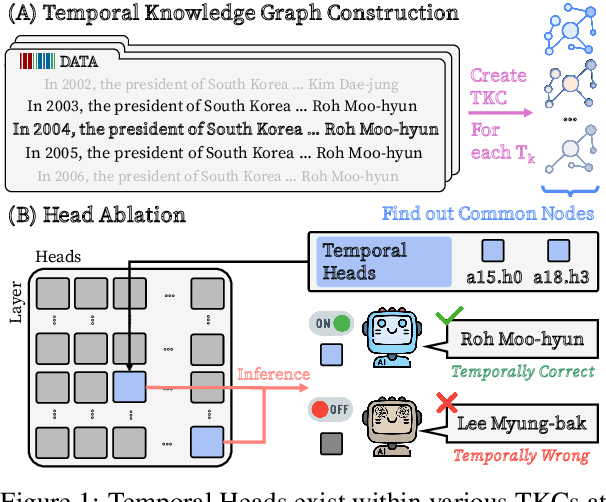
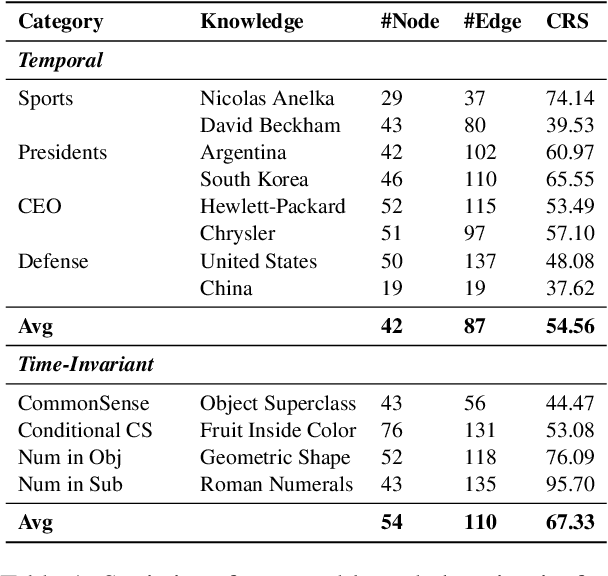
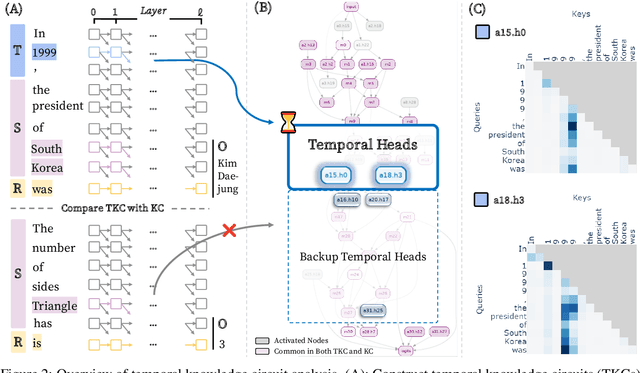
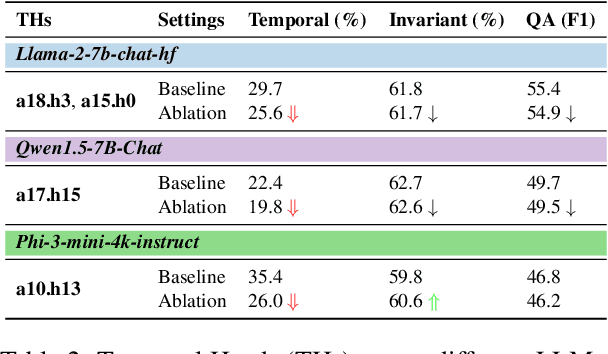
While the ability of language models to elicit facts has been widely investigated, how they handle temporally changing facts remains underexplored. We discover Temporal Heads, specific attention heads primarily responsible for processing temporal knowledge through circuit analysis. We confirm that these heads are present across multiple models, though their specific locations may vary, and their responses differ depending on the type of knowledge and its corresponding years. Disabling these heads degrades the model's ability to recall time-specific knowledge while maintaining its general capabilities without compromising time-invariant and question-answering performances. Moreover, the heads are activated not only numeric conditions ("In 2004") but also textual aliases ("In the year ..."), indicating that they encode a temporal dimension beyond simple numerical representation. Furthermore, we expand the potential of our findings by demonstrating how temporal knowledge can be edited by adjusting the values of these heads.
Monet: Mixture of Monosemantic Experts for Transformers
Dec 05, 2024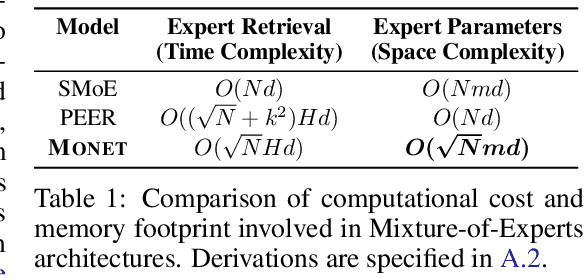
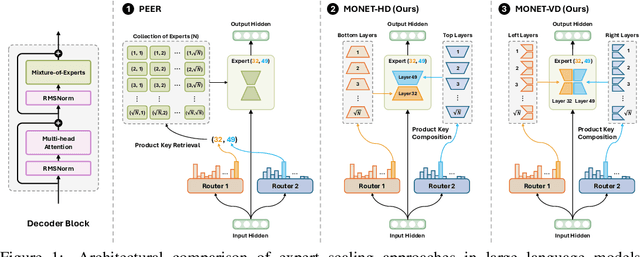
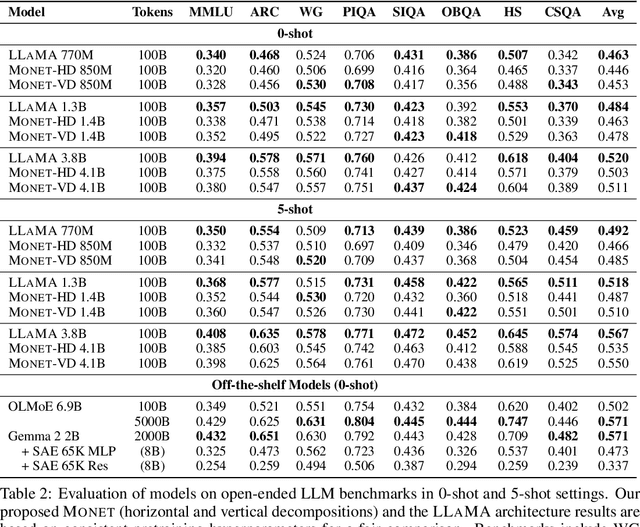
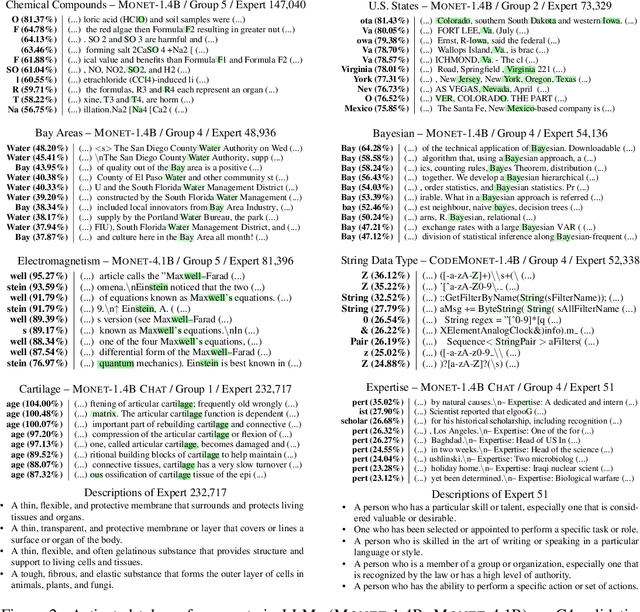
Understanding the internal computations of large language models (LLMs) is crucial for aligning them with human values and preventing undesirable behaviors like toxic content generation. However, mechanistic interpretability is hindered by polysemanticity -- where individual neurons respond to multiple, unrelated concepts. While Sparse Autoencoders (SAEs) have attempted to disentangle these features through sparse dictionary learning, they have compromised LLM performance due to reliance on post-hoc reconstruction loss. To address this issue, we introduce Mixture of Monosemantic Experts for Transformers (Monet) architecture, which incorporates sparse dictionary learning directly into end-to-end Mixture-of-Experts pretraining. Our novel expert decomposition method enables scaling the expert count to 262,144 per layer while total parameters scale proportionally to the square root of the number of experts. Our analyses demonstrate mutual exclusivity of knowledge across experts and showcase the parametric knowledge encapsulated within individual experts. Moreover, Monet allows knowledge manipulation over domains, languages, and toxicity mitigation without degrading general performance. Our pursuit of transparent LLMs highlights the potential of scaling expert counts to enhance} mechanistic interpretability and directly resect the internal knowledge to fundamentally adjust} model behavior. The source code and pretrained checkpoints are available at https://github.com/dmis-lab/Monet.
ChroKnowledge: Unveiling Chronological Knowledge of Language Models in Multiple Domains
Oct 13, 2024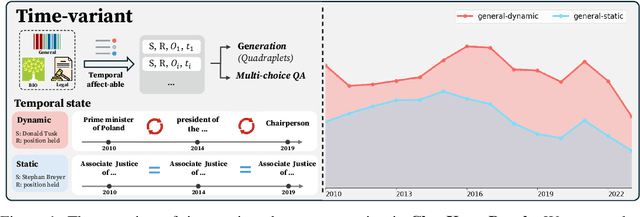
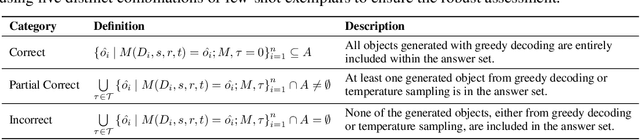
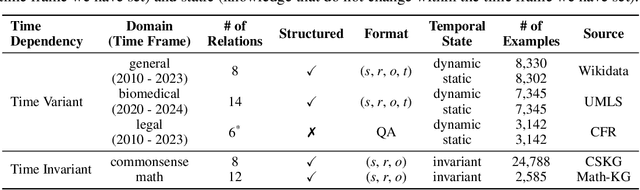
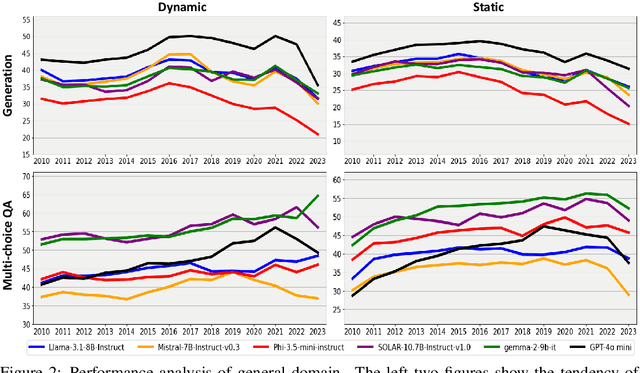
Large language models (LLMs) have significantly impacted many aspects of our lives. However, assessing and ensuring their chronological knowledge remains challenging. Existing approaches fall short in addressing the accumulative nature of knowledge, often relying on a single time stamp. To overcome this, we introduce ChroKnowBench, a benchmark dataset designed to evaluate chronologically accumulated knowledge across three key aspects: multiple domains, time dependency, temporal state. Our benchmark distinguishes between knowledge that evolves (e.g., scientific discoveries, amended laws) and knowledge that remain constant (e.g., mathematical truths, commonsense facts). Building on this benchmark, we present ChroKnowledge (Chronological Categorization of Knowledge), a novel sampling-based framework for evaluating and updating LLMs' non-parametric chronological knowledge. Our evaluation shows: (1) The ability of eliciting temporal knowledge varies depending on the data format that model was trained on. (2) LLMs partially recall knowledge or show a cut-off at temporal boundaries rather than recalling all aspects of knowledge correctly. Thus, we apply our ChroKnowPrompt, an in-depth prompting to elicit chronological knowledge by traversing step-by-step through the surrounding time spans. We observe that our framework successfully updates the overall knowledge across the entire timeline in both the biomedical domain (+11.9%) and the general domain (+2.8%), demonstrating its effectiveness in refining temporal knowledge. This non-parametric approach also enables knowledge updates not only in open-source models but also in proprietary LLMs, ensuring comprehensive applicability across model types. We perform a comprehensive analysis based on temporal characteristics of ChroKnowPrompt and validate the potential of various models to elicit intrinsic temporal knowledge through our method.
SyncVSR: Data-Efficient Visual Speech Recognition with End-to-End Crossmodal Audio Token Synchronization
Jun 18, 2024Visual Speech Recognition (VSR) stands at the intersection of computer vision and speech recognition, aiming to interpret spoken content from visual cues. A prominent challenge in VSR is the presence of homophenes-visually similar lip gestures that represent different phonemes. Prior approaches have sought to distinguish fine-grained visemes by aligning visual and auditory semantics, but often fell short of full synchronization. To address this, we present SyncVSR, an end-to-end learning framework that leverages quantized audio for frame-level crossmodal supervision. By integrating a projection layer that synchronizes visual representation with acoustic data, our encoder learns to generate discrete audio tokens from a video sequence in a non-autoregressive manner. SyncVSR shows versatility across tasks, languages, and modalities at the cost of a forward pass. Our empirical evaluations show that it not only achieves state-of-the-art results but also reduces data usage by up to ninefold.