 Add to Chrome
 Add to Firefox
 Add to Edge
Can Natural Image Autoencoders Compactly Tokenize fMRI Volumes for Long-Range Dynamics Modeling?
Apr 04, 2026
Modeling long-range spatiotemporal dynamics in functional Magnetic Resonance Imaging (fMRI) remains a key challenge due to the high dimensionality of the four-dimensional signals. Prior voxel-based models, although demonstrating excellent performance and interpretation capabilities, are constrained by prohibitive memory demands and thus can only capture limited temporal windows. To address this, we propose TABLeT (Two-dimensionally Autoencoded Brain Latent Transformer), a novel approach that tokenizes fMRI volumes using a pre-trained 2D natural image autoencoder. Each 3D fMRI volume is compressed into a compact set of continuous tokens, enabling long-sequence modeling with a simple Transformer encoder with limited VRAM. Across large-scale benchmarks including the UK-Biobank (UKB), Human Connectome Project (HCP), and ADHD-200 datasets, TABLeT outperforms existing models in multiple tasks, while demonstrating substantial gains in computational and memory efficiency over the state-of-the-art voxel-based method given the same input. Furthermore, we develop a self-supervised masked token modeling approach to pre-train TABLeT, which improves the model's performance for various downstream tasks. Our findings suggest a promising approach for scalable and interpretable spatiotemporal modeling of brain activity. Our code is available at https://github.com/beotborry/TABLeT.

DIVER-1 : Deep Integration of Vast Electrophysiological Recordings at Scale
Dec 22, 2025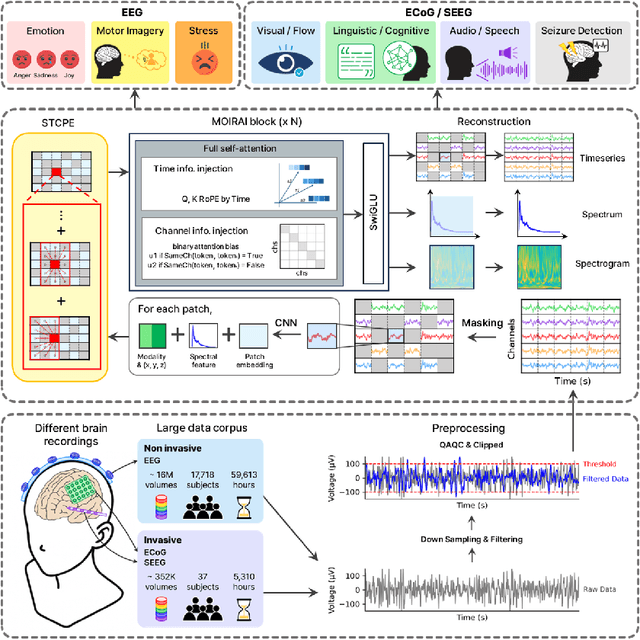
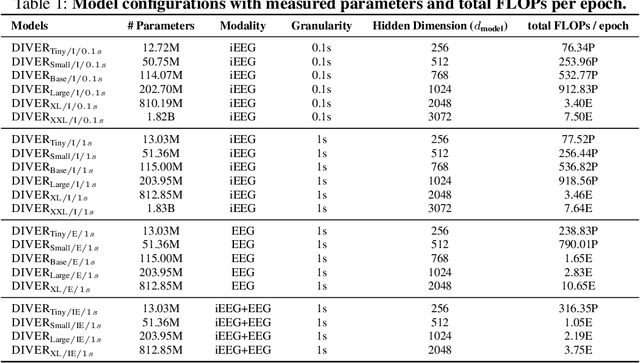
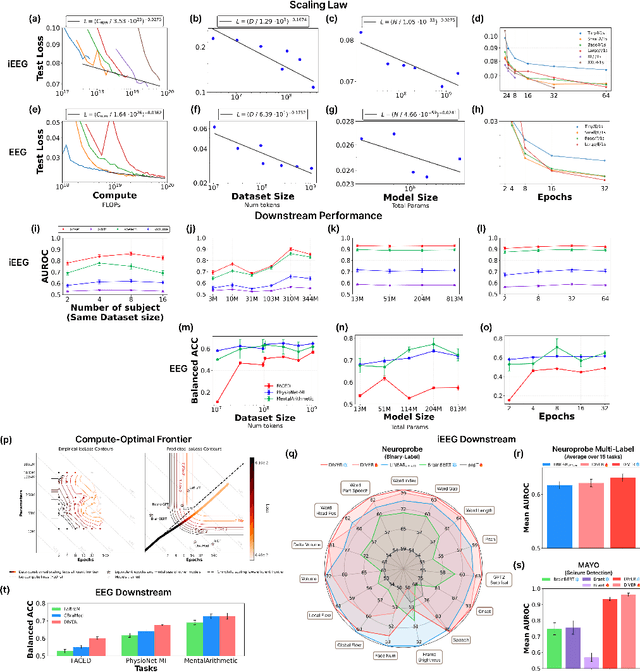
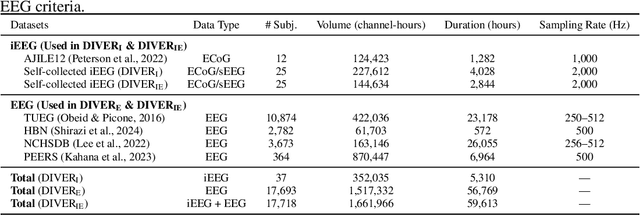
Electrophysiology signals such as EEG and iEEG are central to neuroscience, brain-computer interfaces, and clinical applications, yet existing foundation models remain limited in scale despite clear evidence that scaling improves performance. We introduce DIVER-1, a family of EEG and iEEG foundation models trained on the largest and most diverse corpus to date-5.3k hours of iEEG and 54k hours of EEG (1.6M channel-hours from over 17.7k subjects)-and scaled up to 1.82B parameters. We present the first systematic scaling law analysis for this domain, showing that they follow data-constrained scaling laws: for a given amount of data and compute, smaller models trained for extended epochs consistently outperform larger models trained briefly. This behavior contrasts with prior electrophysiology foundation models that emphasized model size over training duration. To achieve strong performance, we also design architectural innovations including any-variate attention, sliding temporal conditional positional encoding, and multi-domain reconstruction. DIVER-1 iEEG and EEG models each achieve state-of-the-art performance on their respective benchmarks, establishing a concrete guidelines for efficient scaling and resource allocation in electrophysiology foundation model development.