 Add to Chrome
 Add to Firefox
 Add to Edge
RLDX-1 Technical Report
May 05, 2026
While Vision-Language-Action models (VLAs) have shown remarkable progress toward human-like generalist robotic policies through the versatile intelligence (i.e. broad scene understanding and language-conditioned generalization) inherited from pre-trained Vision-Language Models, they still struggle with complex real-world tasks requiring broader functional capabilities (e.g. motion awareness, memory-aware decision making, and physical sensing). To address this, we introduce RLDX-1, a general-purpose robotic policy for dexterous manipulation built on the Multi-Stream Action Transformer (MSAT), an architecture that unifies these capabilities by integrating heterogeneous modalities through modality-specific streams with cross-modal joint self-attention. RLDX-1 further combines this architecture with system-level design choices, including synthesizing training data for rare manipulation scenarios, learning procedures specialized for human-like manipulation, and inference optimizations for real-time deployment. Through empirical evaluation, we show that RLDX-1 consistently outperforms recent frontier VLAs (e.g. $π_{0.5}$ and GR00T N1.6) across both simulation benchmarks and real-world tasks that require broad functional capabilities beyond general versatility. In particular, RLDX-1 shows superiority in ALLEX humanoid tasks by achieving success rates of 86.8% while $π_{0.5}$ and GR00T N1.6 achieve around 40%, highlighting the ability of RLDX-1 to control a high-DoF humanoid robot under diverse functional demands. Together, these results position RLDX-1 as a promising step toward reliable VLAs for complex, contact-rich, and dynamic real-world dexterous manipulation.

Confidence-aware Denoised Fine-tuning of Off-the-shelf Models for Certified Robustness
Nov 13, 2024
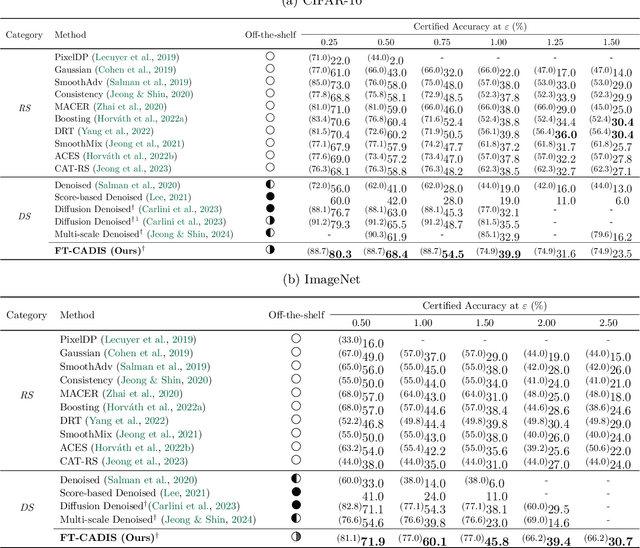
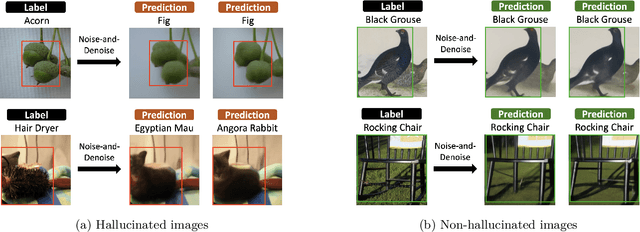
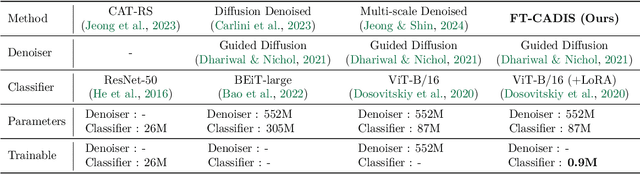
The remarkable advances in deep learning have led to the emergence of many off-the-shelf classifiers, e.g., large pre-trained models. However, since they are typically trained on clean data, they remain vulnerable to adversarial attacks. Despite this vulnerability, their superior performance and transferability make off-the-shelf classifiers still valuable in practice, demanding further work to provide adversarial robustness for them in a post-hoc manner. A recently proposed method, denoised smoothing, leverages a denoiser model in front of the classifier to obtain provable robustness without additional training. However, the denoiser often creates hallucination, i.e., images that have lost the semantics of their originally assigned class, leading to a drop in robustness. Furthermore, its noise-and-denoise procedure introduces a significant distribution shift from the original distribution, causing the denoised smoothing framework to achieve sub-optimal robustness. In this paper, we introduce Fine-Tuning with Confidence-Aware Denoised Image Selection (FT-CADIS), a novel fine-tuning scheme to enhance the certified robustness of off-the-shelf classifiers. FT-CADIS is inspired by the observation that the confidence of off-the-shelf classifiers can effectively identify hallucinated images during denoised smoothing. Based on this, we develop a confidence-aware training objective to handle such hallucinated images and improve the stability of fine-tuning from denoised images. In this way, the classifier can be fine-tuned using only images that are beneficial for adversarial robustness. We also find that such a fine-tuning can be done by updating a small fraction of parameters of the classifier. Extensive experiments demonstrate that FT-CADIS has established the state-of-the-art certified robustness among denoised smoothing methods across all $\ell_2$-adversary radius in various benchmarks.