 Add to Chrome
 Add to Firefox
 Add to Edge
Rectifying Mask via Entropy for Distractor-Free 3DGS in Ambiguous Scenarios
Jun 28, 2026
We present RefineSplat, a systematic framework that effectively constructs transient masks to identify diverse ambiguous distractors. To do this, we qualitatively and quantitatively analyze issues and propose a novel entropy-aware adaptive masking method. Unlike existing approaches that struggle to distinguish transient elements from static scenes due to color or semantic ambiguity, RefineSplat captures ambiguous distractors leveraging entropy and instance masks. Furthermore, we propose a simple yet effective entropy-aware density control to align Gaussians in ambiguous scenarios considering Entropy-aware positional gradients. Additionally, to rigorously validate our method, we first create and release the Ambiguous wild dataset, including 18 scenes where distractors and static scenes are hard to distinguish due to color or semantic resemblances. Experimental results on various datasets demonstrate that RefineSplat shows state-of-the-art performance, showing distractor-free novel view synthesis.

Probing Token Spaces under Generator Shift in AI-Generated Music Detection
Jun 07, 2026AI-generated music detectors can appear robust on standard benchmark splits, yet their deployments require transfer to generator sources absent during training. We study this problem with source-restricted evaluation on \textsc{MoM-open}, an open reconstruction of MoM-CLAM that replaces the non-redistributable real corpus with FMA and MTG-Jamendo while preserving the fake-generator protocol. To isolate the role of representation, we introduce \textsc{CoMoE}, a compact fixed classifier for comparing heterogeneous audio token spaces while keeping the downstream architecture and training recipe unchanged. Experiments show that standard and real-source-restricted splits are nearly saturated, whereas fake-source restriction exposes large differences between token spaces: X-Codec tokens are strongest when training on Udio alone, while MERT-derived tokens are stronger when training on Suno-v3.5 alone. These results suggest that codec-style discrete token spaces should be treated as a primary experimental axis under generator shift in AI-generated music detection. Our code and data are available at https://github.com/MAAP-LAB/CoMoE.
Mosaic: Compositional Multi-Concept Erasure via Vector Field Blending
May 25, 2026Concept erasure has emerged as a key research direction for ensuring safe and ethical image synthesis in Text-to-Image (T2I) models. While existing studies have explored concept erasure across multiple concepts, they typically assume only a single target concept per image, a limitation increasingly exposed by modern flow-based T2I models, which can generate complex scenes with multiple concepts simultaneously. To address this gap, we introduce compositional multi-concept erasure, a new task that aims to simultaneously remove multiple target concepts within a single scene. We propose CoME-Bench, a benchmark for evaluating compositional multi-concept erasure, which covers both intra- and cross-category scenarios. We further propose Mosaic, a novel framework for multi-concept erasure in flow-based T2I models, which exploits the spatial locality of target concepts in the vector field by dynamically constructing concept-specific masks and selectively blending them without additional optimization. Extensive experiments demonstrate that Mosaic effectively removes multiple target concepts in complex compositional scenes while preserving non-target contexts.
Progressive Learned Image Compression for Machine Perception
Dec 23, 2025Recent advances in learned image codecs have been extended from human perception toward machine perception. However, progressive image compression with fine granular scalability (FGS)-which enables decoding a single bitstream at multiple quality levels-remains unexplored for machine-oriented codecs. In this work, we propose a novel progressive learned image compression codec for machine perception, PICM-Net, based on trit-plane coding. By analyzing the difference between human- and machine-oriented rate-distortion priorities, we systematically examine the latent prioritization strategies in terms of machine-oriented codecs. To further enhance real-world adaptability, we design an adaptive decoding controller, which dynamically determines the necessary decoding level during inference time to maintain the desired confidence of downstream machine prediction. Extensive experiments demonstrate that our approach enables efficient and adaptive progressive transmission while maintaining high performance in the downstream classification task, establishing a new paradigm for machine-aware progressive image compression.
Multi-view Pyramid Transformer: Look Coarser to See Broader
Dec 08, 2025
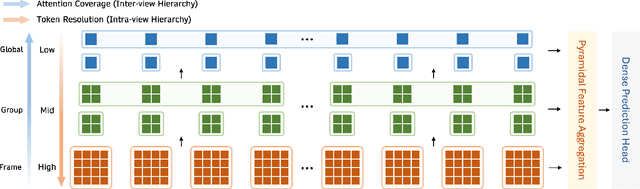
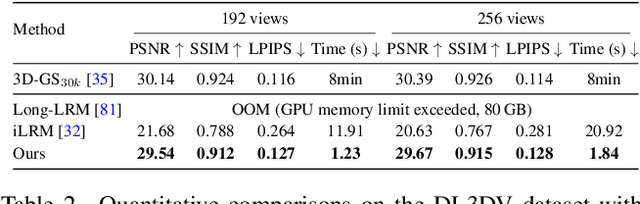
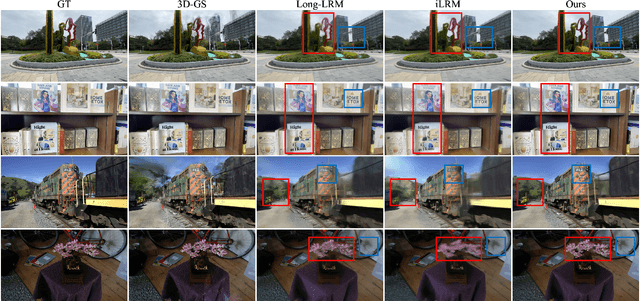
We propose Multi-view Pyramid Transformer (MVP), a scalable multi-view transformer architecture that directly reconstructs large 3D scenes from tens to hundreds of images in a single forward pass. Drawing on the idea of ``looking broader to see the whole, looking finer to see the details," MVP is built on two core design principles: 1) a local-to-global inter-view hierarchy that gradually broadens the model's perspective from local views to groups and ultimately the full scene, and 2) a fine-to-coarse intra-view hierarchy that starts from detailed spatial representations and progressively aggregates them into compact, information-dense tokens. This dual hierarchy achieves both computational efficiency and representational richness, enabling fast reconstruction of large and complex scenes. We validate MVP on diverse datasets and show that, when coupled with 3D Gaussian Splatting as the underlying 3D representation, it achieves state-of-the-art generalizable reconstruction quality while maintaining high efficiency and scalability across a wide range of view configurations.
Streaming Tensor Program: A streaming abstraction for dynamic parallelism
Nov 11, 2025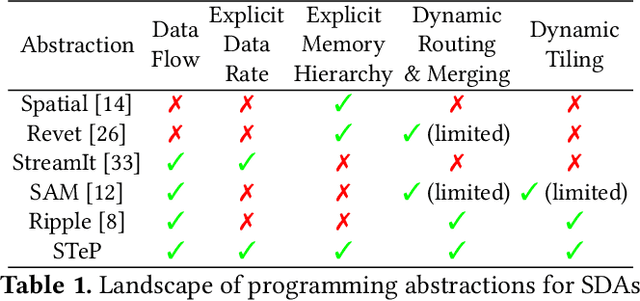
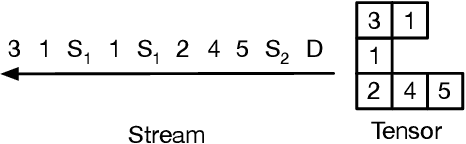
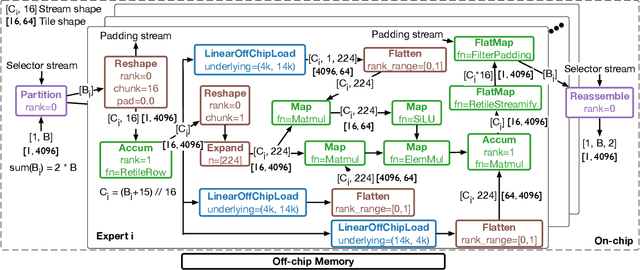
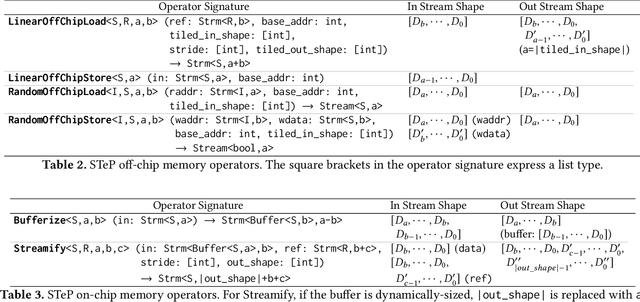
Dynamic behaviors are becoming prevalent in many tensor applications. In machine learning, for example, the input tensors are dynamically shaped or ragged, and data-dependent control flow is widely used in many models. However, the limited expressiveness of prior programming abstractions for spatial dataflow accelerators forces the dynamic behaviors to be implemented statically or lacks the visibility for performance-critical decisions. To address these challenges, we present the Streaming Tensor Program (STeP), a new streaming abstraction that enables dynamic tensor workloads to run efficiently on spatial dataflow accelerators. STeP introduces flexible routing operators, an explicit memory hierarchy, and symbolic shape semantics that expose dynamic data rates and tensor dimensions. These capabilities unlock new optimizations-dynamic tiling, dynamic parallelization, and configuration time-multiplexing-that adapt to dynamic behaviors while preserving dataflow efficiency. Using a cycle-approximate simulator on representative LLM layers with real-world traces, dynamic tiling reduces on-chip memory requirement by 2.18x, dynamic parallelization improves latency by 1.5x, and configuration time-multiplexing improves compute utilization by 2.57x over implementations available in prior abstractions.
Rethinking Caching for LLM Serving Systems: Beyond Traditional Heuristics
Aug 26, 2025Serving Large Language Models (LLMs) at scale requires meeting strict Service Level Objectives (SLOs) under severe computational and memory constraints. Nevertheless, traditional caching strategies fall short: exact-matching and prefix caches neglect query semantics, while state-of-the-art semantic caches remain confined to traditional intuitions, offering little conceptual departure. Building on this, we present SISO, a semantic caching system that redefines efficiency for LLM serving. SISO introduces centroid-based caching to maximize coverage with minimal memory, locality-aware replacement to preserve high-value entries, and dynamic thresholding to balance accuracy and latency under varying workloads. Across diverse datasets, SISO delivers up to 1.71$\times$ higher hit ratios and consistently stronger SLO attainment compared to state-of-the-art systems.
Exploring Cross-Stage Adversarial Transferability in Class-Incremental Continual Learning
Aug 12, 2025Class-incremental continual learning addresses catastrophic forgetting by enabling classification models to preserve knowledge of previously learned classes while acquiring new ones. However, the vulnerability of the models against adversarial attacks during this process has not been investigated sufficiently. In this paper, we present the first exploration of vulnerability to stage-transferred attacks, i.e., an adversarial example generated using the model in an earlier stage is used to attack the model in a later stage. Our findings reveal that continual learning methods are highly susceptible to these attacks, raising a serious security issue. We explain this phenomenon through model similarity between stages and gradual robustness degradation. Additionally, we find that existing adversarial training-based defense methods are not sufficiently effective to stage-transferred attacks. Codes are available at https://github.com/mcml-official/CSAT.
Targetless LiDAR-Camera Calibration with Anchored 3D Gaussians
Apr 06, 2025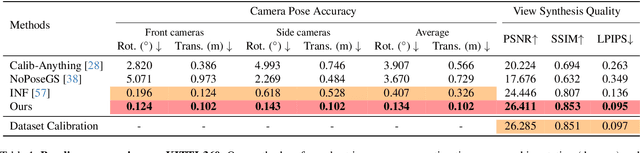
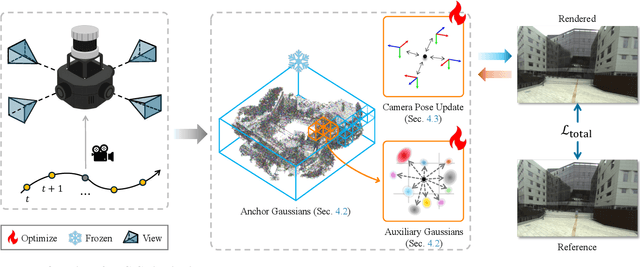

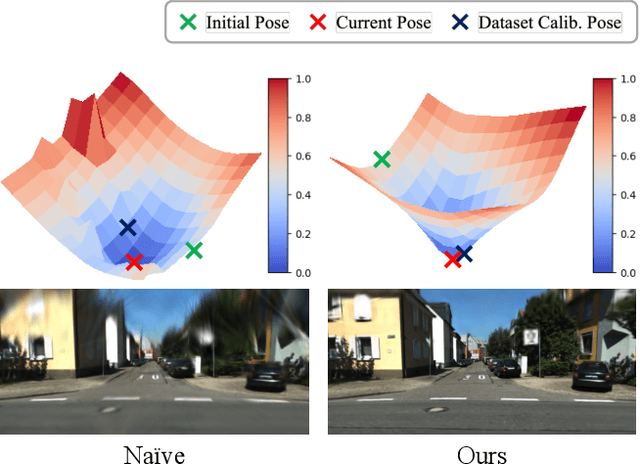
We present a targetless LiDAR-camera calibration method that jointly optimizes sensor poses and scene geometry from arbitrary scenes, without relying on traditional calibration targets such as checkerboards or spherical reflectors. Our approach leverages a 3D Gaussian-based scene representation. We first freeze reliable LiDAR points as anchors, then jointly optimize the poses and auxiliary Gaussian parameters in a fully differentiable manner using a photometric loss. This joint optimization significantly reduces sensor misalignment, resulting in higher rendering quality and consistently improved PSNR compared to the carefully calibrated poses provided in popular datasets. We validate our method through extensive experiments on two real-world autonomous driving datasets, KITTI-360 and Waymo, each featuring distinct sensor configurations. Additionally, we demonstrate the robustness of our approach using a custom LiDAR-camera setup, confirming strong performance across diverse hardware configurations.
SeDi-Instruct: Enhancing Alignment of Language Models through Self-Directed Instruction Generation
Feb 07, 2025The rapid evolution of Large Language Models (LLMs) has enabled the industry to develop various AI-based services. Instruction tuning is considered essential in adapting foundation models for target domains to provide high-quality services to customers. A key challenge in instruction tuning is obtaining high-quality instruction data. Self-Instruct, which automatically generates instruction data using ChatGPT APIs, alleviates the data scarcity problem. To improve the quality of instruction data, Self-Instruct discards many of the instructions generated from ChatGPT, even though it is inefficient in terms of cost owing to many useless API calls. To generate high-quality instruction data at a low cost, we propose a novel data generation framework, Self-Direct Instruction generation (SeDi-Instruct), which employs diversity-based filtering and iterative feedback task generation. Diversity-based filtering maintains model accuracy without excessively discarding low-quality generated instructions by enhancing the diversity of instructions in a batch. This reduces the cost of synthesizing instruction data. The iterative feedback task generation integrates instruction generation and training tasks and utilizes information obtained during the training to create high-quality instruction sets. Our results show that SeDi-Instruct enhances the accuracy of AI models by 5.2%, compared with traditional methods, while reducing data generation costs by 36%.