 Add to Chrome
 Add to Firefox
 Add to Edge
Articulated Object Reconstruction from Rest-State Observation
Jul 30, 2026
Building interactive digital twins requires recovering both 3D geometry and the kinematic structures that govern how objects articulate. Yet existing methods for articulated object reconstruction require explicitly observable motion from multiple articulation states. We introduce a rest-state formulation that reconstructs articulated objects from a single closed configuration, an inherently ill-posed setting where geometry, semantics, and motion priors compensate for the absence of motion cues. Our framework adopts an explicit mesh as an intermediate representation for cross-model verification and fusion, reconciling noisy outputs from vision-language and segmentation models into spatially consistent part structures. To estimate joint parameters without observed motion, we use a video diffusion model to synthesize articulation hypotheses and validate them through geometric consistency. Our approach achieves accurate part decomposition and physically plausible articulation, performing competitively with motion-observing reconstruction-based, generation-based, and modular pretrained-model baselines.

Metropolis-Hastings Sampling for 3D Gaussian Reconstruction
Jun 15, 2025We propose an adaptive sampling framework for 3D Gaussian Splatting (3DGS) that leverages comprehensive multi-view photometric error signals within a unified Metropolis-Hastings approach. Traditional 3DGS methods heavily rely on heuristic-based density-control mechanisms (e.g., cloning, splitting, and pruning), which can lead to redundant computations or the premature removal of beneficial Gaussians. Our framework overcomes these limitations by reformulating densification and pruning as a probabilistic sampling process, dynamically inserting and relocating Gaussians based on aggregated multi-view errors and opacity scores. Guided by Bayesian acceptance tests derived from these error-based importance scores, our method substantially reduces reliance on heuristics, offers greater flexibility, and adaptively infers Gaussian distributions without requiring predefined scene complexity. Experiments on benchmark datasets, including Mip-NeRF360, Tanks and Temples, and Deep Blending, show that our approach reduces the number of Gaussians needed, enhancing computational efficiency while matching or modestly surpassing the view-synthesis quality of state-of-the-art models.
Targetless LiDAR-Camera Calibration with Anchored 3D Gaussians
Apr 06, 2025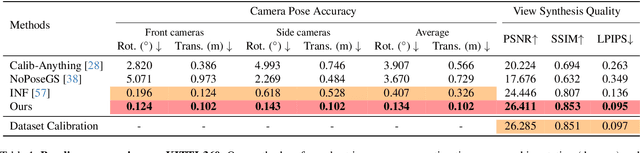
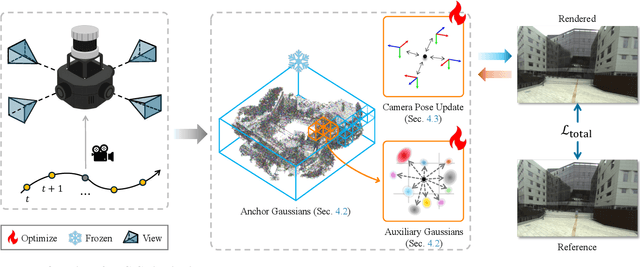

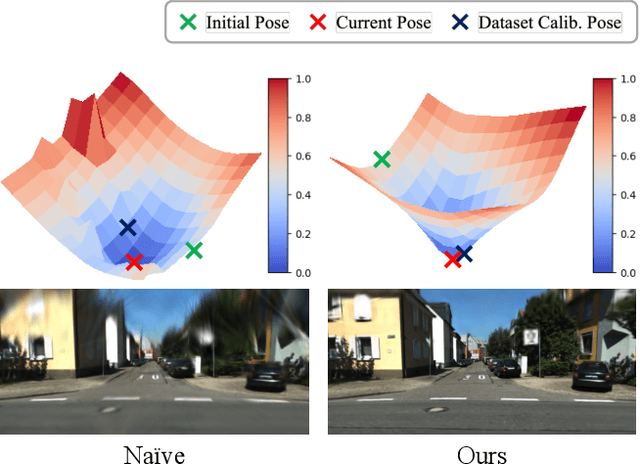
We present a targetless LiDAR-camera calibration method that jointly optimizes sensor poses and scene geometry from arbitrary scenes, without relying on traditional calibration targets such as checkerboards or spherical reflectors. Our approach leverages a 3D Gaussian-based scene representation. We first freeze reliable LiDAR points as anchors, then jointly optimize the poses and auxiliary Gaussian parameters in a fully differentiable manner using a photometric loss. This joint optimization significantly reduces sensor misalignment, resulting in higher rendering quality and consistently improved PSNR compared to the carefully calibrated poses provided in popular datasets. We validate our method through extensive experiments on two real-world autonomous driving datasets, KITTI-360 and Waymo, each featuring distinct sensor configurations. Additionally, we demonstrate the robustness of our approach using a custom LiDAR-camera setup, confirming strong performance across diverse hardware configurations.