 Add to Chrome
 Add to Firefox
 Add to Edge
Multi-view Pyramid Transformer: Look Coarser to See Broader
Dec 08, 2025

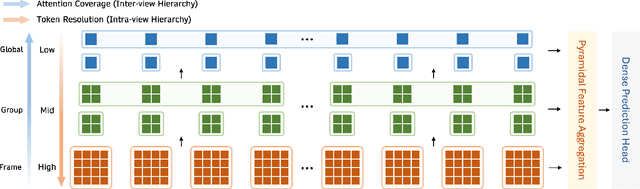
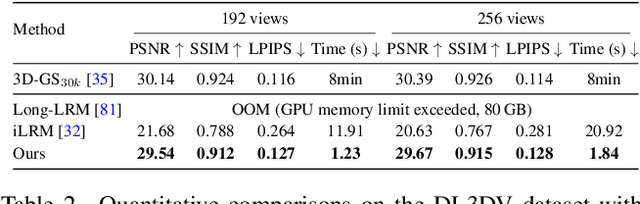
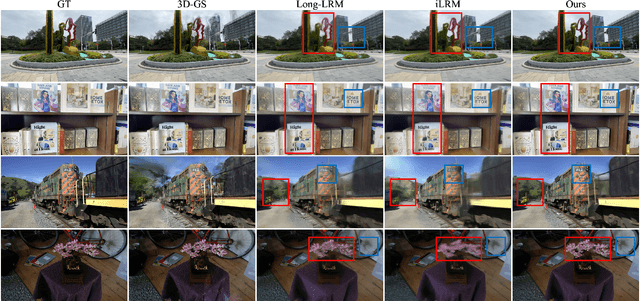
We propose Multi-view Pyramid Transformer (MVP), a scalable multi-view transformer architecture that directly reconstructs large 3D scenes from tens to hundreds of images in a single forward pass. Drawing on the idea of ``looking broader to see the whole, looking finer to see the details," MVP is built on two core design principles: 1) a local-to-global inter-view hierarchy that gradually broadens the model's perspective from local views to groups and ultimately the full scene, and 2) a fine-to-coarse intra-view hierarchy that starts from detailed spatial representations and progressively aggregates them into compact, information-dense tokens. This dual hierarchy achieves both computational efficiency and representational richness, enabling fast reconstruction of large and complex scenes. We validate MVP on diverse datasets and show that, when coupled with 3D Gaussian Splatting as the underlying 3D representation, it achieves state-of-the-art generalizable reconstruction quality while maintaining high efficiency and scalability across a wide range of view configurations.

Hybrid 3D-4D Gaussian Splatting for Fast Dynamic Scene Representation
May 19, 2025Recent advancements in dynamic 3D scene reconstruction have shown promising results, enabling high-fidelity 3D novel view synthesis with improved temporal consistency. Among these, 4D Gaussian Splatting (4DGS) has emerged as an appealing approach due to its ability to model high-fidelity spatial and temporal variations. However, existing methods suffer from substantial computational and memory overhead due to the redundant allocation of 4D Gaussians to static regions, which can also degrade image quality. In this work, we introduce hybrid 3D-4D Gaussian Splatting (3D-4DGS), a novel framework that adaptively represents static regions with 3D Gaussians while reserving 4D Gaussians for dynamic elements. Our method begins with a fully 4D Gaussian representation and iteratively converts temporally invariant Gaussians into 3D, significantly reducing the number of parameters and improving computational efficiency. Meanwhile, dynamic Gaussians retain their full 4D representation, capturing complex motions with high fidelity. Our approach achieves significantly faster training times compared to baseline 4D Gaussian Splatting methods while maintaining or improving the visual quality.
Generative Densification: Learning to Densify Gaussians for High-Fidelity Generalizable 3D Reconstruction
Dec 09, 2024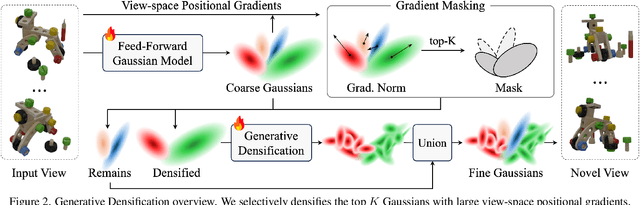
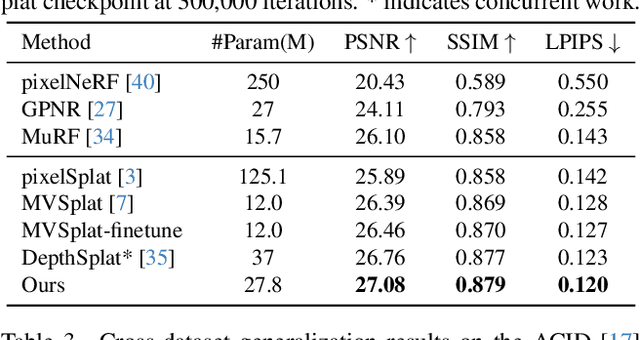
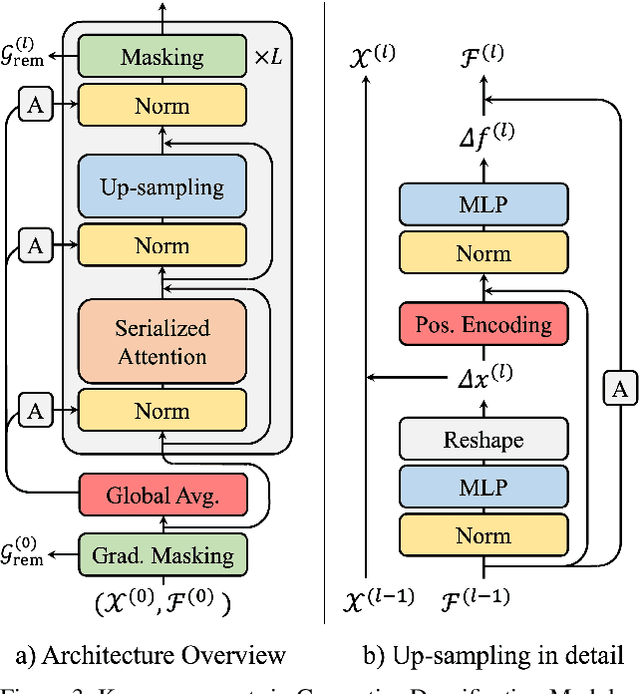
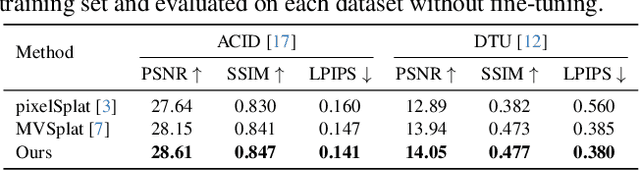
Generalized feed-forward Gaussian models have achieved significant progress in sparse-view 3D reconstruction by leveraging prior knowledge from large multi-view datasets. However, these models often struggle to represent high-frequency details due to the limited number of Gaussians. While the densification strategy used in per-scene 3D Gaussian splatting (3D-GS) optimization can be adapted to the feed-forward models, it may not be ideally suited for generalized scenarios. In this paper, we propose Generative Densification, an efficient and generalizable method to densify Gaussians generated by feed-forward models. Unlike the 3D-GS densification strategy, which iteratively splits and clones raw Gaussian parameters, our method up-samples feature representations from the feed-forward models and generates their corresponding fine Gaussians in a single forward pass, leveraging the embedded prior knowledge for enhanced generalization. Experimental results on both object-level and scene-level reconstruction tasks demonstrate that our method outperforms state-of-the-art approaches with comparable or smaller model sizes, achieving notable improvements in representing fine details.
CodecNeRF: Toward Fast Encoding and Decoding, Compact, and High-quality Novel-view Synthesis
Apr 07, 2024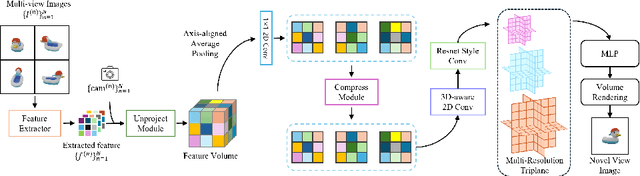

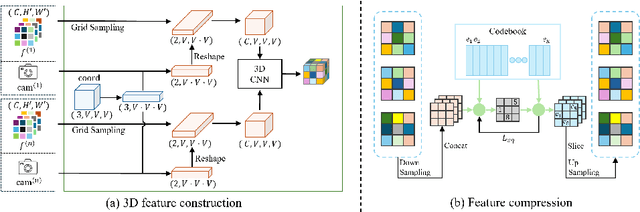
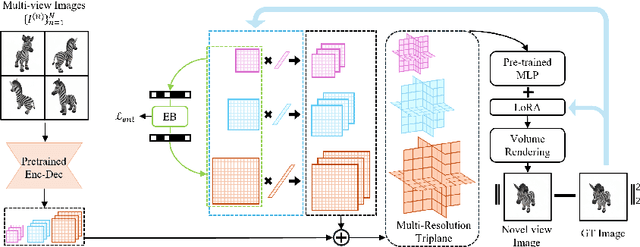
Neural Radiance Fields (NeRF) have achieved huge success in effectively capturing and representing 3D objects and scenes. However, several factors have impeded its further proliferation as next-generation 3D media. To establish a ubiquitous presence in everyday media formats, such as images and videos, it is imperative to devise a solution that effectively fulfills three key objectives: fast encoding and decoding time, compact model sizes, and high-quality renderings. Despite significant advancements, a comprehensive algorithm that adequately addresses all objectives has yet to be fully realized. In this work, we present CodecNeRF, a neural codec for NeRF representations, consisting of a novel encoder and decoder architecture that can generate a NeRF representation in a single forward pass. Furthermore, inspired by the recent parameter-efficient finetuning approaches, we develop a novel finetuning method to efficiently adapt the generated NeRF representations to a new test instance, leading to high-quality image renderings and compact code sizes. The proposed CodecNeRF, a newly suggested encoding-decoding-finetuning pipeline for NeRF, achieved unprecedented compression performance of more than 150x and 20x reduction in encoding time while maintaining (or improving) the image quality on widely used 3D object datasets, such as ShapeNet and Objaverse.