 Add to Chrome
 Add to Firefox
 Add to Edge
NoDrift3R: Raymap-Guided Coupling for Drift-Robust Unposed Feed-Forward 3D Reconstruction
Jul 08, 2026
Pose-Free Feed-forward 3D Gaussian Splatting (3DGS) has recently emerged as a powerful paradigm for fast scene reconstruction. However, its performance degrades significantly in long image sequences due to cumulative camera pose estimation drift, which propagates errors into geometric modeling and severely limits rendering fidelity. In this work, we revisit the long-sequence bottleneck and identify pose drift as the primary factor restricting reconstruction quality. Furthermore, while SfM-based pseudo ground-truth poses introduce sensor noise, purely rendering-based supervision often leads to optimization instability and local minima due to the entangled optimization of geometry and pose. To address the challenges, we propose a synergistic pose-free framework that explicitly couples geometry and appearance via a Raymap-Guided Coupling Module (RGC). Concretely, we anchor Gaussian centers to raymap-induced geometry and jointly optimize RGB reconstruction, raymap consistency, and camera regularization under a unified objective, yielding a bidirectional feedback loop: stronger geometry improves rendering, and appearance supervision in turn refines geometry and pose. To further stabilize learning across wide temporal ranges, we introduce a Dual-Frequency Viewpoint Scheduling strategy that combines easy-to-hard interval expansion with replay of short-interval pairs. Extensive experiments across in-domain and cross-domain datasets show consistent gains in both rendering and pose estimation, with notably improved robustness on long sequences. Ablation studies validate our central insight: explicitly designed geometry-appearance synergy is the key to scalable and drift-robust pose-free feed-forward 3D reconstruction.

2Xplat: Two Experts Are Better Than One Generalist
Mar 24, 2026Pose-free feed-forward 3D Gaussian Splatting (3DGS) has opened a new frontier for rapid 3D modeling, enabling high-quality Gaussian representations to be generated from uncalibrated multi-view images in a single forward pass. The dominant approach in this space adopts unified monolithic architectures, often built on geometry-centric 3D foundation models, to jointly estimate camera poses and synthesize 3DGS representations within a single network. While architecturally streamlined, such "all-in-one" designs may be suboptimal for high-fidelity 3DGS generation, as they entangle geometric reasoning and appearance modeling within a shared representation. In this work, we introduce 2Xplat, a pose-free feed-forward 3DGS framework based on a two-expert design that explicitly separates geometry estimation from Gaussian generation. A dedicated geometry expert first predicts camera poses, which are then explicitly passed to a powerful appearance expert that synthesizes 3D Gaussians. Despite its conceptual simplicity, being largely underexplored in prior works, the proposed approach proves highly effective. In fewer than 5K training iterations, the proposed two-experts pipeline substantially outperforms prior pose-free feed-forward 3DGS approaches and achieves performance on par with state-of-the-art posed methods. These results challenge the prevailing unified paradigm and suggest the potential advantages of modular design principles for complex 3D geometric estimation and appearance synthesis tasks.
Two Experts Are Better Than One Generalist: Decoupling Geometry and Appearance for Feed-Forward 3D Gaussian Splatting
Mar 22, 2026Pose-free feed-forward 3D Gaussian Splatting (3DGS) has opened a new frontier for rapid 3D modeling, enabling high-quality Gaussian representations to be generated from uncalibrated multi-view images in a single forward pass. The dominant approach in this space adopts unified monolithic architectures, often built on geometry-centric 3D foundation models, to jointly estimate camera poses and synthesize 3DGS representations within a single network. While architecturally streamlined, such "all-in-one" designs may be suboptimal for high-fidelity 3DGS generation, as they entangle geometric reasoning and appearance modeling within a shared representation. In this work, we introduce 2Xplat, a pose-free feed-forward 3DGS framework based on a two-expert design that explicitly separates geometry estimation from Gaussian generation. A dedicated geometry expert first predicts camera poses, which are then explicitly passed to a powerful appearance expert that synthesizes 3D Gaussians. Despite its conceptual simplicity, being largely underexplored in prior works, the proposed approach proves highly effective. In fewer than 5K training iterations, the proposed two-experts pipeline substantially outperforms prior pose-free feed-forward 3DGS approaches and achieves performance on par with state-of-the-art posed methods. These results challenge the prevailing unified paradigm and suggest the potential advantages of modular design principles for complex 3D geometric estimation and appearance synthesis tasks.
Multi-view Pyramid Transformer: Look Coarser to See Broader
Dec 08, 2025
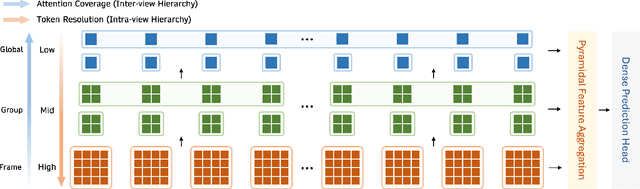
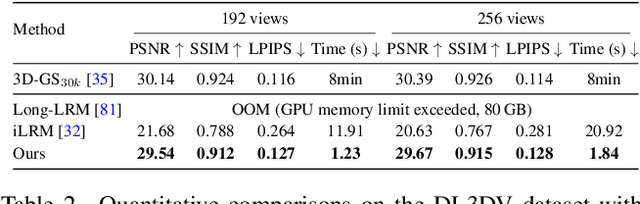
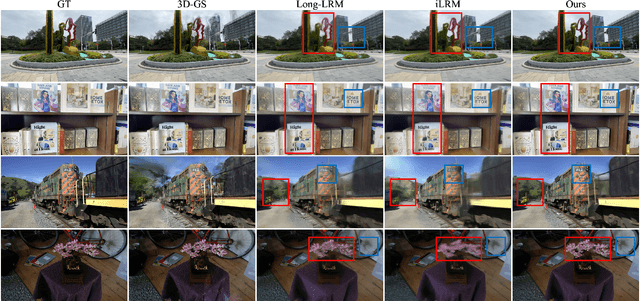
We propose Multi-view Pyramid Transformer (MVP), a scalable multi-view transformer architecture that directly reconstructs large 3D scenes from tens to hundreds of images in a single forward pass. Drawing on the idea of ``looking broader to see the whole, looking finer to see the details," MVP is built on two core design principles: 1) a local-to-global inter-view hierarchy that gradually broadens the model's perspective from local views to groups and ultimately the full scene, and 2) a fine-to-coarse intra-view hierarchy that starts from detailed spatial representations and progressively aggregates them into compact, information-dense tokens. This dual hierarchy achieves both computational efficiency and representational richness, enabling fast reconstruction of large and complex scenes. We validate MVP on diverse datasets and show that, when coupled with 3D Gaussian Splatting as the underlying 3D representation, it achieves state-of-the-art generalizable reconstruction quality while maintaining high efficiency and scalability across a wide range of view configurations.