 Add to Chrome
 Add to Firefox
 Add to Edge
Tailoring the Curriculum: Student-Centered Reasoning Distillation via Dynamic Data-Model Compatibility
May 28, 2026
Reasoning distillation transfers complex reasoning abilities from large language models (LLMs) to smaller ones, yet its success depends on how well the training data align with the student model. This paper introduces the Data-Model Compatibility (DMC) metric, which can be used to assess the suitability of a dataset for reasoning distillation on a student model. DMC provides an assessment by jointly considering data quality, relative difficulty, and student capability. We validated the effectiveness of DMC from two perspectives: (1) DMC exhibits a strong correlation with reasoning distillation performance; and (2) using DMC as the criterion for data selection leads to improved reasoning distillation performance. Both findings are consistently demonstrated across multiple student models and tasks. Moreover, since the DMC of each dataset dynamically changes during training, our experiments demonstrate that dynamically selecting datasets based on DMC can further enhance performance.

BenchTrace: A Benchmark for Testing Reflection Ability and Controlled Evolution in LLM Agents
May 28, 2026Self-evolving agents improve over time by reflecting on past failures, but existing evaluation is limited in two ways: it measures only task scores, leaving reflection quality unknown, and it relies on agents' own episode runs, offering no mechanism to target specific failure patterns. We present \textbf{BenchTrace}, a benchmark for evaluating self-evolution ability in LLM agents. BenchTrace is built on a snapshot-reflection dataset of 1,821 annotated episodes spanning six diverse tasks, and comprises a \textbf{Reflection Evaluation} that probes failure identification through targeted QA tasks, and an \textbf{Evolution Evaluation} that tests whether past failure experience translates into avoidance behavior in a controlled self-evolution simulation. Building on BenchTrace, we propose \textbf{failure avoidance rate (FAR)}, a new evaluation metric measuring the fraction of test cases in which the agent successfully avoids the target failure instance. Experiments with Qwen3-32B and GPT-4.1 reveal that both models fall below a 30\% end-to-end pass rate on reflection evaluation, with diagnosis as the primary bottleneck. Evolution evaluation shows that self-evolution methods generally improve FAR over the non-evolving baseline, but agents forget early lessons as noise episodes accumulate, and agents fail to generalize their reflections beyond the specific context, causing negative transfer across task contexts. Our correlation analysis further reveals that only a fully correct reflection is strongly associated with higher FAR. BenchTrace exposes concrete limits of current self-evolution approaches and provides a controlled, model-agnostic framework for targeted evaluation.
Med-CoReasoner: Reducing Language Disparities in Medical Reasoning via Language-Informed Co-Reasoning
Jan 13, 2026While reasoning-enhanced large language models perform strongly on English medical tasks, a persistent multilingual gap remains, with substantially weaker reasoning in local languages, limiting equitable global medical deployment. To bridge this gap, we introduce Med-CoReasoner, a language-informed co-reasoning framework that elicits parallel English and local-language reasoning, abstracts them into structured concepts, and integrates local clinical knowledge into an English logical scaffold via concept-level alignment and retrieval. This design combines the structural robustness of English reasoning with the practice-grounded expertise encoded in local languages. To evaluate multilingual medical reasoning beyond multiple-choice settings, we construct MultiMed-X, a benchmark covering seven languages with expert-annotated long-form question answering and natural language inference tasks, comprising 350 instances per language. Experiments across three benchmarks show that Med-CoReasoner improves multilingual reasoning performance by an average of 5%, with particularly substantial gains in low-resource languages. Moreover, model distillation and expert evaluation analysis further confirm that Med-CoReasoner produces clinically sound and culturally grounded reasoning traces.
RadGS-Reg: Registering Spine CT with Biplanar X-rays via Joint 3D Radiative Gaussians Reconstruction and 3D/3D Registration
Aug 28, 2025Computed Tomography (CT)/X-ray registration in image-guided navigation remains challenging because of its stringent requirements for high accuracy and real-time performance. Traditional "render and compare" methods, relying on iterative projection and comparison, suffer from spatial information loss and domain gap. 3D reconstruction from biplanar X-rays supplements spatial and shape information for 2D/3D registration, but current methods are limited by dense-view requirements and struggles with noisy X-rays. To address these limitations, we introduce RadGS-Reg, a novel framework for vertebral-level CT/X-ray registration through joint 3D Radiative Gaussians (RadGS) reconstruction and 3D/3D registration. Specifically, our biplanar X-rays vertebral RadGS reconstruction module explores learning-based RadGS reconstruction method with a Counterfactual Attention Learning (CAL) mechanism, focusing on vertebral regions in noisy X-rays. Additionally, a patient-specific pre-training strategy progressively adapts the RadGS-Reg from simulated to real data while simultaneously learning vertebral shape prior knowledge. Experiments on in-house datasets demonstrate the state-of-the-art performance for both tasks, surpassing existing methods. The code is available at: https://github.com/shenao1995/RadGS_Reg.
A Survey on Computational Solutions for Reconstructing Complete Objects by Reassembling Their Fractured Parts
Oct 18, 2024Reconstructing a complete object from its parts is a fundamental problem in many scientific domains. The purpose of this article is to provide a systematic survey on this topic. The reassembly problem requires understanding the attributes of individual pieces and establishing matches between different pieces. Many approaches also model priors of the underlying complete object. Existing approaches are tightly connected problems of shape segmentation, shape matching, and learning shape priors. We provide existing algorithms in this context and emphasize their similarities and differences to general-purpose approaches. We also survey the trends from early non-deep learning approaches to more recent deep learning approaches. In addition to algorithms, this survey will also describe existing datasets, open-source software packages, and applications. To the best of our knowledge, this is the first comprehensive survey on this topic in computer graphics.
Beyond English-Centric LLMs: What Language Do Multilingual Language Models Think in?
Aug 20, 2024



In this study, we investigate whether non-English-centric LLMs, despite their strong performance, `think' in their respective dominant language: more precisely, `think' refers to how the representations of intermediate layers, when un-embedded into the vocabulary space, exhibit higher probabilities for certain dominant languages during generation. We term such languages as internal $\textbf{latent languages}$. We examine the latent language of three typical categories of models for Japanese processing: Llama2, an English-centric model; Swallow, an English-centric model with continued pre-training in Japanese; and LLM-jp, a model pre-trained on balanced English and Japanese corpora. Our empirical findings reveal that, unlike Llama2 which relies exclusively on English as the internal latent language, Japanese-specific Swallow and LLM-jp employ both Japanese and English, exhibiting dual internal latent languages. For any given target language, the model preferentially activates the latent language most closely related to it. In addition, we explore how intermediate layers respond to questions involving cultural conflicts between latent internal and target output languages. We further explore how the language identity shifts across layers while keeping consistent semantic meaning reflected in the intermediate layer representations. This study deepens the understanding of non-English-centric large language models, highlighting the intricate dynamics of language representation within their intermediate layers.
TWOLAR: a TWO-step LLM-Augmented distillation method for passage Reranking
Mar 26, 2024In this paper, we present TWOLAR: a two-stage pipeline for passage reranking based on the distillation of knowledge from Large Language Models (LLM). TWOLAR introduces a new scoring strategy and a distillation process consisting in the creation of a novel and diverse training dataset. The dataset consists of 20K queries, each associated with a set of documents retrieved via four distinct retrieval methods to ensure diversity, and then reranked by exploiting the zero-shot reranking capabilities of an LLM. Our ablation studies demonstrate the contribution of each new component we introduced. Our experimental results show that TWOLAR significantly enhances the document reranking ability of the underlying model, matching and in some cases even outperforming state-of-the-art models with three orders of magnitude more parameters on the TREC-DL test sets and the zero-shot evaluation benchmark BEIR. To facilitate future work we release our data set, finetuned models, and code.
A Survey of Pre-trained Language Models for Processing Scientific Text
Jan 31, 2024The number of Language Models (LMs) dedicated to processing scientific text is on the rise. Keeping pace with the rapid growth of scientific LMs (SciLMs) has become a daunting task for researchers. To date, no comprehensive surveys on SciLMs have been undertaken, leaving this issue unaddressed. Given the constant stream of new SciLMs, appraising the state-of-the-art and how they compare to each other remain largely unknown. This work fills that gap and provides a comprehensive review of SciLMs, including an extensive analysis of their effectiveness across different domains, tasks and datasets, and a discussion on the challenges that lie ahead.
JVNV: A Corpus of Japanese Emotional Speech with Verbal Content and Nonverbal Expressions
Oct 09, 2023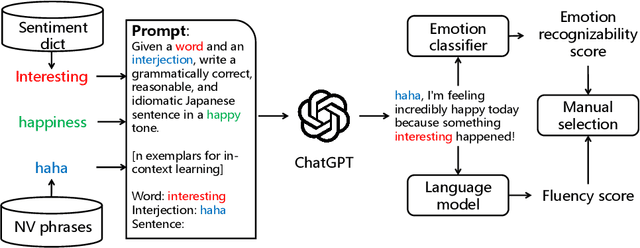

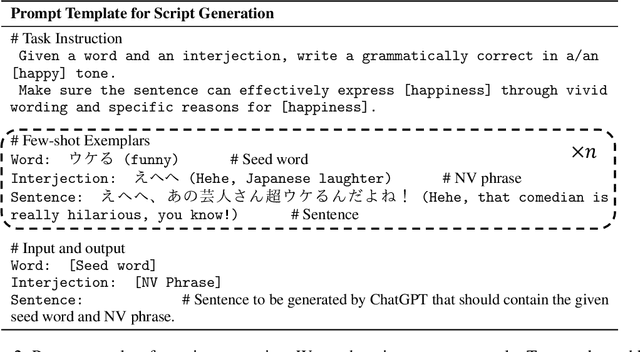
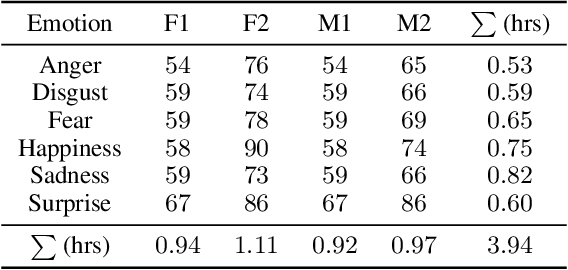
We present the JVNV, a Japanese emotional speech corpus with verbal content and nonverbal vocalizations whose scripts are generated by a large-scale language model. Existing emotional speech corpora lack not only proper emotional scripts but also nonverbal vocalizations (NVs) that are essential expressions in spoken language to express emotions. We propose an automatic script generation method to produce emotional scripts by providing seed words with sentiment polarity and phrases of nonverbal vocalizations to ChatGPT using prompt engineering. We select 514 scripts with balanced phoneme coverage from the generated candidate scripts with the assistance of emotion confidence scores and language fluency scores. We demonstrate the effectiveness of JVNV by showing that JVNV has better phoneme coverage and emotion recognizability than previous Japanese emotional speech corpora. We then benchmark JVNV on emotional text-to-speech synthesis using discrete codes to represent NVs. We show that there still exists a gap between the performance of synthesizing read-aloud speech and emotional speech, and adding NVs in the speech makes the task even harder, which brings new challenges for this task and makes JVNV a valuable resource for relevant works in the future. To our best knowledge, JVNV is the first speech corpus that generates scripts automatically using large language models.
SuperDialseg: A Large-scale Dataset for Supervised Dialogue Segmentation
May 15, 2023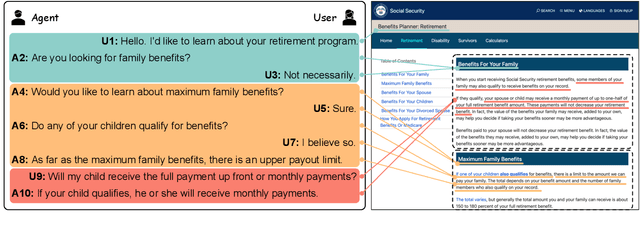
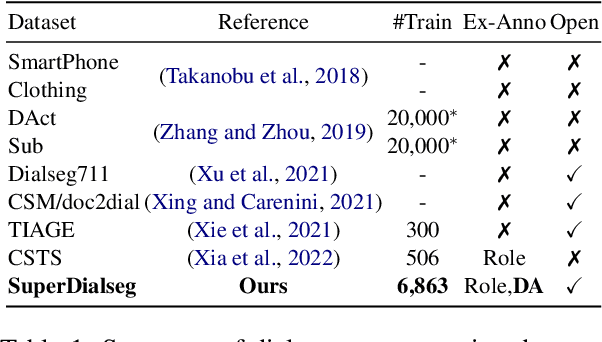
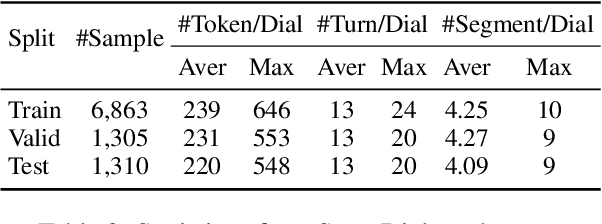
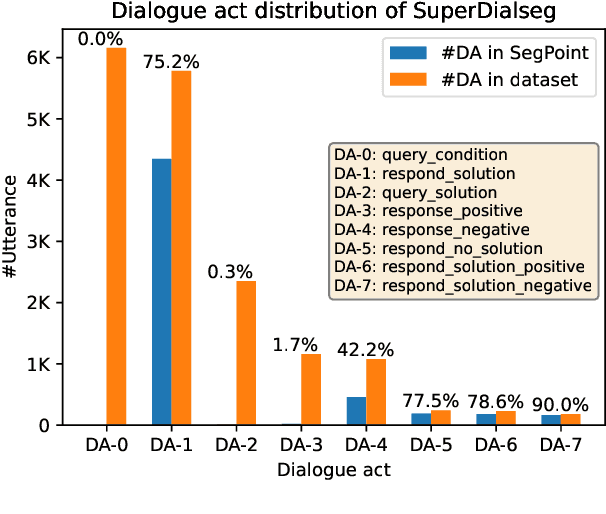
Dialogue segmentation is a crucial task for dialogue systems allowing a better understanding of conversational texts. Despite recent progress in unsupervised dialogue segmentation methods, their performances are limited by the lack of explicit supervised signals for training. Furthermore, the precise definition of segmentation points in conversations still remains as a challenging problem, increasing the difficulty of collecting manual annotations. In this paper, we provide a feasible definition of dialogue segmentation points with the help of document-grounded dialogues and release a large-scale supervised dataset called SuperDialseg, containing 9K dialogues based on two prevalent document-grounded dialogue corpora, and also inherit their useful dialogue-related annotations. Moreover, we propose two models to exploit the dialogue characteristics, achieving state-of-the-art performance on SuperDialseg and showing good generalization ability on the out-of-domain datasets. Additionally, we provide a benchmark including 20 models across four categories for the dialogue segmentation task with several proper evaluation metrics. Based on the analysis of the empirical studies, we also provide some insights for the task of dialogue segmentation. We believe our work is an important step forward in the field of dialogue segmentation.