 Add to Chrome
 Add to Firefox
 Add to Edge
Learning to Assemble Novel Structures with Unfamiliar Parts under Semantic Constraints
Aug 13, 2026
This paper describes a neurosymbolic architecture for learning to assemble novel structures using evidence from embodied conversations and task demonstrations. We focus on scenarios where an agent encounters, after deployment, semantic constraints on structures--in other words, constraints as to which part types and features make valid structures--that were not available during training, and where it is initially unaware of the relevant structure and component part concepts. The agent must acquire and exploit such knowledge through user interactions while attempting assembly. We study this setting in a simulated toy truck assembly domain, learning from symbolic evidence encoded in natural language and from dense visual observations. Our experiments show that communicating semantic constraints through natural language (e.g., "dump trucks have a dumper") yields more data-efficient online adaptation than relying only on task demonstrations and/or only naming the parts through natural language.

UrbanCDNet: Appearance-Robust and Boundary-Aware Bitemporal Change Detection for Korean Urban Building Monitoring
Jun 29, 2026Urban building change detection from bi-temporal aerial imagery is important for redevelopment monitoring, infrastructure management, and unauthorized-construction screening, but Korean urban scenes remain difficult because changed regions are often sparse, appearance varies strongly between acquisition dates, and useful outputs must follow building footprints rather than coarse blobs. This paper presents UrbanCDNet, a task specific Siamese CNN that combines appearance-robust multi-cue comparison, alignment-aware middle-scale differencing, lightweight context refinement, scene calibration, and auxiliary boundary supervision. Experiments use a corrected AIHub-based Korean benchmark with 3,998 training, 503 validation, and 499 test pairs, and report changed-class precision, recall, F1, and IoU. On the locked test split, UrbanCDNet achieves 0.7335 precision, 0.7696 recall, 0.7511 F1, and 0.6014 IoU, outperforming a strong Siamese U-Net baseline (0.7108 F1, 0.5514 IoU) and the strongest external competitor, ChangeFormer-MIT-B0 (0.7107 F1, 0.5512 IoU). Additional diagnostic slicing shows that the gain is concentrated in the operating regimes that motivated the design: on the sparse-change subset with less than 5% changed area, F1 improves from 0.4765 to 0.6175, and on the high photometric-gap subset it improves from 0.6349 to 0.7285. Boundary F1 at 3-pixel tolerance rises from 0.3445 to 0.4447, while object F1 at IoU 0.3 rises from 0.0690 to 0.2258. These results indicate that, on this Korean benchmark, task-shaped temporal comparison and boundary-aware supervision matter more than generic model scale alone
CoSA: Correlation-Guided Change Attention with Learnable Residual Gating for Remote Sensing Change Detection
Jun 20, 2026Remote sensing change detection (CD) from bi-temporal imagery is critical for applications such as urban monitoring, disaster assessment, and environmental management, yet robust localization remains challenging under sparse changes, noisy labels, and appearance variations. In this paper, we propose Context Sampling Attention (CoSA), a lightweight decoder-side refinement module that explicitly leverages bi-temporal feature correlation as a control signal for adaptive change-aware feature enhancement. This differs from conventional attention mechanisms that rely on implicit feature weighting without explicit temporal control. In the implemented FC-Siam setting, CoSA computes normalized same-location cross-correlation between paired decoder features, converts low correlation into a change gate, and injects the resulting gated residual at native 1/8 and 1/16 feature scales through learnable residual scaling. This design enables effective discrimination between stable and ambiguous regions without relying on computationally expensive global attention. Extensive experiments on four benchmark datasets (LEVIR-CD, S2Looking, DSIFN, and CLCD) demonstrate consistent improvements over strong baselines, achieving 1.5-2.6% gains in changed-class F1 while introducing negligible parameter overhead. Ablation studies confirm that multiscale placement and learnable residual gating are both important for peak performance. These results indicate that CoSA establishes a practical and effective refinement paradigm for enhancing temporal discriminability in Siamese change detection frameworks.
* 12 pages, 5 figures; published in IEEE Access. Code: https://github.com/rashiedomar/CoSA
NTIRE 2026 Challenge on Single Image Reflection Removal in the Wild: Datasets, Results, and Methods
Apr 11, 2026In this paper, we review the NTIRE 2026 challenge on single-image reflection removal (SIRR) in the Wild. SIRR is a fundamental task in image restoration. Despite progress in academic research, most methods are tested on synthetic images or limited real-world images, creating a gap in real-world applications. In this challenge, we provide participants with the OpenRR-5k dataset, which requires them to process real-world images that cover a range of reflection scenarios and intensities, with the goal of generating clean images without reflections. The challenge attracted more than 100 registrations, with 11 of them participating in the final testing phase. The top-ranked methods advanced the state-of-the-art reflection removal performance and earned unanimous recognition from the five experts in the field. The proposed OpenRR-5k dataset is available at https://huggingface.co/datasets/qiuzhangTiTi/OpenRR-5k, and the homepage of this challenge is at https://github.com/caijie0620/OpenRR-5k. Due to page limitations, this article only presents partial content; the full report and detailed analyses are available in the extended arXiv version.
Refining Visual Artifacts in Diffusion Models via Explainable AI-based Flaw Activation Maps
Dec 09, 2025Diffusion models have achieved remarkable success in image synthesis. However, addressing artifacts and unrealistic regions remains a critical challenge. We propose self-refining diffusion, a novel framework that enhances image generation quality by detecting these flaws. The framework employs an explainable artificial intelligence (XAI)-based flaw highlighter to produce flaw activation maps (FAMs) that identify artifacts and unrealistic regions. These FAMs improve reconstruction quality by amplifying noise in flawed regions during the forward process and by focusing on these regions during the reverse process. The proposed approach achieves up to a 27.3% improvement in Fréchet inception distance across various diffusion-based models, demonstrating consistently strong performance on diverse datasets. It also shows robust effectiveness across different tasks, including image generation, text-to-image generation, and inpainting. These results demonstrate that explainable AI techniques can extend beyond interpretability to actively contribute to image refinement. The proposed framework offers a versatile and effective approach applicable to various diffusion models and tasks, significantly advancing the field of image synthesis.
MatteViT: High-Frequency-Aware Document Shadow Removal with Shadow Matte Guidance
Dec 09, 2025Document shadow removal is essential for enhancing the clarity of digitized documents. Preserving high-frequency details (e.g., text edges and lines) is critical in this process because shadows often obscure or distort fine structures. This paper proposes a matte vision transformer (MatteViT), a novel shadow removal framework that applies spatial and frequency-domain information to eliminate shadows while preserving fine-grained structural details. To effectively retain these details, we employ two preservation strategies. First, our method introduces a lightweight high-frequency amplification module (HFAM) that decomposes and adaptively amplifies high-frequency components. Second, we present a continuous luminance-based shadow matte, generated using a custom-built matte dataset and shadow matte generator, which provides precise spatial guidance from the earliest processing stage. These strategies enable the model to accurately identify fine-grained regions and restore them with high fidelity. Extensive experiments on public benchmarks (RDD and Kligler) demonstrate that MatteViT achieves state-of-the-art performance, providing a robust and practical solution for real-world document shadow removal. Furthermore, the proposed method better preserves text-level details in downstream tasks, such as optical character recognition, improving recognition performance over prior methods.
Learning Visually Grounded Domain Ontologies via Embodied Conversation and Explanation
Dec 13, 2024In this paper, we offer a learning framework in which the agent's knowledge gaps are overcome through corrective feedback from a teacher whenever the agent explains its (incorrect) predictions. We test it in a low-resource visual processing scenario, in which the agent must learn to recognize distinct types of toy truck. The agent starts the learning process with no ontology about what types of trucks exist nor which parts they have, and a deficient model for recognizing those parts from visual input. The teacher's feedback to the agent's explanations addresses its lack of relevant knowledge in the ontology via a generic rule (e.g., "dump trucks have dumpers"), whereas an inaccurate part recognition is corrected by a deictic statement (e.g., "this is not a dumper"). The learner utilizes this feedback not only to improve its estimate of the hypothesis space of possible domain ontologies and probability distributions over them, but also to use those estimates to update its visual interpretation of the scene. Our experiments demonstrate that teacher-learner pairs utilizing explanations and corrections are more data-efficient than those without such a faculty.
Interactive Acquisition of Fine-grained Visual Concepts by Exploiting Semantics of Generic Characterizations in Discourse
May 05, 2023Interactive Task Learning (ITL) concerns learning about unforeseen domain concepts via natural interactions with human users. The learner faces a number of significant constraints: learning should be online, incremental and few-shot, as it is expected to perform tangible belief updates right after novel words denoting unforeseen concepts are introduced. In this work, we explore a challenging symbol grounding task--discriminating among object classes that look very similar--within the constraints imposed by ITL. We demonstrate empirically that more data-efficient grounding results from exploiting the truth-conditions of the teacher's generic statements (e.g., "Xs have attribute Z.") and their implicatures in context (e.g., as an answer to "How are Xs and Ys different?", one infers Y lacks attribute Z).
Improving 3D Imaging with Pre-Trained Perpendicular 2D Diffusion Models
Mar 15, 2023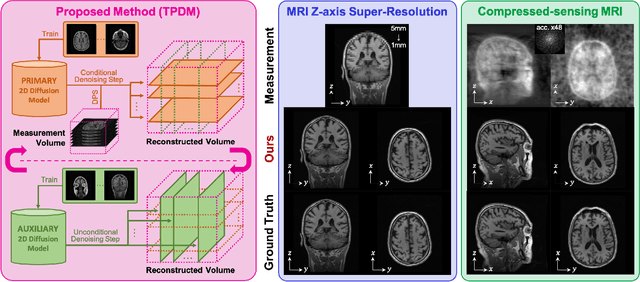
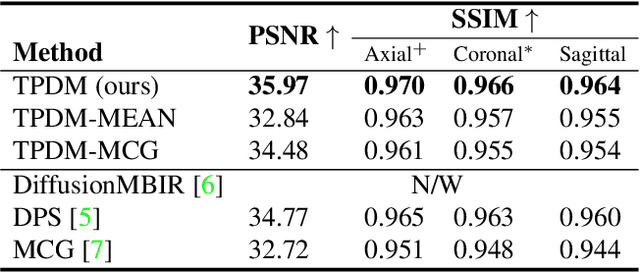
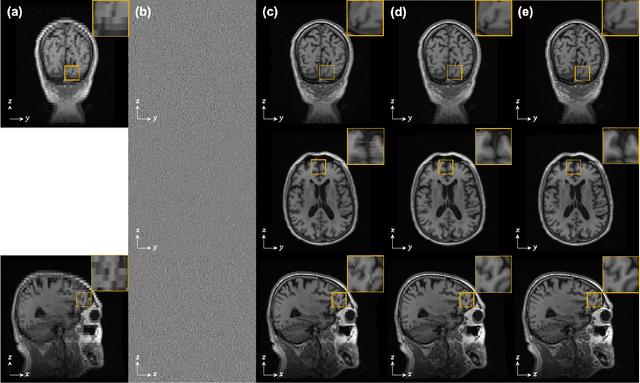
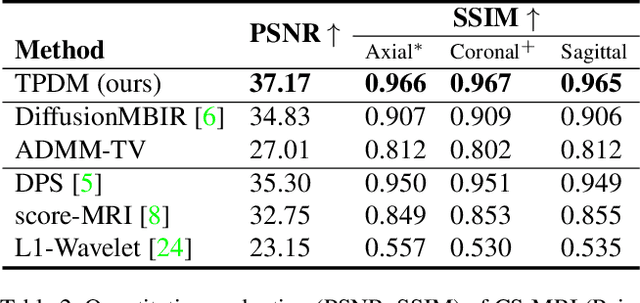
Diffusion models have become a popular approach for image generation and reconstruction due to their numerous advantages. However, most diffusion-based inverse problem-solving methods only deal with 2D images, and even recently published 3D methods do not fully exploit the 3D distribution prior. To address this, we propose a novel approach using two perpendicular pre-trained 2D diffusion models to solve the 3D inverse problem. By modeling the 3D data distribution as a product of 2D distributions sliced in different directions, our method effectively addresses the curse of dimensionality. Our experimental results demonstrate that our method is highly effective for 3D medical image reconstruction tasks, including MRI Z-axis super-resolution, compressed sensing MRI, and sparse-view CT. Our method can generate high-quality voxel volumes suitable for medical applications.
HintPose
Mar 04, 2020
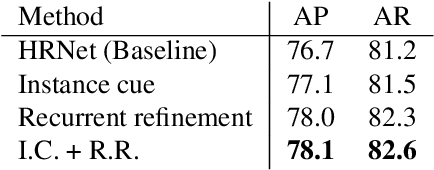
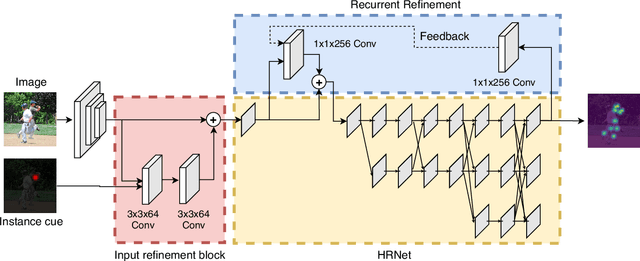
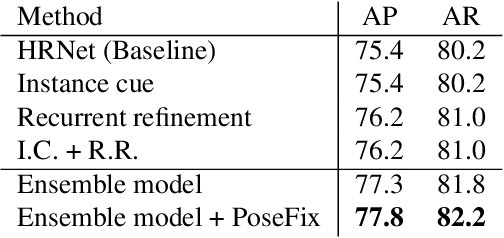
Most of the top-down pose estimation models assume that there exists only one person in a bounding box. However, the assumption is not always correct. In this technical report, we introduce two ideas, instance cue and recurrent refinement, to an existing pose estimator so that the model is able to handle detection boxes with multiple persons properly. When we evaluated our model on the COCO17 keypoints dataset, it showed non-negligible improvement compared to its baseline model. Our model achieved 76.2 mAP as a single model and 77.3 mAP as an ensemble on the test-dev set without additional training data. After additional post-processing with a separate refinement network, our final predictions achieved 77.8 mAP on the COCO test-dev set.