 Add to Chrome
 Add to Firefox
 Add to Edge
Learning to Assemble Novel Structures with Unfamiliar Parts under Semantic Constraints
Aug 13, 2026
This paper describes a neurosymbolic architecture for learning to assemble novel structures using evidence from embodied conversations and task demonstrations. We focus on scenarios where an agent encounters, after deployment, semantic constraints on structures--in other words, constraints as to which part types and features make valid structures--that were not available during training, and where it is initially unaware of the relevant structure and component part concepts. The agent must acquire and exploit such knowledge through user interactions while attempting assembly. We study this setting in a simulated toy truck assembly domain, learning from symbolic evidence encoded in natural language and from dense visual observations. Our experiments show that communicating semantic constraints through natural language (e.g., "dump trucks have a dumper") yields more data-efficient online adaptation than relying only on task demonstrations and/or only naming the parts through natural language.

Comparing British and American Audio Description of Movies
Aug 10, 2026Narrating the visual component of movies is known as audio description. It is a narrative technique designed to enable blind and visually impaired individuals to follow the story. However, it is far more constrained than most narratives: the descriptions not only need to convey the story in the movie, but they must also fit into gaps between dialogue and they need to conform to guidelines that exist in each region. In this work, we compare audio description created in the United Kingdom against audio description created in the United States. We use guidelines written for these two regions, alongside the impressions from a practitioner in the field, to motivate specific hypotheses about the differences. We test these hypotheses against our pre-existing corpus, which provides both human-authored American and British audio description for each of 206 movies. Results provide quantitative evidence to uphold all tested hypotheses, including differences in lexicon, the use of the progressive aspect, the use of passive constructions, the use of subjective adjectives and modifiers, when characters are named, how scenes are cued, and degree of overlap with movie dialogue and music. Our work offers a quantitative lens into the narrative technique of audio description.
REFRAMED: Towards Realistic Audio Description Generation for Movies
Aug 10, 2026Audio Description (AD) is a verbal narration of key visual content in videos, enabling access for visually impaired audiences. Unlike standard video captioning, AD is a structured editorial task: descriptions must be inserted into gaps in dialogue and must convey only what is needed to understand the narrative being told. However, existing approaches formulate AD generation in an artificial setting where both the content and timing of descriptions are pre-specified, reducing the task to clip-level captioning. They further rely on noisy transcription and alignment pipelines, and lack the rich parallel data required for modeling narrative context. We introduce a new formulation of AD generation in which models must jointly decide what to describe and when to do it. To support this, we present REFRAMED, a high-quality dataset of 2,023 videos that span 3,302 scenes from 206 movies, with professional AD transcripts (both American and British versions), professional subtitles and aligned screenplays. We also provide a manually curated challenge set that pairs full movies with multiple AD references, together with evaluation protocols that leverage dialogue gaps and multi-reference comparisons. Experiments with state-of-the-art AD systems and multimodal LLMs show that they outperform trivial baselines but fall far short of expert human performance. Our dataset and benchmark establish a new foundation for research on video understanding.
Contrastive Learning with Narrative Twins for Modeling Story Salience
Jan 12, 2026Understanding narratives requires identifying which events are most salient for a story's progression. We present a contrastive learning framework for modeling narrative salience that learns story embeddings from narrative twins: stories that share the same plot but differ in surface form. Our model is trained to distinguish a story from both its narrative twin and a distractor with similar surface features but different plot. Using the resulting embeddings, we evaluate four narratologically motivated operations for inferring salience (deletion, shifting, disruption, and summarization). Experiments on short narratives from the ROCStories corpus and longer Wikipedia plot summaries show that contrastively learned story embeddings outperform a masked-language-model baseline, and that summarization is the most reliable operation for identifying salient sentences. If narrative twins are not available, random dropout can be used to generate the twins from a single story. Effective distractors can be obtained either by prompting LLMs or, in long-form narratives, by using different parts of the same story.
Plancraft: an evaluation dataset for planning with LLM agents
Dec 30, 2024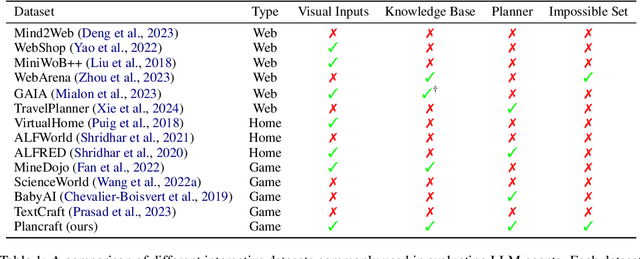
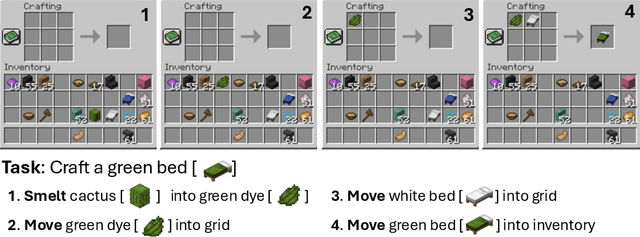
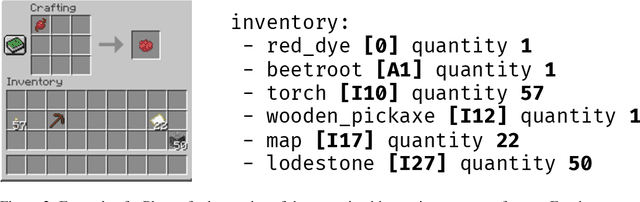
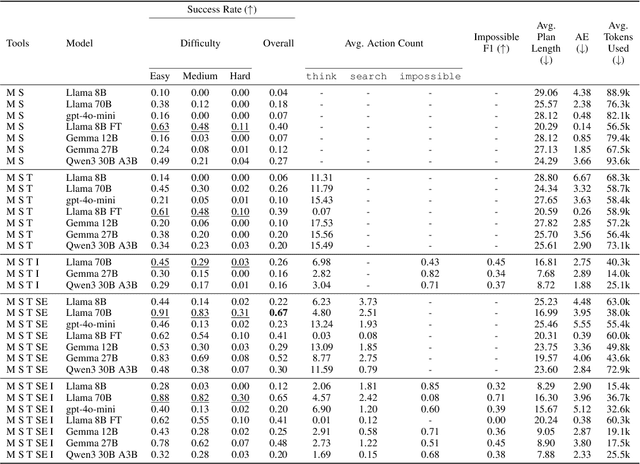
We present Plancraft, a multi-modal evaluation dataset for LLM agents. Plancraft has both a text-only and multi-modal interface, based on the Minecraft crafting GUI. We include the Minecraft Wiki to evaluate tool use and Retrieval Augmented Generation (RAG), as well as an oracle planner and oracle RAG information extractor, to ablate the different components of a modern agent architecture. To evaluate decision-making, Plancraft also includes a subset of examples that are intentionally unsolvable, providing a realistic challenge that requires the agent not only to complete tasks but also to decide whether they are solvable at all. We benchmark both open-source and closed-source LLMs and strategies on our task and compare their performance to a handcrafted planner. We find that LLMs and VLMs struggle with the planning problems that Plancraft introduces, and we offer suggestions on how to improve their capabilities.
Learning Visually Grounded Domain Ontologies via Embodied Conversation and Explanation
Dec 13, 2024In this paper, we offer a learning framework in which the agent's knowledge gaps are overcome through corrective feedback from a teacher whenever the agent explains its (incorrect) predictions. We test it in a low-resource visual processing scenario, in which the agent must learn to recognize distinct types of toy truck. The agent starts the learning process with no ontology about what types of trucks exist nor which parts they have, and a deficient model for recognizing those parts from visual input. The teacher's feedback to the agent's explanations addresses its lack of relevant knowledge in the ontology via a generic rule (e.g., "dump trucks have dumpers"), whereas an inaccurate part recognition is corrected by a deictic statement (e.g., "this is not a dumper"). The learner utilizes this feedback not only to improve its estimate of the hypothesis space of possible domain ontologies and probability distributions over them, but also to use those estimates to update its visual interpretation of the scene. Our experiments demonstrate that teacher-learner pairs utilizing explanations and corrections are more data-efficient than those without such a faculty.
Generating Driving Simulations via Conversation
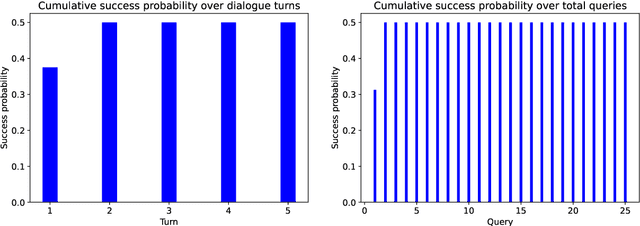
Oct 13, 2024Cyber-physical systems like autonomous vehicles are tested in simulation before deployment, using domain-specific programs for scenario specification. To aid the testing of autonomous vehicles in simulation, we design a natural language interface, using an instruction-following large language model, to assist a non-coding domain expert in synthesising the desired scenarios and vehicle behaviours. We show that using it to convert utterances to the symbolic program is feasible, despite the very small training dataset. Human experiments show that dialogue is critical to successful simulation generation, leading to a 4.5 times higher success rate than a generation without engaging in extended conversation.
SECURE: Semantics-aware Embodied Conversation under Unawareness for Lifelong Robot Learning
Sep 26, 2024

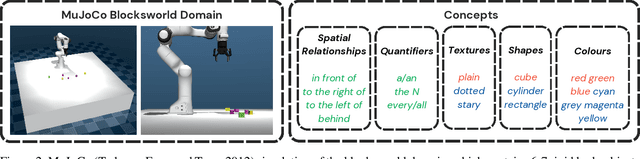
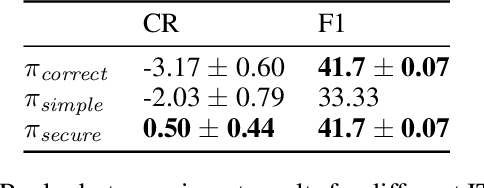
This paper addresses a challenging interactive task learning scenario we call rearrangement under unawareness: to manipulate a rigid-body environment in a context where the robot is unaware of a concept that's key to solving the instructed task. We propose SECURE, an interactive task learning framework designed to solve such problems by fixing a deficient domain model using embodied conversation. Through dialogue, the robot discovers and then learns to exploit unforeseen possibilities. Using SECURE, the robot not only learns from the user's corrective feedback when it makes a mistake, but it also learns to make strategic dialogue decisions for revealing useful evidence about novel concepts for solving the instructed task. Together, these abilities allow the robot to generalise to subsequent tasks using newly acquired knowledge. We demonstrate that a robot that is semantics-aware -- that is, it exploits the logical consequences of both sentence and discourse semantics in the learning and inference process -- learns to solve rearrangement under unawareness more effectively than a robot that lacks such capabilities.
Dialogue-based generation of self-driving simulation scenarios using Large Language Models
Oct 26, 2023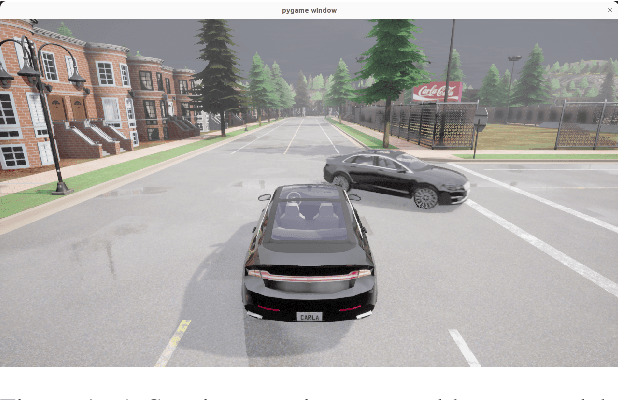
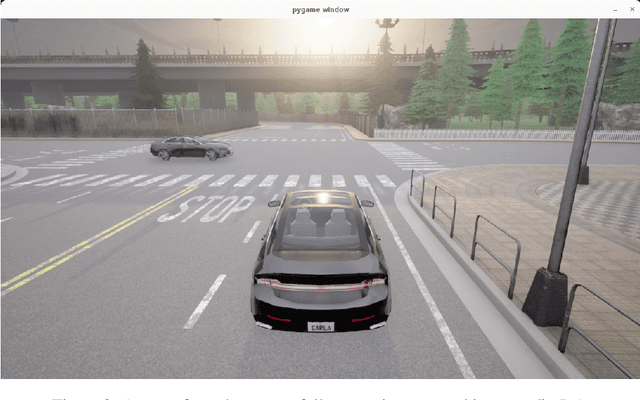
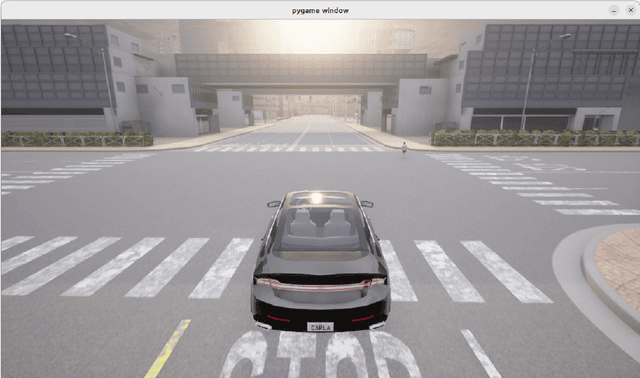
Simulation is an invaluable tool for developing and evaluating controllers for self-driving cars. Current simulation frameworks are driven by highly-specialist domain specific languages, and so a natural language interface would greatly enhance usability. But there is often a gap, consisting of tacit assumptions the user is making, between a concise English utterance and the executable code that captures the user's intent. In this paper we describe a system that addresses this issue by supporting an extended multimodal interaction: the user can follow up prior instructions with refinements or revisions, in reaction to the simulations that have been generated from their utterances so far. We use Large Language Models (LLMs) to map the user's English utterances in this interaction into domain-specific code, and so we explore the extent to which LLMs capture the context sensitivity that's necessary for computing the speaker's intended message in discourse.
Dynamic Planning with a LLM
Aug 11, 2023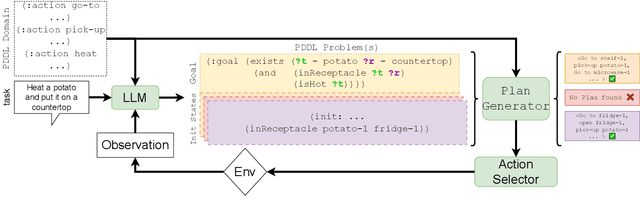
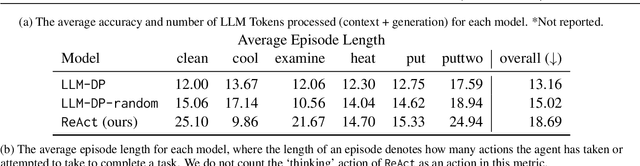
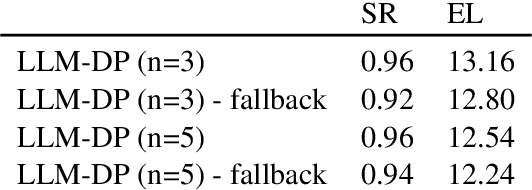
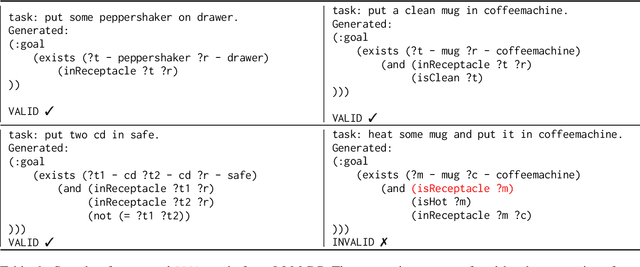
While Large Language Models (LLMs) can solve many NLP tasks in zero-shot settings, applications involving embodied agents remain problematic. In particular, complex plans that require multi-step reasoning become difficult and too costly as the context window grows. Planning requires understanding the likely effects of one's actions and identifying whether the current environment satisfies the goal state. While symbolic planners find optimal solutions quickly, they require a complete and accurate representation of the planning problem, severely limiting their use in practical scenarios. In contrast, modern LLMs cope with noisy observations and high levels of uncertainty when reasoning about a task. Our work presents LLM Dynamic Planner (LLM-DP): a neuro-symbolic framework where an LLM works hand-in-hand with a traditional planner to solve an embodied task. Given action-descriptions, LLM-DP solves Alfworld faster and more efficiently than a naive LLM ReAct baseline.