 Add to Chrome
 Add to Firefox
 Add to Edge
Grasp Execution Without a Planner: Configuration-Space Grasp Distance Fields with Certified Safety & Guaranteed Quality
Aug 01, 2026
Standard multifingered grasp execution architectures plan a collision-free trajectory to a selected grasp pose and track it with a feedback law. Execution-time object pose uncertainty or perturbations may invalidate the planned trajectory, forcing a costly replanning step. We present Grasp Distance Fields (GDFs), a smooth softmin distance field over grasp configurations in the arm-hand configuration space. Our controller executes a grasp by following this field's negative gradient with a stationary feedback law, eliminating the need for a planner, stored trajectory, or grasp selection. For safety, we filter this command through a CBF-CLF quadratic program (QP) constraining self-collision, workspace, object, and obstacle clearance, reporting impeded progress as explicit slack. We prove that the softmin tracks the true set distance within \(\log N/ρ\) for \(N\) candidates and smoothing parameter \(ρ\), and that the filtered loop renders the safe set forward invariant. Since no smooth field captures hand-object contact switching, we switch modes with hysteresis at a pregrasp configuration, trading object collision avoidance for contact admission. A wrench-quality barrier then keeps the realized grasp's force-closure margin within a prescribed tolerance of its value at hold onset. We evaluate in kinematic simulation on a fixed-base arm and a Unitree G1 humanoid, both fitted with the same underactuated hand. Our controller navigates cluttered and dynamic scenes to safely reach for, grasp, and lift 46 of 50 objects spanning primitive, household, and adversarial classes. Across those lifts, the executed grasps retain a median 94\% of their synthesized quality margin, at 0.09 ms QP solve time per 20 ms control step. Per-step softmax weights confirm that our controller executes the nearest candidate, obviating a separate selection step. Project page: www.clintonenwerem.com/gdf.

FIRMGrasp: A Friction-Informed Risk Margin for Robust Grasp Synthesis
Jul 27, 2026Classical grasp quality metrics assume a single deterministic friction coefficient, so they cannot predict whether a grasp retains force closure across the range of friction values the contacting surfaces may exhibit. To predict these failures, we present FIRMGrasp, a family of friction-volatility-aware grasp quality metrics grounded in the Conditional Value-at-Risk (CVaR) risk measure. Unlike standard grasp quality assessors that assume a single friction realization, our metric evaluates the force-closure margin at the CVaR-discounted mean of the adverse friction tail, yielding a risk-adjusted margin $\varepsilon^{(β)}$, the inscribed-ball radius of the risk-adjusted wrench space. We establish its monotonicity in the confidence level $β$, its differentiability in the grasp parameters, and a probabilistic closure certificate that guarantees force closure with probability at least $β$ whenever $\varepsilon^{(β)}$ is positive. Under a calibrated friction distribution, analytic evaluation shows our $\varepsilon^{(β)}$ metric identifies friction-sensitive grasps that the nominal Ferrari-Canny epsilon rates as high-quality, and we compare against the nominal epsilon and recent differentiable baselines. Across 1,599 LEAP Hand and Allegro Hand grasps, 53% of the grasps the nominal Ferrari-Canny margin certifies lose force closure in the adverse friction tail. On the same set, the nominal margin separates realized shake and pick success with probabilities of only 0.53 and 0.67, near chance on shake success, whereas $\varepsilon^{(β)}$ orders the pair correctly with probabilities of 0.63 and 0.78, respectively. In simulated lift trials with gravity enabled at an adverse friction coefficient of 0.2, grasps $\varepsilon^{(β)}$ certifies reach a 70% success rate under lateral pull, against 25% for grasps the nominal margin certifies but $\varepsilon^{(β)}$ rejects.
EquiDexFlow: Contact-Grounded SE(3)-Equivariant Dexterous Grasp Generative Flows
Jun 10, 2026Most learned dexterous grasp generators relegate contact forces to a downstream verification step, so a kinematically-plausible pose can still violate the conditions for a stable physical grasp. We address this with EquiDexFlow, an SE(3)-equivariant flow-matching model that jointly predicts wrist pose, joint angles, fingertip contacts, surface normals, and contact forces from an object point cloud. Our architecture projects contacts onto the object surface and forces into the Coulomb friction cone by construction, so placement and friction compliance hold without loss penalties. We prove end-to-end SE(3) equivariance and verify it empirically over 200 rotations, with wrist residuals below $0.04^\circ$ and exactly zero joint deviation. Trained on 8,100 force-closure grasps across 81 objects for the 16-DoF Allegro Hand, our model achieves zero friction violations, the best composite score, and the lowest wrench residual among all ablation variants. We retarget decoded fingertip contacts to a 16-DoF LEAP Hand via per-finger inverse kinematics, and our hardware-feasible refinement places every joint at least 5% inside its actuator envelope while preserving wrench balance. On the physical robot, retargeted EquiDexFlow-decoded grasps complete open-loop pick-and-hold trials on all six test objects, with every asymmetric object succeeding at both the canonical pose and a $120^\circ$ co-rotation. Videos, code, and checkpoints are available at https://equidexflow.github.io.
IDDMBSE: Integrating Data-Driven and Model-Based Systems Engineering for Trusted Autonomous Cyber-Physical Systems
Jun 04, 2026Autonomous cyber-physical systems (CPS) sit at the intersection of Model-Based Systems Engineering (MBSE) and data-driven Machine Learning and Artificial Intelligence (ML/AI), yet no integrated Systems Engineering (SE) methodology natively spans both. We address this gap with IDDMBSE, an Integrated Data-Driven and Model-Based Systems Engineering methodology that extends the rigorous MBSE V-process with a data-driven loop at every step, anchored in SysML, the autonomy stack, and a hybrid model-based plus data-driven trade-off architecture. We instantiate IDDMBSE as an interoperable, open-source tool chain: PERFECT, which maps SysML system architectures to executable ROS autonomy stacks for scalable performance evaluation; TRADES-X, which decomposes design-space exploration into a model-based optimization stage followed by a data-driven evaluation stage; and VERITAS, which combines formal, data-driven, and runtime verification into a single assurance workflow. We demonstrate IDDMBSE on a Trusted Autonomous Ground Robot across its development lifecycle, spanning sensor-suite selection, risk-sensitive path planning, behavior-tree task verification, conformal-prediction-based robust perception, and assured multi-robot coordination, all exercised in a contested-terrain Isaac Sim test range that we release with the tool chain. We close by sketching how IDDMBSE is being re-formulated on SysML v2 / KerML foundations to enable language-native composability and tighter ML/AI integration.
Variational Neural Belief Parameterizations for Robust Dexterous Grasping under Multimodal Uncertainty
Apr 28, 2026Contact variability, sensing uncertainty, and external disturbances make grasp execution stochastic. Expected-quality objectives ignore tail outcomes and often select grasps that fail under adverse contact realizations. Risk-sensitive POMDPs address this failure mode, but many use particle-filter beliefs that scale poorly, obstruct gradient-based optimization, and estimate Conditional Value-at-Risk (CVaR) with high-variance approximations. We instead formulate grasp acquisition as variational inference over latent contact parameters and object pose, representing the belief with a differentiable Gaussian mixture. We use Gumbel-Softmax component selection and location-scale reparameterization to express samples as smooth functions of the belief parameters, enabling pathwise gradients through a differentiable CVaR surrogate for direct optimization of tail robustness. In simulation, our variational neural belief improves robust grasp success under contact-parameter uncertainty and exogenous force perturbations while reducing planning time by roughly an order of magnitude relative to particle-filter model-predictive control. On a serial-chain robot arm with a multifingered hand, we validate grasp-and-lift success under object-pose uncertainty against a Gaussian baseline. Both methods succeed on the tested perturbations, but our controller terminates in fewer steps and less wall-clock time while achieving a higher tactile grasp-quality proxy. Our learned belief also calibrates risk more accurately, keeping mean absolute calibration error below 0.14 across tested simulation regimes, compared with 0.58 for a Cross-Entropy Method planner.
Risk-Constrained Belief-Space Optimization for Safe Control under Latent Uncertainty
Apr 04, 2026Many safety-critical control systems must operate under latent uncertainty that sensors cannot directly resolve at decision time. Such uncertainty, arising from unknown physical properties, exogenous disturbances, or unobserved environment geometry, influences dynamics, task feasibility, and safety margins. Standard methods optimize expected performance and offer limited protection against rare but severe outcomes, while robust formulations treat uncertainty conservatively without exploiting its probabilistic structure. We consider partially observed dynamical systems whose dynamics, costs, and safety constraints depend on a latent parameter maintained as a belief distribution, and propose a risk-sensitive belief-space Model Predictive Path Integral (MPPI) control framework that plans under this belief while enforcing a Conditional Value-at-Risk (CVaR) constraint on a trajectory safety margin over the receding horizon. The resulting controller optimizes a risk-regularized performance objective while explicitly constraining the tail risk of safety violations induced by latent parameter variability. We establish three properties of the resulting risk-constrained controller: (1) the CVaR constraint implies a probabilistic safety guarantee, (2) the controller recovers the risk-neutral optimum as the risk weight in the objective tends to zero, and (3) a union-bound argument extends the per-horizon guarantee to cumulative safety over repeated solves. In physics-based simulations of a vision-guided dexterous stowing task in which a grasped object must be inserted into an occupied slot with pose uncertainty exceeding prescribed lateral clearance requirements, our method achieves 82% success with zero contact violations at high risk aversion, compared to 55% and 50% for a risk-neutral configuration and a chance-constrained baseline, both of which incur nonzero exterior contact forces.
Robust Stochastic Shortest-Path Planning via Risk-Sensitive Incremental Sampling
Aug 16, 2024
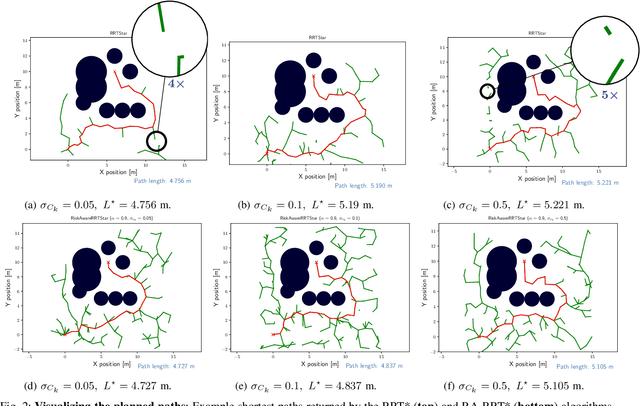


With the pervasiveness of Stochastic Shortest-Path (SSP) problems in high-risk industries, such as last-mile autonomous delivery and supply chain management, robust planning algorithms are crucial for ensuring successful task completion while mitigating hazardous outcomes. Mainstream chance-constrained incremental sampling techniques for solving SSP problems tend to be overly conservative and typically do not consider the likelihood of undesirable tail events. We propose an alternative risk-aware approach inspired by the asymptotically-optimal Rapidly-Exploring Random Trees (RRT*) planning algorithm, which selects nodes along path segments with minimal Conditional Value-at-Risk (CVaR). Our motivation rests on the step-wise coherence of the CVaR risk measure and the optimal substructure of the SSP problem. Thus, optimizing with respect to the CVaR at each sampling iteration necessarily leads to an optimal path in the limit of the sample size. We validate our approach via numerical path planning experiments in a two-dimensional grid world with obstacles and stochastic path-segment lengths. Our simulation results show that incorporating risk into the tree growth process yields paths with lengths that are significantly less sensitive to variations in the noise parameter, or equivalently, paths that are more robust to environmental uncertainty. Algorithmic analyses reveal similar query time and memory space complexity to the baseline RRT* procedure, with only a marginal increase in processing time. This increase is offset by significantly lower noise sensitivity and reduced planner failure rates.
Safe Collective Control under Noisy Inputs and Competing Constraints via Non-Smooth Barrier Functions
Nov 06, 2023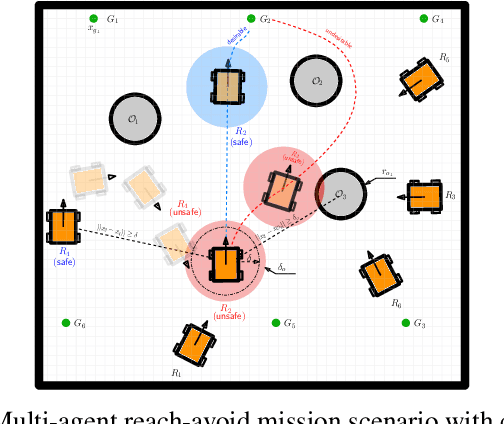

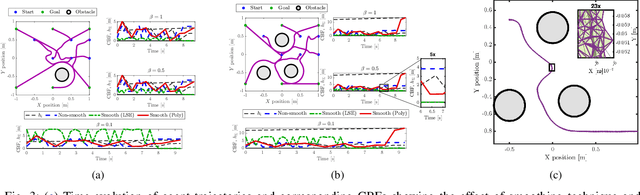

We consider the problem of safely coordinating ensembles of identical autonomous agents to conduct complex missions with conflicting safety requirements and under noisy control inputs. Using non-smooth control barrier functions (CBFs) and stochastic model-predictive control as springboards and by adopting an extrinsic approach where the ensemble is treated as a unified dynamic entity, we devise a method to synthesize safety-aware control inputs for uncertain collectives, drawing upon recent developments in Boolean CBF composition and extensions of CBFs to stochastic systems. Specifically, we approximate the combined CBF by a smooth function and solve a stochastic optimization problem, with agent-level forcing terms restricted to the resulting affine subspace of safe control inputs. For the smoothing step, we employ a polynomial approximation scheme, providing evidence for its advantage in generating more conservative yet sufficiently-filtered control signals than the smoother but more aggressive equivalents realized via an approximation technique based on the log-sum-exp function. To further demonstrate the utility of the proposed method, we present bounds for the expected value of the CBF approximation error, along with results from simulations of a single-integrator collective under velocity perturbations, comparing these results with those obtained using a naive state-feedback controller lacking safety filters.