 Add to Chrome
 Add to Firefox
 Add to Edge
DAT-CFTNet: Speech Enhancement for Cochlear Implant Recipients using Attention-based Dual-Path Recurrent Neural Network
Apr 08, 2026
The human auditory system has the ability to selectively focus on key speech elements in an audio stream while giving secondary attention to less relevant areas such as noise or distortion within the background, dynamically adjusting its attention over time. Inspired by the recent success of attention models, this study introduces a dual-path attention module in the bottleneck layer of a concurrent speech enhancement network. Our study proposes an attention-based dual-path RNN (DAT-RNN), which, when combined with the modified complex-valued frequency transformation network (CFTNet), forms the DAT-CFTNet. This attention mechanism allows for precise differentiation between speech and noise in time-frequency (T-F) regions of spectrograms, optimizing both local and global context information processing in the CFTNet. Our experiments suggest that the DAT-CFTNet leads to consistently improved performance over the existing models, including CFTNet and DCCRN, in terms of speech intelligibility and quality. Moreover, the proposed model exhibits superior performance in enhancing speech intelligibility for cochlear implant (CI) recipients, who are known to have severely limited T-F hearing restoration (e.g., >10%) in CI listener studies in noisy settings show the proposed solution is capable of suppressing non-stationary noise, avoiding the musical artifacts often seen in traditional speech enhancement methods. The implementation of the proposed model will be publicly available.
* 5 pages

Convolutional Neural Network-based Speech Enhancement for Cochlear Implant Recipients
Jul 03, 2019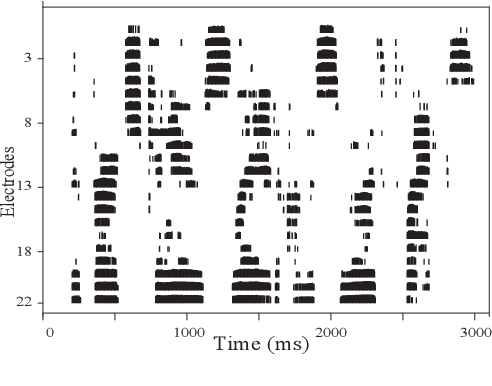
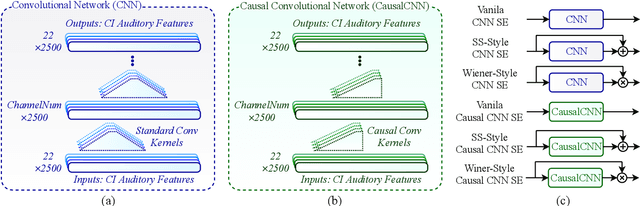
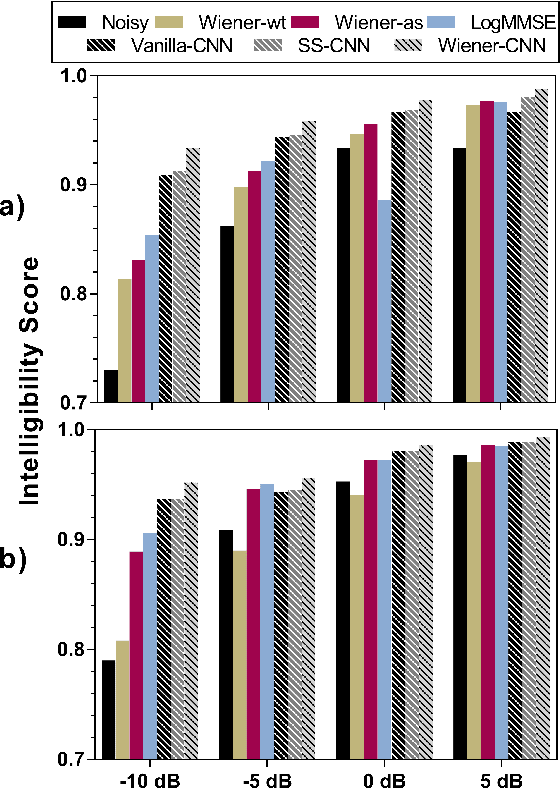
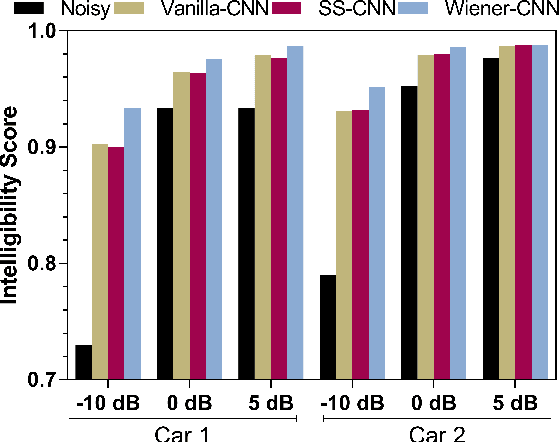
Attempts to develop speech enhancement algorithms with improved speech intelligibility for cochlear implant (CI) users have met with limited success. To improve speech enhancement methods for CI users, we propose to perform speech enhancement in a cochlear filter-bank feature space, a feature-set specifically designed for CI users based on CI auditory stimuli. We leverage a convolutional neural network (CNN) to extract both stationary and non-stationary components of environmental acoustics and speech. We propose three CNN architectures: (1) vanilla CNN that directly generates the enhanced signal; (2) spectral-subtraction-style CNN (SS-CNN) that first predicts noise and then generates the enhanced signal by subtracting noise from the noisy signal; (3) Wiener-style CNN (Wiener-CNN) that generates an optimal mask for suppressing noise. An important problem of the proposed networks is that they introduce considerable delays, which limits their real-time application for CI users. To address this, this study also considers causal variations of these networks. Our experiments show that the proposed networks (both causal and non-causal forms) achieve significant improvement over existing baseline systems. We also found that causal Wiener-CNN outperforms other networks, and leads to the best overall envelope coefficient measure (ECM). The proposed algorithms represent a viable option for implementation on the CCi-MOBILE research platform as a pre-processor for CI users in naturalistic environments.