 Add to Chrome
 Add to Firefox
 Add to Edge
JointHOI: Jointly Generating Contact Maps Enhances Hand Object Interaction Generation
Jul 02, 2026
Text driven hand object interaction (HOI) generation is gaining attention for immersive applications and robotics, yet producing physically plausible interactions remains challenging. Even when individual motions appear natural, small contact errors can cause conspicuous artifacts such as floating and interpenetration. Prior methods mitigate these issues using explicit contact cues or implicit grasp priors, but typically rely on multi stage pipelines and fail to model temporally evolving contact. We present JointHOI, a single stage diffusion framework that jointly generates 3D hand object motion and dynamic, distance based contact maps from text. By treating contact as an auxiliary inner modality, joint generation enables the model to learn contact motion coupling during training. At inference, contact guided sampling enforces consistency between generated contact maps and motion implied geometry, improving temporal stability and reducing penetration and floating. Experiments on GRAB and ARCTIC demonstrate consistent improvements in text adherence and physical plausibility over prior methods.

AutoDex: An Automated Real-World System for Dexterous Grasping Data Collection
Jun 22, 2026Learning robust dexterous grasping requires real-world data that records the physical outcomes of grasp attempts. Such data is hard to obtain at scale: teleoperation yields valid physical outcomes but is slow and operator-biased, while simulation-based generation is cheap and scalable but cannot certify contact validity. A natural solution is to generate candidate grasps and verify them on real hardware, but this scales only if the entire collection loop (perception, execution, labeling, and reset) runs without human intervention. We present AutoDex, an automated real-world data-collection system that closes this loop: for each candidate from a replaceable generator, it localizes the object under severe hand-object occlusion with dense 20-camera perception, executes collision-monitored robot motions, labels lift-and-hold success or failure, and actively resets the object between trials to expose additional candidates across stable poses. The result is a reusable database of physically labeled grasp trials that downstream systems can query by retrieval and feasibility filtering. Using AutoDex, we collect 3,593 grasp trials across Allegro and Inspire hands on 100 diverse objects, with synchronized multi-view observations and robot-state logs. For a matched 500-trajectory collection, AutoDex requires 10.3 h versus 49.4 h for teleoperation, yielding a 4.8x throughput improvement, and grasps retrieved from the AutoDex-validated database succeed 76% versus 34% for simulation-only validation. Code and data will be publicly released.
ZeroDex: Zero-Shot Long-Horizon Dexterous Manipulation via Multi-View 3D-Grounded VLM Reasoning
Jun 19, 2026We present ZeroDex, a zero-shot framework for long-horizon dexterous manipulation that grounds language instructions into executable 3D task plans from calibrated multi-view RGB images. Rather than training an end-to-end policy, our system uses a vision-language model (VLM) to produce reference-frame task grounding and primitive-level 2D keypoints, then lifts them into 3D via multi-view fusion. This lifting combines triangulation of view-wise VLM groundings with reference-view ray voting, which searches along a semantic camera ray for geometrically consistent candidates across neighboring views. The resulting 3D keypoints support both pick-and-place and tool-use: for tool-use, we retrieve an object-centric atomic action corresponding to the inferred skill category and align its stored 6D tool trajectory to the scene; for dexterous execution, we expand the lifted grasp keypoint into a task-conditioned grasp affordance region and generate feasible grasp-motion pairs with an arm-hand motion generator. Real-world experiments show improved 3D grounding accuracy and execution reliability over single-view RGB-D grounding and fine-tuned VLA baselines. We further demonstrate long-horizon manipulation through closed-loop status verification and replan, enabling zero-shot execution on unseen objects and tool-use tasks in novel scenes.
Scaling up fine-grained intracranial vessel annotations in computed tomography angiography
Jun 19, 2026In this work, we present SemanticVessel, a dataset for fine-grained brain vessel segmentation in computed tomography angiography scans. Based on the detailed contrast provided by dynamic 4D-CTA scans, we generate segmentation traces for arteries and veins. We then use intensity-guided region growing to obtain segmentations of the majority of vascular territories in the human brain, which are refined and annotated with 20 unique arterial classes by an expert radiologist. Unlike existing datasets, where minor arteries are discarded as background content, we merge these minor arteries into a generic arterial class. Due to the multiple-phase acquisition of dynamic 4D-CTA, labels for a single phase can be re-used for other phases in the same series, greatly increasing the size of our dataset with no additional annotation cost. The results show that models trained with the additional generic artery class produce better fine-grained segmentations across the board. We will make our code, annotation GUI, and model weights available to the scientific community. Code, weights, and data will be made available on https://github.com/alceballosa/robust-vessel-segmentation
Zero-Shot Long-Horizon Dexterous Manipulation via Multi-View 3D-Grounded VLM Reasoning
Jun 17, 2026We present a zero-shot framework for long-horizon dexterous manipulation that grounds language instructions into executable 3D task plans from calibrated multi-view RGB images. Rather than training an end-to-end policy, our system uses a vision-language model (VLM) to produce reference-frame task grounding and primitive-level 2D keypoints, then lifts them into 3D via multi-view fusion. This lifting combines triangulation of view-wise VLM groundings with reference-view ray voting, which searches along a semantic camera ray for geometrically consistent candidates across neighboring views. The resulting 3D keypoints support both pick-and-place and tool-use: for tool-use, we retrieve an object-centric atomic action corresponding to the inferred skill category and align its stored 6D tool trajectory to the scene; for dexterous execution, we expand the lifted grasp keypoint into a task-conditioned grasp affordance region and generate feasible grasp-motion pairs with an arm-hand motion generator. Real-world experiments show improved 3D grounding accuracy and execution reliability over single-view RGB-D grounding and fine-tuned VLA baselines. We further demonstrate long-horizon manipulation through closed-loop status verification and replan, enabling zero-shot execution on unseen objects and tool-use tasks in novel scenes.
HRDexDB: A Large-Scale Dataset of Dexterous Human and Robotic Hand Grasps
Apr 16, 2026We present HRDexDB, a large-scale, multi-modal dataset of high-fidelity dexterous grasping sequences featuring both human and diverse robotic hands. Unlike existing datasets, HRDexDB provides a comprehensive collection of grasping trajectories across human hands and multiple robot hand embodiments, spanning 100 diverse objects. Leveraging state-of-the-art vision methods and a new dedicated multi-camera system, our HRDexDB offers high-precision spatiotemporal 3D ground-truth motion for both the agent and the manipulated object. To facilitate the study of physical interaction, HRDexDB includes high-resolution tactile signals, synchronized multi-view video, and egocentric video streams. The dataset comprises 1.4K grasping trials, encompassing both successes and failures, each enriched with visual, kinematic, and tactile modalities. By providing closely aligned captures of human dexterity and robotic execution on the same target objects under comparable grasping motions, HRDexDB serves as a foundational benchmark for multi-modal policy learning and cross-domain dexterous manipulation.
Pri4R: Learning World Dynamics for Vision-Language-Action Models with Privileged 4D Representation
Mar 02, 2026Humans learn not only how their bodies move, but also how the surrounding world responds to their actions. In contrast, while recent Vision-Language-Action (VLA) models exhibit impressive semantic understanding, they often fail to capture the spatiotemporal dynamics governing physical interaction. In this paper, we introduce Pri4R, a simple yet effective approach that endows VLA models with an implicit understanding of world dynamics by leveraging privileged 4D information during training. Specifically, Pri4R augments VLAs with a lightweight point track head that predicts 3D point tracks. By injecting VLA features into this head to jointly predict future 3D trajectories, the model learns to incorporate evolving scene geometry within its shared representation space, enabling more physically aware context for precise control. Due to its architectural simplicity, Pri4R is compatible with dominant VLA design patterns with minimal changes. During inference, we run the model using the original VLA architecture unchanged; Pri4R adds no extra inputs, outputs, or computational overhead. Across simulation and real-world evaluations, Pri4R significantly improves performance on challenging manipulation tasks, including a +10% gain on LIBERO-Long and a +40% gain on RoboCasa. We further show that 3D point track prediction is an effective supervision target for learning action-world dynamics, and validate our design choices through extensive ablations.
Robust automatic brain vessel segmentation in 3D CTA scans using dynamic 4D-CTA data
Jan 30, 2026In this study, we develop a novel methodology for annotating the brain vasculature using dynamic 4D-CTA head scans. By using multiple time points from dynamic CTA acquisitions, we subtract bone and soft tissue to enhance the visualization of arteries and veins, reducing the effort required to obtain manual annotations of brain vessels. We then train deep learning models on our ground truth annotations by using the same segmentation for multiple phases from the dynamic 4D-CTA collection, effectively enlarging our dataset by 4 to 5 times and inducing robustness to contrast phases. In total, our dataset comprises 110 training images from 25 patients and 165 test images from 14 patients. In comparison with two similarly-sized datasets for CTA-based brain vessel segmentation, a nnUNet model trained on our dataset can achieve significantly better segmentations across all vascular regions, with an average mDC of 0.846 for arteries and 0.957 for veins in the TopBrain dataset. Furthermore, metrics such as average directed Hausdorff distance (adHD) and topology sensitivity (tSens) reflected similar trends: using our dataset resulted in low error margins (aDHD of 0.304 mm for arteries and 0.078 for veins) and high sensitivity (tSens of 0.877 for arteries and 0.974 for veins), indicating excellent accuracy in capturing vessel morphology. Our code and model weights are available online: https://github.com/alceballosa/robust-vessel-segmentation
Automated anatomy-based post-processing reduces false positives and improved interpretability of deep learning intracranial aneurysm detection
Jul 01, 2025Introduction: Deep learning (DL) models can help detect intracranial aneurysms on CTA, but high false positive (FP) rates remain a barrier to clinical translation, despite improvement in model architectures and strategies like detection threshold tuning. We employed an automated, anatomy-based, heuristic-learning hybrid artery-vein segmentation post-processing method to further reduce FPs. Methods: Two DL models, CPM-Net and a deformable 3D convolutional neural network-transformer hybrid (3D-CNN-TR), were trained with 1,186 open-source CTAs (1,373 annotated aneurysms), and evaluated with 143 held-out private CTAs (218 annotated aneurysms). Brain, artery, vein, and cavernous venous sinus (CVS) segmentation masks were applied to remove possible FPs in the DL outputs that overlapped with: (1) brain mask; (2) vein mask; (3) vein more than artery masks; (4) brain plus vein mask; (5) brain plus vein more than artery masks. Results: CPM-Net yielded 139 true-positives (TP); 79 false-negative (FN); 126 FP. 3D-CNN-TR yielded 179 TP; 39 FN; 182 FP. FPs were commonly extracranial (CPM-Net 27.3%; 3D-CNN-TR 42.3%), venous (CPM-Net 56.3%; 3D-CNN-TR 29.1%), arterial (CPM-Net 11.9%; 3D-CNN-TR 53.3%), and non-vascular (CPM-Net 25.4%; 3D-CNN-TR 9.3%) structures. Method 5 performed best, reducing CPM-Net FP by 70.6% (89/126) and 3D-CNN-TR FP by 51.6% (94/182), without reducing TP, lowering the FP/case rate from 0.88 to 0.26 for CPM-NET, and from 1.27 to 0.62 for the 3D-CNN-TR. Conclusion: Anatomy-based, interpretable post-processing can improve DL-based aneurysm detection model performance. More broadly, automated, domain-informed, hybrid heuristic-learning processing holds promise for improving the performance and clinical acceptance of aneurysm detection models.
Layer-wise Update Aggregation with Recycling for Communication-Efficient Federated Learning
Mar 14, 2025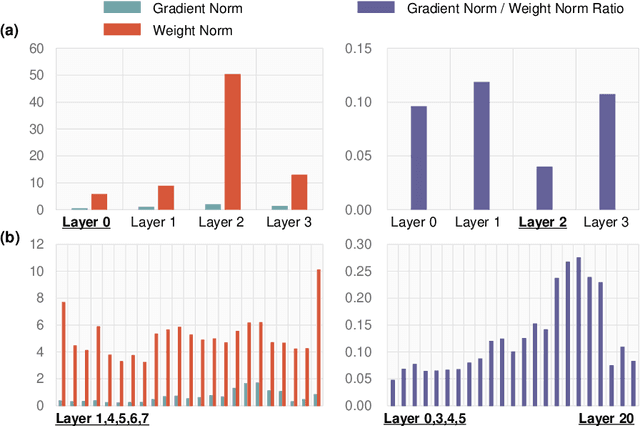

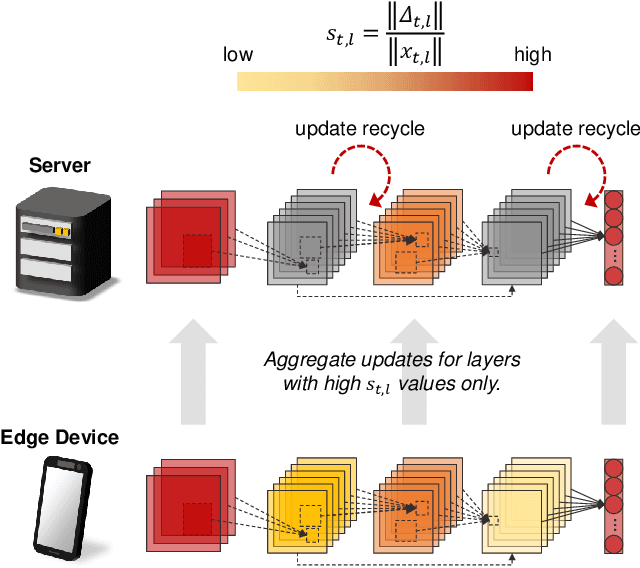
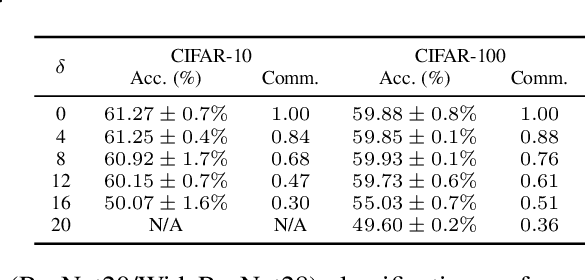
Expensive communication cost is a common performance bottleneck in Federated Learning (FL), which makes it less appealing in real-world applications. Many communication-efficient FL methods focus on discarding a part of model updates mostly based on gradient magnitude. In this study, we find that recycling previous updates, rather than simply dropping them, more effectively reduces the communication cost while maintaining FL performance. We propose FedLUAR, a Layer-wise Update Aggregation with Recycling scheme for communication-efficient FL. We first define a useful metric that quantifies the extent to which the aggregated gradients influences the model parameter values in each layer. FedLUAR selects a few layers based on the metric and recycles their previous updates on the server side. Our extensive empirical study demonstrates that the update recycling scheme significantly reduces the communication cost while maintaining model accuracy. For example, our method achieves nearly the same AG News accuracy as FedAvg, while reducing the communication cost to just 17%.